


02 · Dossiers
- Code
- OWS-2026-002-P
- Status
- Locked
- Version
- 1.8-en-popular
- Evidence level
- Mixed source
- Risk level
- Medium
- Last updated
- 17 June 2026
- Red-Team status
- re-translated from locked TR v1.8; narrative register and epistemic distinctions preserved; English final-clean micro-pass applied
The Sacred Remains of Yaroslav the Wise: A Sarcophagus, an Unexpected Skeleton, and the Brooklyn Claim
How did the remains of a grand prince who died a thousand years ago go missing, why is there still no conclusive proof of their whereabouts today, and why is the "in America" claim still only a claim? The story told by separating evidence from claim.
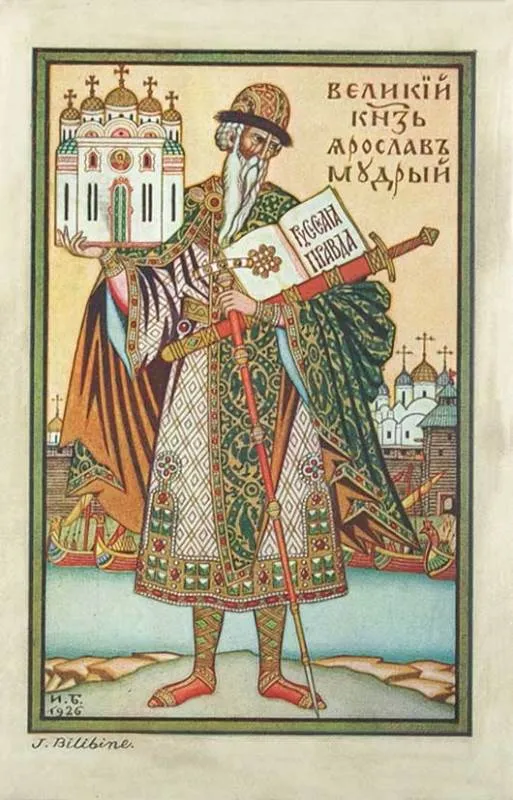
Yaroslav the Wise, illustration by Ivan Bilibin (early 20th c.) — an artistic depiction, not a contemporary portrait. Source: Wikimedia Commons, public domain.
The Sacred Remains of Yaroslav the Wise
A sarcophagus, an unexpected skeleton, and the Brooklyn claim
This text is written in narrative form. Some of its conclusions are documented and certain, some are strong but conditional inferences, and some are unverified claims; these distinctions are flagged in the wording throughout. For the source and evidence level of each claim, see the full dossier linked at the end.
On a September morning in 2009, in St. Sophia Cathedral in the heart of Kyiv, a group of specialists once more lifted the heavy lid of Yaroslav the Wise’s thousand-year-old marble sarcophagus — a sarcophagus already opened several times during the twentieth century. What they expected to find inside were the sacred remains of Yaroslav the Wise, Grand Prince of Kyivan Rus’: the bodily remains of a ruler who died in 1054. There was a skeleton inside. But within a few days the conclusion was reached that the remains in the sarcophagus did not match the male skeleton identified in 1939–40 as Yaroslav, and that the main identity markers were, on the dominant reading, consistent with a woman.
The male remains presumed to be Yaroslav’s had not come out of the sarcophagus identified with him. And no one knew exactly when or how they had gone.
This begins like a detective story — but at the end you are left not with a culprit but with a gap. And what fills that gap is not hard documentation but narrative. To understand the story, what matters is not where the bones went but separating what is certain from what is merely a claim.
First a grand prince, then a marble chest
By historical tradition, Yaroslav ruled Kyivan Rus’ in the early eleventh century — that shared medieval state claimed in different ways by today’s Ukrainian, Russian and Belarusian narratives. St. Sophia Cathedral is associated with him; after his death he is held to have been buried there, in a marble sarcophagus carved with Byzantine workmanship.
The trouble is that this acceptance was never confirmed by an unbroken record. It is easy to say that a grand prince’s bodily remains stayed in the same chest for a thousand years; proving it is another matter. And the twentieth century would open that chest several times.
The bones go to Leningrad
In the 1930s the cathedral was secularised and turned into a museum. In 1936 the sarcophagus was opened in a form documented for the modern period. Out of it came not a single person but mixed bones: material consistent, by examination, with an adult man, an adult woman, and a child.
In 1939, as relayed in the sources, the Leningrad-linked anthropologist Vulf Ginzburg took the bones north for examination. In the laboratory the male and female skeletons were separated. The male skeleton showed traces that could cause a limp in old age — and because this matched what the sources say about Yaroslav being lame, the skeleton was identified as “Yaroslav.” The renowned anthropologist Mikhail Gerasimov made a bust reconstructing Yaroslav’s face from the skull.
Here one must be honest: this identification is a reasonable hypothesis, but not a certainty. The limp, the age and the general fit are clues that make it plausible — but it is not conclusively settled, at the level of DNA or an unbroken chain of custody, that the male skeleton really was Yaroslav. (The difference is this: on the Soviet side there are recorded examination and return acts; on the diaspora side the critical transfer links are undocumented. This does not make the Soviet identification certain; it only shows that the two trails do not carry the same kind of documentary gap.) According to the record, both skeletons were sent back to Kyiv in 1940. But note: the bones were placed not in the sarcophagus but in wooden boxes in the museum’s holdings.
A parenthesis is essential here, because this is the often-skipped half of the story: in the Stalin era, the opening of a sarcophagus carrying sacred and dynastic meaning and the moving of the bones to another city cannot be read as merely a neutral “cataloguing”; by whose order and under what authority it was done is also undocumented. So to read what happened to the bones only as “the diaspora smuggled them out during the war” would be to ignore the Soviet half of the story. The same question must be put to both sides: where is your document? But this does not mean the two chains are equally strong or equally weak; it only means each side should be asked for as much documentation as its own claim requires.
The lost window: between 1940 and 1964
One of the most critical uncertainties begins here. The bones were placed in the holdings in 1940. In 1964 the sarcophagus was reopened and an act was drawn up recording that an oak box had been placed inside it. The wording in the act is striking: on the box was written “Yaroslav’s remains (?).” That question mark stands in the institution’s own document — meaning the identity was suspect even on that day.
More importantly: according to testimony, no new scientific examination was made in 1964. According to what a museum staffer who personally witnessed the procedure recounted years later, not two but a single box remained in the holdings; the responsible person was sure it belonged to Yaroslav and insisted it be placed in the sarcophagus. The woman’s remains were thought possibly never to have returned from Leningrad — itself a separate assumption, one that requires the box’s continuity and the exclusion of any later intervention.
If this testimony and the box’s continuity are correct, the conclusion is: if remains consistent with a woman came out of the sarcophagus in 2009, and that box is the same one placed in 1964, then the bones identified as Yaroslav’s disappeared much earlier — even before 1964. Under these assumptions the loss window narrows strongly to between 1940 and 1964 — the years when the bones were not in the sarcophagus but in the holdings. The objection “the lid was too heavy, no one could have stolen them covertly” also ceases to be decisive in this scenario: what would have been stolen was not in the sarcophagus anyway.
(To whom the remains that emerged in 2009 belong is a separate puzzle; the dominant reading leans female, but the osteology is not settled — one of the experts said the skull might even be male, so that whether the skeleton is Yaroslav’s wife or his son remains open. This was not reflected in public in any detail.)
And then: America
When it emerged that the male remains expected to be Yaroslav’s were not in the box in 2009, eyes turned to another narrative — a story long relayed in some Ukrainian diaspora sources. According to this story the bones were taken out of Kyiv in 1943, during the Second World War: first handed to an archbishop, then taken by a person referred to in the narrative as a “German major” — whose identity and name are themselves disputed — carried to Warsaw, and from there moved around 1950 to America. Today, in the latest form of some retellings, the bones are said to be in a Ukrainian church in Brooklyn.
(The institutional and political context of the 2009 opening is a separate debate; what is critical here is that the opening does not prove this American trail — it only redirected the search toward it.)
An appealing story. The trouble is that within the sources reviewed for this dossier, not a single critical link in the chain is confirmed by a primary document. In the records searched in this dossier — including the German administration, the war, immigration and customs, and church inventories — no primary trace tracking these bones could be shown.
Moreover, the diaspora sources that support this narrative do not give an internally consistent chain, especially about who hid the bones. To the question of who hid them, one source gives one name, another a completely different name; in one account the bones were hidden “under a bed” in New York. The claim about exactly where the bones are has also drifted over time: first a vague “someone in New York,” then a cemetery in New Jersey, most recently Brooklyn. And these places — Bound Brook, Brooklyn and different diaspora church structures — are not a single bloc but separate, if cousinly, circles. The crucial parts of the story rest not on direct event records but on late-dated attributions and oral/secondary transmissions. What is more, the sources carrying the “the bones are in Brooklyn” frame most loudly are, contrary to expectation, largely the Russian press — which suggests not that the claim is false but who has put the location narrative into circulation.
The nature of what is today called “evidence” also becomes critical here. What the museum management running the search calls “we have documentary confirmation” is, in the visible dossier, not a written inventory but an archbishop’s verbal account. That is, not a document but a memory passed on by word of mouth. Moreover, within the sources searched in this dossier, no conclusive inventory or open confirmation belonging to the Brooklyn congregation at the centre of the claim was seen — just as no direct statement by the Russian Orthodox side about this chain of custody is found within the sources reviewed here either.
There is also an icon — but it does not prove the bones on its own
A significant part of the story’s persuasive force comes not from the bones but from an icon said to be mentioned alongside them: the icon of St. Nicholas the Wet (Mokryi). The icon is said to have made a similar journey, finally reaching Brooklyn.
But here too the ground shifts. Whether the object in Brooklyn is the original or a copy has never been confirmed — the sources do not agree: one account treats the object as the original, while another expert argues the Brooklyn object may be a copy; later assessments mention both an original and a copy together. Furthermore, even if the icon’s story were true, it would not follow that the bones travelled in the same chest, by the same route. The icon cannot be taken on its own as a physical anchor for the bones narrative; because the icon’s own chain of authenticity and route is not settled either.
Where the certainty ends
What remains? This much we know for certain: the remains that came out of the sarcophagus in 2009 did not match the male skeleton expected to be Yaroslav’s. (The remains inside point, on the dominant reading, to a woman; but the osteology is not settled — even the possibilities of a male skull, indeed of Yaroslav’s wife or son, were raised.) This much we can say as a strong but conditional inference: the bones were probably lost between 1940 and 1964, while in the Soviet museum holdings — which is not a firm assignment of responsibility but a conclusion valid only if the testimony and the box’s continuity are correct. This, however, we do not know: that the bones are in America, in Brooklyn, today. That is not an established fact; it is a claim awaiting physical confirmation — a bone, a DNA test, an inventory record. This does not mean the trail is false; it only means it is unconfirmed.
This is the most honest form of the story: the male remains thought to be Yaroslav’s are lost, and those who advance this claim do not yet hold the kind of primary document that would satisfy an independent researcher. Perhaps the bones really were carried across the Atlantic; perhaps they were irrecoverably severed in a mix-up in the Soviet/Kyiv museum holdings. At present neither a physical nor a documentary confirmation that would separate the two is on the table.
Terminology note: The Russian мощи (Greek λείψανα, Latin reliquiae) denotes bodily remains venerated in an Orthodox-Christian context; the standard English equivalent is relics / holy relics. Because the subject of this dossier is the identity and displacement chain of the remains, the neutral terms remains / bodily remains are preferred in evidentiary and anthropological contexts; sacred remains / holy relics is used only when describing Orthodox veneration and the historical-religious context.
This is a narrative version prepared for the general reader. For the source, documentary status and evidence level of each claim, and a detailed account of the counter-arguments, see the full dossier (evidence version): Yaroslav’s Lost Remains — The Alleged Trail from Kyiv to Brooklyn and Its Actors.
— Cartographus Mentis / Open War Studies · EN-Popular v1.8