


02 · Dossiers
- Code
- OWS-2026-002
- Status
- Locked
- Version
- 1.8-en
- Evidence level
- Mixed source
- Risk level
- Medium
- Last updated
- 17 June 2026
- Red-Team status
- re-synced to locked TR v1.8; epistemic labels, terminology and evidence/claim distinction preserved; English final-clean micro-pass applied
Yaroslav's Lost Remains: The Alleged Trail from Kyiv to Brooklyn and Its Actors
The disappearance of the remains, the Soviet examination, the diaspora "taken to the USA" narrative, and the actors' biographies — separating evidence from claim.
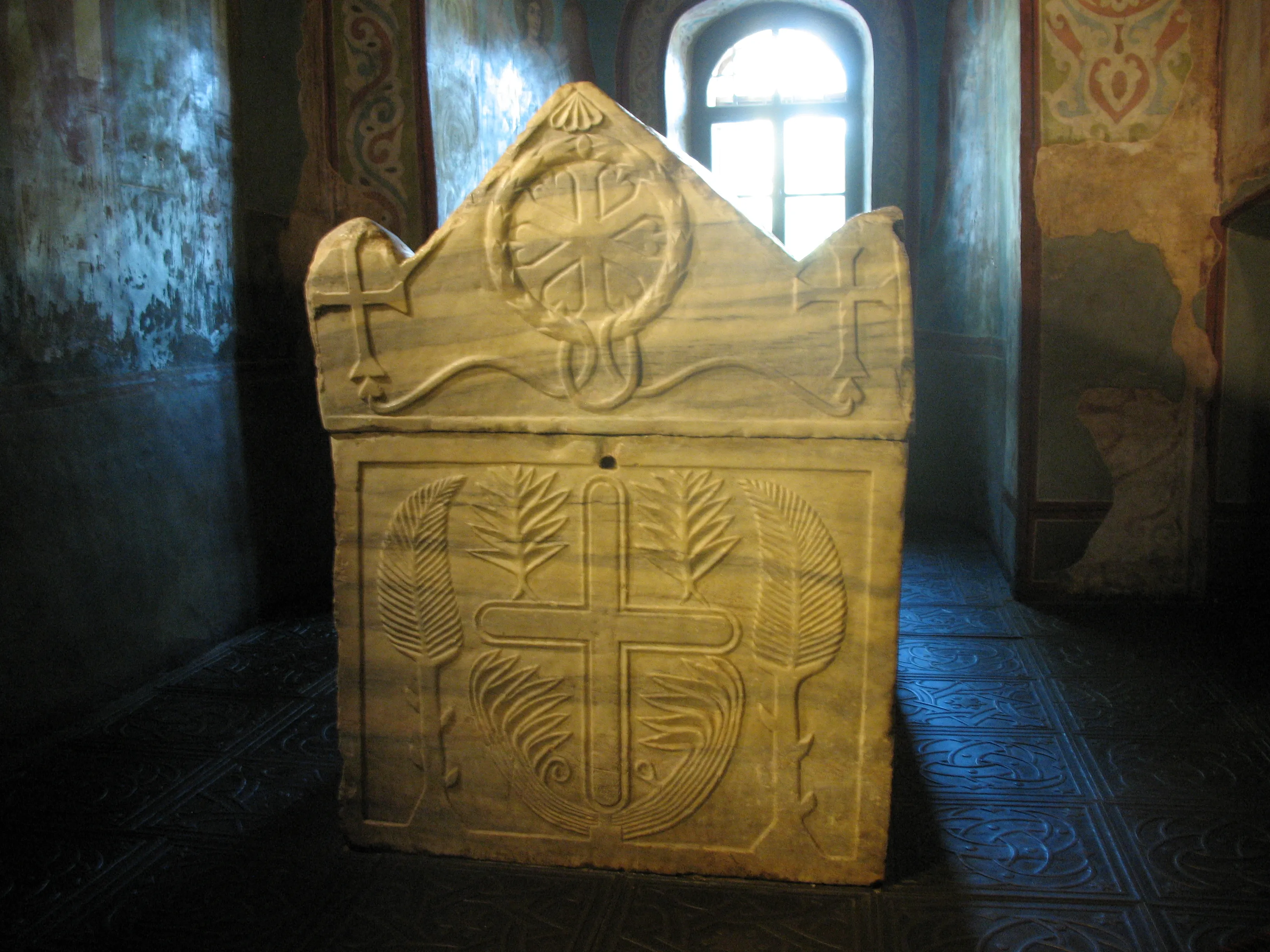
Sarcophagus of Yaroslav the Wise, Saint Sophia Cathedral, Kyiv. Photo: Stas-Adolf, Wikimedia Commons, CC BY-SA 4.0.
Summary
Yaroslav the Wise (d. 1054), Grand Prince of Kyivan Rus’, was long assumed to rest in the marble sarcophagus inside St. Sophia Cathedral. When the sarcophagus was opened in 2009, it held only a single skeleton; the 2009–2010 examinations showed that this was not the male skeleton identified as Yaroslav but, on the dominant reading, consistent with the remains of an unknown woman — though the osteology is not settled, with even the possibility of a male skull being raised [FACT / STRONG INFERENCE].
Core finding: The box removed from Yaroslav’s sarcophagus in 2009 contained no remains matching the male skeleton identified in 1939–40 as Yaroslav; the 1936–1940 records show that male and female remains existed earlier and were returned to Kyiv after the Leningrad examination. The 1964 act documents that a box labelled “Yaroslav’s remains (?)” was placed in the sarcophagus [FACT] — but the question mark, present in the institution’s own presentation, already signals that the identity was uncertain. That no independent anthropological check was made in 1964 and that only a single box remained on the shelves is supported by the testimony of a museum staffer who was present [STRONG INFERENCE]; if that testimony is correct and the 1964 box is the same as the 2009 box, it follows that the 1964 box contained misidentified female remains and that the male remains attributed to Yaroslav left the chain before 1964 [STRONG INFERENCE — conditional]. The US/Brooklyn trail is a diaspora hypothesis consistent with the Ilarion–Odarchenko–icon tradition; but without primary custody, customs, immigration, church-inventory or physical/DNA confirmation it is not proven [UNVERIFIED].
Methodological principle: This article applies the same demand for documents to the Soviet side that it applies to the diaspora narrative — symmetrically, but without manufacturing false equivalence. The ideological nature of the Soviet context does not validate the diaspora chain; it only shows that the 1936–1940 identification should not be taken as “neutral science” either.
Epistemic label key
[FACT] documented / established record · [PRIMARY] act/protocol/record/facsimile or direct institutional record · [INSTITUTIONAL] official/institutional biography or organisational record (close to primary, but not the event act) · [STRONG INFERENCE] undocumented but strongly supported · [MODERATE LIKELIHOOD] alternatives remain open · [HYPOTHESIS] untested explanation · [SPECULATION] weak guess · [UNVERIFIED] could not be confirmed · [RESEARCH LIMIT] not visible within this source universe (not absolute absence) · [SECONDARY] primary document not seen.
Two axes: [FACT] marks the status of a claim; [PRIMARY]/[INSTITUTIONAL]/[SECONDARY] mark the type of source. A sentence can be both a fact and rest on an institutional source; when labels overlap this is not a contradiction but two separate axes.
I. The story of the remains
1. Before — Yaroslav and the sarcophagus
[FACT] Yaroslav Vladimirovich ruled Kyivan Rus’ ~1019–1054. St. Sophia was central to his building programme. On his death he was interred in a sarcophagus carved from white Proconnesian marble; the sarcophagus is of Byzantine workmanship and may originally have been made for another saint [HYPOTHESIS]. (The sarcophagus and its lid are heavy and require mechanical lifting; exact tonnage figures vary across sources.)
2. The Soviet examination (1936–1940)
[FACT] In 1934 the cathedral was secularised and turned into the “Sofiysky Museum” preserve. [STRONG INFERENCE] The opening of the tomb is connected to this context. [HYPOTHESIS] That the triggering idea came by direct regime order is not proven unless the order document is shown.
Chronology:
- 25/26 January 1936 [FACT]: Staff opened the sarcophagus; mixed bones (adult male + adult female + child). (Act НАДР-914; the date appears as 25/26 January in two sources.)
- 23 January 1939 [FACT]: Ginzburg arrived from Leningrad and took the bones to the USSR Academy of Sciences Institute.
- 1939–1940: In the Leningrad laboratory the male and female skeletons were separated; the male skeleton showed findings consistent with a limp.
- Identification distinction: The Soviet examination identified the male skeleton as Yaroslav [FACT — act of identification]. The correctness of that identification is supported by the limp, age and chronic-condition match but is not conclusive at the level of DNA / an unbroken chain of custody [STRONG INFERENCE]. Gerasimov produced a bust from the skull in 1940.
- December 1940 [FACT]: Both skeletons were returned to Kyiv (two acts). The bones were placed not in the sarcophagus but in wooden boxes in the museum holdings, on storage shelves.
Symmetric skepticism — with a false-equivalence barrier [STRONG INFERENCE]: An anthropologist opening a sacred sarcophagus and moving the remains to Leningrad in 1939 is not an apolitical “cataloguing”; it is contextually consistent with Stalin-era history politics [MODERATE LIKELIHOOD]. Who authorised Ginzburg, and by what document, is also not shown [UNVERIFIED]. However, this does not validate the diaspora chain; the two sides are not “equally unreliable” — each is held to its own evidence standard separately.
3. The disappearance (1940–2009) — the existence/identity distinction of 1964
[FACT] In 1964 the sarcophagus was reopened (with 1964-dated Soviet newspapers inside) and an act was drawn up; the act records that an oak box labelled “Yaroslav’s remains (?)” (plus a glass tube holding the acts and a ceramic memorial plaque) was placed in the sarcophagus. The question mark appears in the institution’s own presentation — showing the identity was problematic from the outset.
[STRONG INFERENCE — first-person testimony] No new anthropological check was made in 1964. According to the account of the museum staffer of that time, Irma Totska, who took part in the procedure, there were not two boxes but only a single box on the shelves; the holdings curator S. Vysotsky was sure it belonged to Yaroslav and insisted the box be placed in the sarcophagus; it was thought Irina’s (the female) remains might not have been returned from Leningrad. (This is a 2010 newspaper interview; it is memory-testimony about 1964, not the text of the act itself — hence [STRONG INFERENCE], not [FACT].)
[FACT — existence/content of the report] 2009 (10 September): The sarcophagus was opened; it held only one skeleton; the preliminary medico-anthropological report states that this skeleton is not Yaroslav’s and, on the dominant reading, is consistent with female remains. [STRONG INFERENCE / CONTESTED] However, the osteology is not settled (Segeda raised the possibility of a male skull, even asking whether it is his wife Ingegerd or his son Vsevolod).
Inference — the window narrows [STRONG INFERENCE — conditional]: If the museum staffer’s (Totska’s) testimony is correct, only one box remained on the shelves in 1964; if that box is the same one opened in 2009 and its contents did not change in between, then the female result in 2009 yields: the male remains attributed to Yaroslav disappeared before 1964, and the disappearance window narrows to 1940 (placement in holdings) – 1964 (the single box remaining); what was placed in the sarcophagus in 1964 was also misidentified female remains. The “heavy lid → covert theft was hard” argument is moot in this picture anyway: between 1940 and 1964 the bones were not in the sarcophagus but in the holdings.
3a. The trigger and politics of the 2009 opening
Who / by what decision [FACT]: The decision to open was taken by the preserve’s Scientific Council (Вчена рада НЗСК) — a unanimous protocol dated 9 September 2009. The process was shaped with the participation of representatives of Minregionbud (Ministry of Regional Development and Construction; not the Ministry of Culture — the transfer occurred only in June 2011), the preserve’s supervising body at that date, and H. Ivakin, deputy head of the Institute of Archaeology NAS. The responsible executor of the anthropological examination was Serhiy Segeda (IMFE Rylsky, NAS Ukraine).
Official rationale [SECONDARY]: Writing new scientific passports for museum objects + renewing the 45–70-year-old examinations with modern methods (radiocarbon, DNA). (The number/date/signatory of this order is not public — only Kukovalska’s verbal attribution [UNVERIFIED].)
The money [SECONDARY / STRONG INFERENCE]: The sponsor is strongly argued to be Viktor Kapustin (chairman of the state bank Ukreximbank’s board, 2005–2010; former “Our Ukraine” MP); however, period press mostly gives the sponsor at the level of an “anonymous senior bank executive” or “patrons,” and no primary document naming him as sponsor was seen within this source universe [STRONG INFERENCE, NOT PRIMARY]. The safest range for the spend is around 56,000–60,000 hryvnia (roughly $7,000–7,500; Vesti.ru’s “$4,000” figure is isolated and inconsistent). For his full biography see Section II.C.
The “Yushchenko initiative” claim — undocumented [correction]: This frame belongs only to Russian state media (Vesti.ru); despite a search of the president.gov.ua 2009 archive (1,112 documents) no decree or instruction by Yushchenko ordering the opening was found [UNVERIFIED]. No non-Russian-state source — including Rossiyskaya Gazeta — uses this frame. Core fact [STRONG INFERENCE]: the sponsor — argued to be Kapustin — is a state-finance figure from Yushchenko’s “Our Ukraine” circle. Inference [HYPOTHESIS]: the Russian frame appears to have expanded the Kapustin–Yushchenko political-financial contact into a “Yushchenko project”; but the editorial intent behind that expansion is not separately documented. In any case “Yushchenko ordered it” cannot be shown by document.
Government change and laboratory alignment [STRONG INFERENCE — dates only]: The 2009 plan used Western laboratories (Sweden/UK/USA; no Russian institutions — specific lab names not found). On 25 February 2010 Yanukovych took office. On 17 September 2010 MGU/RAS (Russian institutions: Buzhilova, Dobrovolskaya, Pejemskiy) took a sample. The official “search for the lost remains” process also began under Yanukovych (Cabinet letters 02.03.2010 №20/2-14; 11.03.2010 №349). The dates align; causation is not established — that is, the simple “Ukraine opened it / Russia was excluded” frame already breaks down with the later participation of Russian institutions.
Not a “cover-up” but “no comment until the results” [correction]: There is no document showing that Segeda, or any named person, made a deliberate cover-up decision. The only thing established is an institutional silence policy (Marholina, 17.10.2009: “no comment during the process so as not to create a sensation”). The phrase “we were ordered not to disclose” belongs to an anonymous staffer (Censor.net, 2010); no name/date.
Going public: The first announcement was at the end of February 2011 (Marholina, KP Ukraina 24.02.2011); the academic article in 2011 (Kukovalska + Marholina + Nikitenko); the public scandal via the 20 June 2013 TV report (1st National Channel; the report was presented by the historian Serhiy Kot, who was not involved in the research, and Kukovalska was barely given a voice).
Reversal of outcome [STRONG INFERENCE]: An opening aimed at re-testing the identity with modern methods produced, instead of the expected confirmation, the absence of the male remains attributed to Yaroslav; it was this unexpected result that redirected the trail toward the US diaspora.
The 2009 opening — chronology (verified nodes):
| Date | Event | Label |
|---|---|---|
| 9 Sep 2009 | Scientific Council’s unanimous decision to open | [PRIMARY] |
| 10 Sep 2009 | Sarcophagus opened (box + glass tube + 1964 plaque + newspapers) | [PRIMARY] |
| 11 Sep 2009 | Single (female) skeleton; first finding: “not Yaroslav” | [PRIMARY] |
| 17 Oct 2009 | Museum’s “no comment until results” policy | [SECONDARY] |
| 25 Feb 2010 | Yanukovych took office | [PRIMARY] |
| 02–11 Mar 2010 | Cabinet: search for lost remains process began | [PRIMARY] |
| 17 Sep 2010 | MGU/RAS (Russian institutions) took a sample | [PRIMARY] |
| 24 Feb 2011 | First public announcement (Marholina) | [SECONDARY] |
| 2011 | Academic article (Kukovalska+Marholina+Nikitenko) | [PRIMARY] |
| 20 Jun 2013 | TV disclosure → public scandal | [SECONDARY] |
4. The diaspora claim: from Kyiv to the USA
The chain [SECONDARY — NO PRIMARY DOCUMENT]:
- 1943: A watchman hid the bones in a small chest (skrynka) and gave them to Archbishop Nikanor (Abramovych); Nikanor kept them in the cabinet in his office.
- 8 October 1943: A “German major” (in the narrative Paul von Denbach — formerly a Ukrainian-army sotnyk, Pavlo Dmytrenko) took the bones as “spoils of war”; on 9 October 1943 he carried them to Warsaw and left them with Archbishop Palladiy.
- ~1950: Palladiy took the bones to the USA.
The accounts contradict one another on the custodian [FACT]: Diaspora sources do not agree on who hid the bones: (a) Odarchenko/Herets → Palladiy; (b) a letter relayed by Fakty → the priest Ivan Tkachuk, living in NY, kept the bones “under his bed”; (c) per Matula (via Petrenko), Powstenko said at a lecture in Augsburg that “the relics are with us” but would not say where. This contradiction shows that the narrative, in its present form, is fed not by a single fixed documentary chain but by inconsistent transmissions [STRONG INFERENCE].
The location claim drifted over time [FACT]: 1954 Ilarion (an anonymous person in NY) → 1967 Odarchenko (with Palladiy; ideal place Bound Brook) → 2010 Kukovalska (Holy Trinity Brooklyn, via Archbishop Antoniy’s verbal account). Odarchenko in 1967 does not say Brooklyn; the location sharpened later.
Not the “place” but the “institutional circle” first [FACT]: For 1950–51 the most that can be said is “allegedly reached the Palladiy/UAOC-in-Exile circle.” Today’s Brooklyn (South 5th St.) Holy Trinity building was acquired in 1961; the congregation was organised in New York in 1951 and was Bronx-based in 1958. “The bones reached Brooklyn Holy Trinity in 1950” is chronologically wrong.
Institutional-distinction warning [FACT]: “Brooklyn Holy Trinity / Bound Brook / UOC-USA / UAOC-in-Exile” are not a single diaspora bloc. Palladiy’s church belonged to UAOC-in-Exile; Mstyslav’s structure in Bound Brook was UOC-USA — at that time separate/rival jurisdictions (they merged later; in 2010 the Archbishop Antoniy who represented Holy Trinity was from UOC-USA). This distinction softens the “single closed echo chamber” assumption: the network is cousinly but not monolithic.
Evidence status — no link confirmed by a primary document:
- For the 1943 removal, no German-administration/ERR/Wehrmacht/museum-evacuation record was found [UNVERIFIED]; the strength of the negative is limited until the full search protocol is published [RESEARCH LIMIT].
- For “Denbach/Dmytrenko” there is no document [UNVERIFIED]; the double name can be explained by embellishment/alias/variant/memory error [HYPOTHESIS].
- The chain is not Nikanor’s own statement but Odarchenko’s (1967) attribution [FACT]. Nikanor does leave a written trace, but it concerns the icon (from a letter, the icon of St. Nicholas the Wet is learned to have been in his apartment in 1942), not first-person testimony about the bones [UNVERIFIED].
- For the Warsaw→USA leg, no DP/IRO/UNRRA record, manifest or church transfer deed was found [UNVERIFIED]. (Open lead: per diaspora correspondence, in the 1940s–50s the journal “Novi Dni” may have discussed a protocol — involving lawyers/clergy — about who held the bones; unverified, worth pursuing.)
- No bone/holy-relic inventory was found in Holy Trinity/UOC-USA archives [UNVERIFIED]. What Kukovalska publicly calls “documentary confirmation” is in fact Archbishop Antoniy’s verbal account [FACT], not a document.
5. The icon trail (a separate thread — and weaker than supposed)
[FACT] The icon of St. Nicholas the Wet (Mykola Mokryi) is an object separate from the bones. A significant part of the narrative’s persuasive force appears to draw on this thread [MODERATE LIKELIHOOD]. The route, link by link: Mstyslav took the icon to Warsaw in 1943 and gave it to Palladiy [SECONDARY/HYPOTHESIS]; Palladiy entrusted it to Toronto in 1954 [SECONDARY]; the icon was later found in Brooklyn [UNVERIFIED].
Critical weakness [FACT]: Whether the object in Brooklyn is the original or a copy is unconfirmed. Romaniuk made a copy; the original is said to be “kept at an unknown place.” The object Mstyslav brought to Kyiv in 1990 was referred to in the 1991 journal Ukrainske Pravoslavne Slovo as a “reduced copy” (зменшена копія); this phrase refers to the object taken to Kyiv, not to the one said to remain in Brooklyn. The matter is still unresolved: Powstenko treats the object as “definitely the original”; another expert argues the Brooklyn object is not the original; Bilokin’s latest position is that both an original and a copy exist [SECONDARY/CONTESTED]. → The icon cannot be taken as the physical anchor of the bones narrative; the anchor itself is shaky. Even if the existing accounts are accepted as true, it does not necessarily follow that the icon and the bones shared the same chest/route [STRONG INFERENCE].
6. Evidence status — summary
| Element | Status |
|---|---|
| Absence of the male remains attributed to Yaroslav in the 2009 box | [FACT] |
| Existence of the 1964 act | [FACT] |
| No independent anthropological check in 1964 | [STRONG INFERENCE — testimony] |
| The 1964 box being misidentified female remains | [STRONG INFERENCE — conditional] |
| Disappearance of the male remains between 1940 and 1964 | [STRONG INFERENCE — conditional] |
| The 1939 act of identification having taken place | [FACT] |
| The correctness of the identification | [STRONG INFERENCE — non-conclusive] |
| The chain resting on Odarchenko’s attribution | [FACT] |
| Nikanor’s written trace being about the icon (not the bones) | [FACT] |
| Diaspora sources contradicting on the custodian | [FACT] |
| Kukovalska’s “confirmation” being verbal | [FACT] |
| The Brooklyn object being the original icon | [UNVERIFIED] |
| 1943 removal / German officer / Warsaw | [UNVERIFIED] |
| The bones being in Brooklyn now | [UNVERIFIED] (positive evidence weak) |
II. Biographies of the actors
A. The Soviet science cluster
Dmitri (David) Rokhlin (1895–1981) — born in Dvinsk; founder of the Soviet school of palaeopathology; radiological/anatomical examination in the Yaroslav file (the limp). Vulf Ginzburg (1904–1969) — born in Kursk; Kunstkamera anthropologist; the person who took the bones to Leningrad in 1939 and carried out the anthropological examination. Mikhail Gerasimov (1907–1970) (supporting) — founder of the facial-reconstruction method; the 1940 Yaroslav bust.
B. The Ukrainian diaspora cluster
Olexa Powstenko (1902–1973) — Ukrainian architect/art historian; UNR background; director of St. Sophia in 1941 (saved the cathedral from destruction); UVAN/NTSh member in the USA, a Capitol architect; author of The Cathedral of St. Sophia in Kiev (1954) (relays the Soviet findings, does not claim that the bones were in the USA). Buried at Bound Brook. Petro Odarchenko (1903–2006) — Ukrainian literary historian/linguist; Ridna Tserkva (1967) is the main source of the diaspora chain; also wrote Powstenko’s biography. Buried at Bound Brook.
C. Other key persons in the chain
Metropolitan Ilarion — Ivan Ohiyenko (1882–1972) — author of the 1954 source; former UNR minister, linguist; from 1951 Metropolitan of Winnipeg and all Canada. The Vira y kultura (1954) note says the bones/icon are “with a person in New York” but gives no name. A separate jurisdiction, outside the US cluster. Metropolitan Nikanor (Abramovych) (1883–1969) — born in Mizove, died in Karlsruhe; Archbishop of Kyiv in 1942; head of the diaspora UAOC from 1953. He is said in the narrative to have received the bones; but no first-person testimony on this point can be shown in the sources [UNVERIFIED]. His written trace concerns the icon (from a letter, the icon of St. Nicholas the Wet is learned to have been in his apartment in 1942 [FACT]) — not the bones. The bone chain is not his but Odarchenko’s attribution. Mstyslav (Stepan Skrypnyk) (1898–1993) — Petliura’s nephew; head of the diaspora UAOC 1969–1981, Metropolitan of UOC-USA from 1971; the first Patriarch in Kyiv in 1990. A linking figure between the icon trail and the diaspora institutions [STRONG INFERENCE]; his direct role in the bone chain is not of the same strength [HYPOTHESIS]. Palladiy (Petro Vydybida-Rudenko) (1891–1971) — born in Strilchyntsi, died in New York; head of the UNR finance department (1918), deputy finance minister (1919–); Germany 1944, USA 1950; head of UAOC-in-Exile from 1951 until his death; acquired the Brooklyn building in 1961. Referred to as “Metropolitan,” but no elevation act was found [UNVERIFIED]. In the narrative, the person who carried the bones/icon [SECONDARY]. Serhiy Bilokin — the historian who proposed that the icon is in Brooklyn and who set Kukovalska’s research in motion; on the original/copy question his latest position is that both an original and a copy exist [SECONDARY/CONTESTED]. Neliya Kukovalska — director-general of “Sofiya Kyivska”; the person who ran the search from 2009. She publicly says “there is documentary confirmation”; but per what the PDF itself shows, this “confirmation” is Archbishop Antoniy’s (UOC-USA) verbal account, not a document [FACT]; nor was any official Ukrainian (MFA/Ministry of Culture) repatriation note to the USA documented [UNVERIFIED]. Her work was also criticised in Ukraine (VUAM; Serhiy Kot).
Sponsor — Viktor Kapustin? (main-flow claim): The sponsor of the 2009 opening is strongly argued to have been a state-finance figure from Yushchenko’s “Our Ukraine” circle (chairman of the state bank Ukreximbank’s board, 2005–2010); however, period press mostly gives the sponsor as an “anonymous senior bank executive” or “patrons,” and no primary document names him as sponsor within this source universe [STRONG INFERENCE, NOT PRIMARY]. This link gives the opening an indirect political colouring; but it does not prove a Yushchenko directive.
▸ Sponsor profile — Viktor Volodymyrovych Kapustin (full biography)
Viktor Volodymyrovych Kapustin (b. 7 April 1958, Kyiv) — Ukrainian banker, politician, sports functionary; son of an academic/teacher family (father a professor at KSU, 1909–1995; discipline unknown).
- Education [PRIMARY/INSTITUTIONAL]: KSU Faculty of International Relations (1980); Kyiv Institute of National Economy, “Finance and Credit” (1981–1986, distance learning).
- Banking career [PRIMARY/INSTITUTIONAL]: USSR State Bank Ukrainian Office (from 1980) → deputy chairman of the newly founded Ukreximbank (1992) → president of the Ukrainian Development Fund (1997) → deputy head of the State Entrepreneurship Committee (1998) → chairman of the supervisory board of the Bank of Regional Development (1999) → chairman of the board of the state bank Ukreximbank (March 2005 – April 2010). This last period places him directly on the state-finance axis: the World Bank (EDP2, $154.5M), EBRD, IFC, NIB, Korea/US Ex-Im credit agreements, and the 2010 $500M eurobond bear his signature.
- Politics [PRIMARY/INSTITUTIONAL]: People’s Deputy 2002–2005 (4th convocation), on Yushchenko’s “Our Ukraine” bloc list (#24; non-party/independent at the election); first deputy head of the Finance and Banking Committee. No MP terms in subsequent national convocations.
- The Yushchenko link — bounded by document [correction]: The “friend since 1984” frame is overstated. Kapustin’s own 2010 interview: “We met in 1984… we were not close friends, we did not socialise much.” The record proves not personal friendship but a shared political-financial network (the same Soviet bank in 1984/85; “Our Ukraine” from 2001; an appointment during the presidency in 2005). The 2009 sponsorship touches this network, but it does not yield the conclusion “Yushchenko ordered it.”
- Conflict/vetting — balance [FACT]: No source surfaced in this research attributes personal embezzlement or corruption to Kapustin; he was never declared a suspect in any investigation, and is on no sanctions/lustration list. (Part of Ukreximbank’s problem “political loan” portfolio is attributed to his period, but without a personal charge.)
- Worldview — corrected [FACT]: His geopolitical stance is documented and consistently anti-Russia — but this comes via his identity as president of the Chess Federation (2010–2024) and from post-2014 records: rejection of “brotherhood” with the Russian Chess Federation (2018), an open letter against Dvorkovich (2018), and on 2 March 2022 calling Putin a “new Hitler” and demanding a ban on all Russian players. On religion/autocephaly there is no documented view [UNVERIFIED]. Periodisation caveat: This hard stance belongs to the post-2014 period; it cannot be retrojected onto the 2009 sponsorship motive — one can only say it is consistent with the sponsor’s general pro-Ukrainian/national-democratic line [STRONG INFERENCE].
- Analytical link: The sponsor is not a neutral benefactor but a figure of the Yushchenko camp; this gives the 2009 opening an indirect political colouring and is the core fact behind the Russian media’s “Yushchenko project” frame. Still, the money came from the Yushchenko camp; the order did not come from Yushchenko — the two must be kept separate.
III. Missing voices (brief)
The Brooklyn Holy Trinity congregation — No inventory or statement belonging to the congregation was found in the sources searched [UNVERIFIED].
The Russian Orthodox side — Not visible within this source universe [RESEARCH LIMIT]. Fact: Russia has a contemporaneous historiography that claims the same figure as “Yaroslav Mudry” and the same woman as “Anna Novgorodskaya” [FACT]. This article does not try to refute that frame but to make it visible. Frame-complexity note [FACT]: Russian scientific institutions also took part in the 2009–2010 physical examination (D. Pejemskiy (Пежемський) of the Novgorod “Nasledie” centre; O. Buzhilova of the Moscow State University Anthropology Museum; M. Dobrovolskaya of the RAS Institute of Archaeology) — so even the “purely Ukrainian project” frame is factually incomplete.
IV. Frame and methodology
Terminology [FACT]: None of the forms “Yaroslav Mudriy / Yaroslav Mudry,” “Sofiya Kyivska / Sofiyskiy sobor,” “Ingigerd / Anna Novgorodskaya” is neutral; each points to a separate tradition of national appropriation. The ownership of the Kyivan Rus’ heritage is a separate debate this article does not resolve.
Political context — and not letting it govern the analysis: The remains are symbolic capital in the post-2014 context. It can be argued that epistemic agnosticism serves one side; but this article refuses to tune its evidence labels to a political outcome — the value of knowledge comes from consistency and evidence, not from whom it benefits. The solution to asymmetric skepticism is not to abandon skepticism in favour of one side, but to apply it symmetrically to all sides.
The source network [HYPOTHESIS]: The bearers of the narrative draw on cousin institutions, which raises a suspicion about independence; but since direct text-to-text source dependence is not shown one-to-one, “a shared oral tradition” is not a proven conclusion but a hypothesis (rival explanations have not been eliminated).
The 1954 vs 1967 difference [MODERATE LIKELIHOOD]: Ilarion says “1944,” Odarchenko “October 1943.” Since Kyiv was retaken on 6 November 1943, “1944” is problematic; this reduces the likelihood of mechanical copying but does not rule out a common source / correction / memory error.
V. Open / unverified points (research agenda)
- A full signed transcription of the 1964 act — a facsimile of the act can be seen in the NMU/Sofiya Kyivska brochure; even so, the full signed diplomatic transcription and the bone-count/scope details should still be separately fixed in a published format.
- Closing documents of the 2009 opening — (a) a photograph of the 9 September 2009 Scientific Council protocol appears in the NMU/Sofiya Kyivska brochure; the full diplomatic transcription and archival reference should still be fixed; (b) the Ministry’s reference for the “museum passports” order (number/date/signatory); (c) any instruction on the Yushchenko side (not found in the archive search); (d) the 2009 foreign-laboratory selection/contract document.
- The “Novi Dni” protocol — per diaspora correspondence, a protocol about who held the bones (involving Bahryany/lawyers/clergy) may have been discussed; worth pursuing.
- The Holy Trinity Brooklyn congregation inventory + the Kings County deed + the UAOC metropolitan-elevation act.
- A physical/art-historical examination of the Brooklyn icon — the original/copy distinction.
- A DNA/anthropological comparison of the Brooklyn objects — with the 2009 skeleton (woman-compatible, identity contested) + the Gerasimov data.
- An ERR/Bundesarchiv/CDAVO search protocol — the fonds scanned, name variants, date range.
Sources
Primary / institutional
- National Preserve «Sofia Kyivska». Study of the contents of Yaroslav the Wise’s sarcophagus, 2009–2010. PDF. URL: https://nmu.ua/wp-content/uploads/2017/11/Doslidzhennya-grobnytsi-YAroslava-Mudrogo.pdf — facsimiles of the 1936, 1939, 1940 and 1964 acts; 9 September 2009 Scientific Council protocol; 2010 sampling records; references to Cabinet letters; Ilarion 1954 and Odarchenko 1967 citations.
- Kukovalska N., Marholina I., Nikitenko N., “A new study of the burial from Yaroslav the Wise’s sarcophagus in St. Sophia of Kyiv” // Sofia Kyivska: Byzantium. Rus’. Ukraine. A collection of articles in honour of … N. M. Nikitenko. — Kyiv, 2011. — 352 pp. — pp. 72–85. (Not a numbered issue but a festschrift; “вип. 1/10” citations could not be verified.)
- Segeda S., Buzhilova O. et al. — joint article, Vestnik MGU. Antropologiya, no. 4, 2013, pp. 40–51 (RAS+MGU+NAS-Ukraine co-authorship). URL: https://www.academia.edu/38448940/ · http://bulletin.antropos.msu.ru/article.php?id=285
- Verkhovna Rada record, Yanukovych inauguration 25.02.2010 (rada.gov.ua).
- Landmarks Preservation Commission, Williamsburgh Trust Company Building (…Holy Trinity Cathedral), LP-0163, 2016. URL: http://s-media.nyc.gov/agencies/lpc/lp/0163.pdf
- Ginzburg V. V., On the anthropological study of skeletons…, Kratkie soobshcheniya IIMK, no. 7, 1940. URL: https://arheologija.ru/ginzburg-ob-antropologicheskom-izuchenii-skeletov-yaroslava-mudrogo-annyi-i-ingigerd/
Diaspora narrative sources
- Ilarion (Ohiyenko I.), “Where are the remains… of Yaroslav the Wise?” Vira y kultura, Winnipeg, 1954, no. 7. URL: https://www.s-bilokin.name/Church/StNicolasWetIcon/Appendices.html
- Odarchenko P., “St. Sophia Cathedral in Kyiv,” Ridna Tserkva, year XVI, 1967.
- Powstenko O., The Cathedral of St. Sophia in Kiev, New York: UVAN, 1954. URL: https://penelope.uchicago.edu/Thayer/E/Gazetteer/Places/Europe/Ukraine/Kyiv/churches/SSofia/_Topics/history/_Texts/POWCSS/home.html
- Osypchuk I., ”…,” Fakty, 30.07.2010 (Irma Totska interview: a single box in 1964, no identity check).
Biographical / encyclopedic
- Dmytriyenko M. F., “Vydybida-Rudenko Palladii,” Encyclopedia of the History of Ukraine, vol. 1, 2003; Encyclopedia of Ukraine, “Vydybida-Rudenko, Palladii.” URL: https://www.encyclopediaofukraine.com/display.asp?linkpath=pages%5CV%5CY%5CVydybida6RudenkoPalladii.htm
- Kostrytsia M. Yu., “Abramovych Nikanor,” Encyclopedia of Modern Ukraine, 2001.
- Bilokin S., “The icon of St. Nicholas the Wet,” ESU, 2018; “The Kyiv icon of St. Nicholas the Wet…” (s-bilokin.name), 1999/2000. URL: http://esu.com.ua/article-64460 · https://www.s-bilokin.name/Church/StNicolasWetIcon.html
- Tymchenko T., “Restoration of icons… 1924” (culturology.academy).
- “Kapustin Viktor Volodymyrovych” — Verkhovna Rada of Ukraine official deputy archive (w1.c1.rada.gov.ua, 4th convocation 2002–2005, “Our Ukraine” bloc); Chess Federation of Ukraine (president 2010–2024); additional banking career: finclub.net / bankchart.com.ua files.
Search protocol (for negative evidence)
- Bundesarchiv — ERR guide (NS 30 / NS 8 / NS 15 / R 6); CDAVO ERR (fonds 3674/3676/3206).
Update and additional findings (added in v1.1, retained in v1.8)
1. Osteological correction [FACT / UNVERIFIED]. On the dominant reading the near-complete skeleton in the 2009 box belongs to an unknown woman; but the osteology is not settled. S. Segeda publicly noted that the bones look female yet the skull may even be male, leaving open whether the skeleton is Yaroslav’s wife Ingegerd or his son Vsevolod; some popular retellings say “two women.” This uncertainty does not affect the core finding (“no male remains attributed to Yaroslav were present” stands); it only leaves the identity of the box’s contents open. The 2013 anthropology article by Segeda, Buzhilova and colleagues further complicates reading the 2009 box’s material as a simple single “female skeleton”; the radiocarbon findings report that the skeleton may be associated with material from two women of different periods. This does not change the core finding: the 2009 box contained no remains matching the male skeleton identified in 1939–40 as Yaroslav. But the identity and composition of the box’s material remain open.
2. Who circulates the narrative [STRONG INFERENCE]. A source-mining of Wikipedia shows that the “bones are in the US / in Brooklyn” location claim rests not on a primary document but largely on the press; “Brooklyn” specifically appears only in the RU Wikipedia, only via Russian press (vesti.ru, AiF), and even there speculatively. The diaspora’s own claim is vaguer (New York/Manhattan, Bound Brook, oral). This does not make the claim false; it shows that the location framing is largely circulated by Russian sources.
3. Single-point fragility and the root of the chain [RESEARCH LIMIT / STRONG INFERENCE]. The entire act-level chronology (1936/1939/1943/1944/1964/2009; “Denbach/Dmytrenko”; radiocarbon) hangs, on the separate UK Wikipedia page “Саркофаг Ярослава Мудрого,” on a single composite institutional footnote (the Zapovidnyk “Sofiya Kyivska” archival publication) whose online access could not be verified; until the full facsimile and signed transcription are public, some details of the chronology remain fragile. Moreover, the documentary root of the smuggling narrative is not the 2016 novel (“Загадка гробниці”) but the 1954 Ilarion/Ohiyenko article; the novel is a downstream result, not the source.
Methodological note: This text was put through more than two rounds of external critique and source review, followed by two targeted document searches (the 1964 procedure; the trigger/chronology chain of the 2009 opening). The 2009 search corrected three over-claims: the “Yushchenko initiative” is undocumented (a Russian-media frame only); in 2009 the supervising body was not the Ministry of Culture but Minregionbud; and there was not a “cover-up” but an institutional “no comment until the results” policy. The core finding has not changed; only the resolution has increased. “The bones are in Brooklyn” is not an established fact but a claim awaiting physical confirmation.
Terminology note: The Russian мощи (Greek λείψανα, Latin reliquiae) denotes bodily remains venerated in an Orthodox-Christian context; the standard English equivalent is relics / holy relics. Because the subject of this dossier is the identity and displacement chain of the remains, in evidentiary and anthropological contexts the neutral terms remains / bodily remains are preferred; relics / holy relics is used only when describing the Orthodox veneration and the historical-religious context.
Terminology and Orthography Note
Personal and place names in this text follow the orthographic standard of the relevant language version. This choice does not imply any political or historical partisanship. The Ukrainian, Russian, English, Greek and Turkish forms of the same terms are given below without hierarchy.
| Concept | Ukrainian | Russian | English | Greek | Turkish |
|---|---|---|---|---|---|
| Kyiv / Kiev | Київ | Киев | Kyiv / Kiev | Κίεβο | Kiev / Kıyiv |
| Volodymyr / Vladimir | Володимир | Владимир | Volodymyr / Vladimir | Βλαδίμηρος | Volodimir / Vladimir |
| Saint Sophia Cathedral | Софія Київська | София Киевская | Saint Sophia Cathedral | Αγία Σοφία Κιέβου | Kiev Ayasofya Katedrali |
| Rus’ | Русь | Русь | Rus’ | Ρως | Rus / Rus’ |
| Moscow | Москва | Москва | Moscow | Μόσχα | Moskova |
| Yaroslav the Wise | Ярослав Мудрий | Ярослав Мудрый | Yaroslav the Wise | Γιαροσλάβ ο Σοφός | Bilge Yaroslav |
| Kyivan Rus’ | Київська Русь | Киевская Русь | Kyivan Rus’ | Ρως του Κιέβου | Kiev Rus’u |
| Ingegerd / Anna | Інгігерда | Анна Новгородская | Ingegerd / Anna of Novgorod | Ινγκιγκέρντ / Άννα του Νόβγκοροντ | Ingegerd / Novgorodlu Anna |
The language version is localized; the historical interpretation and the standard of evidence are not.
— Cartographus Mentis / Open War Studies · EN v1.8