
02 · Dossiers
Orthodox Axis: The Russia–Ukraine Fault Line
History, Canon, Memory, and the Production of Postwar Legitimacy
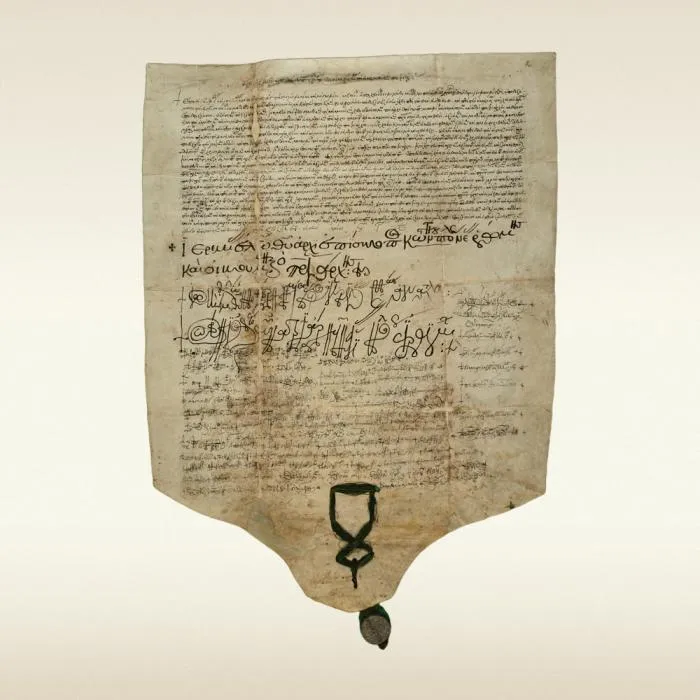
Orthodox Axis: The Russia–Ukraine Fault Line
History, Canon, Memory, and the Production of Postwar Legitimacy
1. What Does This Study Do?
This study examines how historical memory, canonical documents, sacred geography, and modern state practice are connected within the Russia–Ukraine Orthodox fault line. Its aim is not to declare one side right, but to show by which actor, in what manner, and at which points these elements are used, and where uncertainty remains.
The study rests on two distinct axes. The first is the axis of use: whether a historical or canonical element has been transformed by an actor into a contemporary instrument of legitimacy; this can be traced through a documentable act — a speech, a church decision, or a law. The second is the axis of truth: whether the historical or canonical claim beneath that element is correct; this requires separate and often heavier evidence.
These two axes are independent of one another. The fact that an element has been used politically does not prove that it is true. Likewise, the fact that a claim is disputed does not mean that it is politically ineffective. This distinction is preserved throughout the study: showing how something is used is not the same as issuing an automatic judgment about its truth.
2. First Layer: Roots of Legitimacy
The deepest layer of the fault line is that a shared historical inheritance serves as a source for two separate national narratives. Four founding motifs stand out in this layer: the early East Slavic chronicle tradition — the Tale of Bygone Years; the memory of Korsun/Chersonesus associated with Prince Vladimir’s baptism; the age of Yaroslav the Wise and the legacy of Kyiv; and the idea of the “Third Rome,” shaped in later centuries.
In each of these motifs, a real historical core can be distinguished from a later-constructed shell of legitimacy. For example, the historical core of engagement between Byzantium and early Rus’ — military bargaining and dynastic marriage — can be traced strongly. By contrast, the sanctification of a particular place as the “site of baptism” is largely a construction of later periods, especially the nineteenth century. Similarly, dynastic networks and the institutional consolidation of the period can be traced strongly, while the framework of a “golden age” and a “wise founder” is a later packaging.
What matters is that most of these motifs are a contested shared inheritance claimed by both Russian and Ukrainian national narratives. The same historical material can feed two rival founding narratives. In the modern period, meanings of geopolitical weight far greater than their original historical core are attached to these early historical elements.
The measure here is this: the early historical core and the later-constructed shell of legitimacy must be separated from one another. This distinction does not deny the reality of the core; nor is the conclusion of this study that “everything was invented later.” It is methodologically impossible, however, to derive a direct territorial right from sacred memory.
3. Second Layer: The Line of Canonical Authority
The church history of Kyiv cannot be explained by a single question: “To whom did it belong?” Different types of authority come to the fore in different periods, and these types of authority cannot be reduced to one another.
Several distinctions are decisive here. The authority to consecrate or appoint a bishop is not the same as the authority to govern a territory. The requirement that a name be commemorated in the liturgy does not automatically mean full jurisdiction — but neither is it a meaningless formality. A long-standing practice is not identical to what the original document said word for word. And autocephaly — self-governance — does not mean unconditional absolute independence.
For this reason, the correct question is not “To whom did Kyiv belong?” but in which period, what type of authority, through which document, by which interpretation, and through which practice was claimed. History is a fractured sequence of different regimes of authority: from the metropolitan order to attempts at native metropolitans; from the separation of lines to orientation toward Rome; from the consecration/jurisdiction dispute of 1686 to the autocephaly arrangement of 2019.
There are three main narratives that read this line, and none can be accepted as correct by default:
-
The narrative of the Patriarchate of Constantinople argues that Kyiv’s mother-church bond belongs to it, that 1686 granted only a limited authority, and that 2019 reactivated this bond. Its documentary basis is strong at certain points, but it has difficulty explaining three centuries of actual practice.
-
The Moscow narrative argues that 1686 established a permanent canonical order and that long practice reinforced it. Its practical basis is strong, but it is disputed whether the language of “full transfer” appears explicitly in the original document.
-
The Kyiv/Ukrainian narrative argues that the identity of the local church was historically suppressed and that 2019 restored it. Its documentary basis — the 2019 Tomos — is strong; however, the framework of an uninterrupted “restoration” is in tension with the fact that early native attempts did not become institutionalized.
The documentary, interpretive, and practical legs of each narrative strengthen and weaken in different places; each makes a selective emphasis.
4. Third Layer: The Modern Orthodox Fault Line
In the modern period, historical and canonical fractures do not remain merely disputes about the past; they are reused in the fields of statehood, war, identity, security, and church status.
Several examples show this use. The memory of Korsun/Chersonesus was connected, in Russian state discourse after 2014, to a narrative of legitimacy concerning Crimea. This use is documentable; however, it proves neither the place of baptism nor territorial belonging. Moreover, the same sacred-geography logic can also feed the Ukrainian founding narrative, because Vladimir was also a ruler of Kyiv. The 2019 OCU Tomos carried church status into a modern rupture. The status of the UOC, whose historical/canonical ties with the Moscow Patriarchate are disputed, remains uncertain despite a declaration of separation in 2022. A law adopted in 2024 established a security mechanism concerning organizations regarded as linked to the Russian church; the establishment of this mechanism is documented, but its practical consequences remain an open field.
The basic principle of this layer is to keep separate the documentability of a use and the truth of the claim beneath it. None of the parties’ discourse can simply be dismissed as “propaganda” in its entirety, nor can any of them be assumed correct by default. A modern security concern does not automatically invalidate a religious-freedom critique; nor does a religious-freedom critique automatically invalidate a security concern.
5. The 2019 OCU Tomos and the Question of “Preserved Bonds”
The 2019 OCU Tomos grants autocephaly to the church in Ukraine while also preserving certain bonds with the institution that calls itself the “Ecumenical Patriarchate” and that the Republic of Türkiye, since Lausanne (1923), recognizes as the “Greek Orthodox Patriarchate of the Phanar.” (This study accepts that naming itself is a field of legitimacy; the terminology used below in the analytical language does not mean approval of any status claim.) The granting of autocephaly is clear and strong at the documentary level: the text declares the Ukrainian church to be “canonically autocephalous, independent, and self-governing” — in Greek, «κανονικῶς αὐτοκέφαλος, ἀνεξάρτητος καὶ αὐτοδιοίκητος». This phrase appears in mutually supporting form both in a primary-adjacent Greek transmission and in the Patriarchate’s official English text; nevertheless, direct confirmation from the Patriarchate’s official Greek page remains open at this stage. From this element alone, no conclusion is drawn regarding a “standard/special model” or a power of veto.
Among the preserved bonds, the following may be listed: the reception of the holy myron from Constantinople; the non-transfer of authority over the diaspora — communities abroad — to the Ukrainian church; the line of appeal — ekkliton — by bishops and clergy to the Patriarch, grounded in the 9th and 17th canons of the Council of Chalcedon; recourse to the Patriarchate in major ecclesiastical matters; and the preservation of the Patriarchate’s rights concerning the Exarchate and Stavropegia — institutions directly subject to the Throne — in Ukraine. The phrase “preserved bonds” is not the Tomos’s own term, but an analytical designation used in this study.
These elements show that the OCU Tomos grants autocephaly while preserving certain bonds with the Patriarchate. However, the degree of binding force of these bonds and their comparative character in relation to earlier tomoi must be examined separately. Whether the text grants the Patriarchate a concrete power of veto or command remains an open question at this stage.
The open question is this: are these bonds standard elements repeated in other autocephaly documents of the Patriarchate, or are they distinctive arrangements specific to this dossier? Preliminary indications suggest that the line of appealing to the Throne in major matters and seeking its valid opinion/understanding may also appear in some earlier autocephaly documents. Poland 1924 and Bulgaria 1945 are examples that must especially be examined in this direction; for Albania 1937, confirmation of the Greek text and its provenance must be kept open separately. Therefore, the possibility of a common core strengthens, but no judgment regarding a comparative model is established. A source entry indicating that the relevant phrase concerning “valid opinion” appears in the Bulgarian 1945 Tomos has been carried forward for further examination; however, this single finding does not close the question by itself.
By contrast, three elements emerge in the 2019 text as potentially distinctive. The expression «βεβαίαν συναντίληψιν» — a compound meaning “firm support/understanding” — is one distinctive candidate that can at this stage be safely observed in the 2019 text; however, no definitive negative judgment can be made that it is absent from other tomoi. The second is the fact that the appeal is directed to the Throne itself rather than to “sister churches.” The third is the prominence of a restriction concerning diaspora authority. These three elements are not equally solid. The diaspora limitation is confirmed at the level of the text; however, whether this limitation is unique to the OCU cannot be said without comparison with earlier tomoi. Even when all are evaluated together, the available data is insufficient to establish either the judgment “this is a standard model” or the judgment “this is a special/restrictive model.” Therefore, the question must at this stage be left open as a working question.
6. Source and Methodology Note
This text is not a final academic edition. The sources on which it rests are layered: some claims rely directly on primary documents, some on academic secondary sources, and some on working translations or verifications not yet completed. This distinction has been preserved throughout the text; unverified points have not been turned into definitive judgments.
Wikipedia and similar encyclopedic sources are not used as final sources. Texts previously consulted only for orientation will, at a later stage, be replaced with original-language sources, facsimiles, official texts, or academically critical editions. A few concrete notes: for the 2019 OCU Tomos, a primary-adjacent Greek transmission and the Patriarchate’s official English text have been used together, and they support one another; direct confirmation of the Patriarchate’s official Greek page remains open. For the early chronicle tradition — the Tale of Bygone Years — the academic critical-edition line, including Ostrowski and Likhachev, has been identified; however, line-level extraction of the relevant passages has not yet been carried out. The 1686 documents remain the most fragile and disputed node; although party sources contain document quotations, they do not substitute for independent copies. The Ohrid / North Macedonia dossier is not a Tomos of autocephaly of the Patriarchate, but rather a document from a different patriarchal tradition and a recognition decision; therefore it is evaluated in a separate category. The backbone sources to be upgraded with priority are the early chronicle tradition, the 1686 documents, and the official text of the 2019 OCU Tomos; these will be followed by the comparison of autocephaly documents and the official documents and speech records of the modern period.
In short, this is a controlled first working text that preserves distinctions between source levels; the weight of each claim must be read together with the strength of the source on which it rests.
7. Conclusion: Not a Final Judgment, but a Map of the Fault Line
This study does not issue a judgment in favor of one side. What it shows is that historical memory, canonical documents, and modern politics are not isolated from one another; the same historical and canonical material can be converted by different actors into different functions of legitimacy. This does not prove the truth of that material — it only shows how it is used.
The real value lies not in answering the question “who is right?” too quickly, but in distinguishing which claim is carried by which source and which uncertainty. The fault line is understood not through the victory of one side, but through the map of layers and uncertainties. As sources are moved to the primary level in the next verification stage, this map will become clearer.
A status note: this text is the controlled first public-facing publication text of the study; it is not a final academic edition, and the process of source upgrading has not been completed. The documentary elements concerning the 2019 OCU Tomos have strengthened at this stage; however, the question of the comparative nature of the “preserved bonds” — that is, whether they are standard or specific — remains open. The early chronicle tradition, the 1686 documents, the comparison of autocephaly tomoi, and the status of the Greek Orthodox Patriarchate of the Phanar in the Ottoman–Turkish context will be treated separately in later stages.
Research Map
This text is the public-facing introductory essay of the Orthodox Axis research. The whole study is not limited to one short article; historical memory, canonical documents, modern state practice, comparisons of tomoi, and audits of source roots will be treated in separate modules.
This introductory essay lays out the study’s basic question and method: Which element can be traced at the level of documentation, which claim remains open, and at which point must party narrative and historical/canonical truth be separated from one another?
In later modules, the following topics in particular will be treated separately: the early chronicle tradition and the legacy of Kyiv; the canonical authority node of 1686; the 2019 OCU Tomos; the comparison of autocephaly documents within the scope of the F-question; the modern Russia–Ukraine Orthodox fault line; and the status of the Greek Orthodox Patriarchate of the Phanar in the Ottoman–Turkish context.
For this reason, the text above is not a final academic edition, but the first public gateway of the research architecture.