


02 · Dossiers
- Code
- OWS-2026-005-S
- Status
- Locked
- Version
- 2.4.1
- Evidence level
- Mixed source
- Risk level
- Medium
- Last updated
- 24 June 2026
- Red-Team status
- Çok-AI red-team; protokol tam-metin doğrulandı (v2.4.1)
The Front Alongside the Field: Wartime Dual-Use Planning and Preparation in Soviet Tractor Plants
Between 1928 and 1932 the USSR was building giant tractor plants from nothing. But while they were still under construction, did the Soviet planning bureaucracy assess what they could produce if war came? Through Protocol No. 17447сс of 6 January 1930.
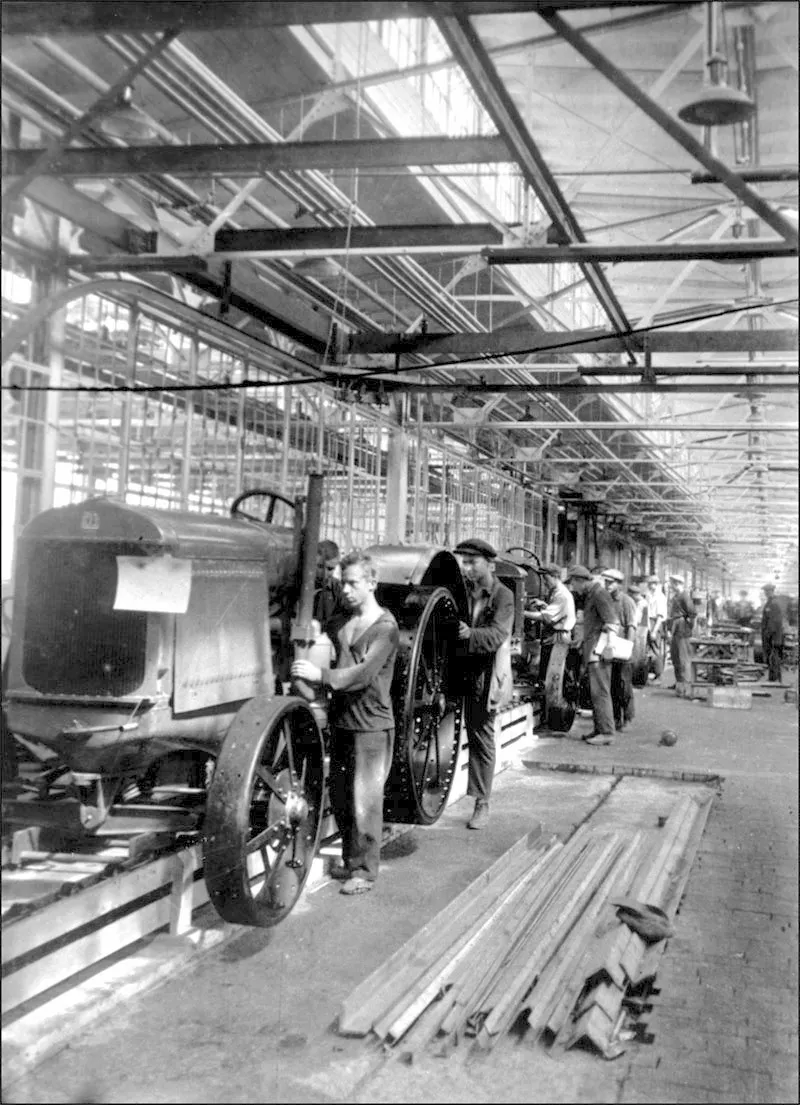
Workshop of the Stalingrad Tractor Factory, 1930 — the era's industrial production capacity. Source: Wikimedia Commons, public domain.
0. Scope and frame
This study is not “a history of tank production in the USSR.” Its question is narrow: in 1928–1932, were the Soviet tractor plants then under construction — while still in their founding phase — assessed by the Soviet technical-planning apparatus with respect to wartime tank production and wartime / military-use tractor production? The axis is ChTZ (Chelyabinsk), the auxiliary axis the new KhTZ (Kharkiv Tractor).
[Scope note] STZ (Stalingrad) is not named in this protocol (full text confirmed); it is not inserted directly into the main thesis but kept as a separate 1930 note in Appendix A.
1. Thesis (the spine): the intent ↔ capacity distinction
[STRONG INFERENCE] VSNKh sub-commission protocol No. 17447сс of 6 January 1930 is early direct evidence that the Soviet technical-planning bureaucracy assessed the tractor plants then under construction — ChTZ in particular — with respect to wartime tank and wartime / military-use tractor production, in a manner that was concurrent with construction and plant-specific.
[FACT — the second half of the spine] The document is not a binding serial-production order; yet neither is it a purely abstract review. The correct description: a protocol containing a pre-planning / feasibility and begin-preparation instruction oriented toward wartime use. (The document orders that construction of the shop begin; it does not record that construction occurred.) An additional element that makes it “not abstract”: Art. 7 states that not only wartime but also an existing peacetime tank program is to be carried out in this shop. The document proves intent and a preparatory step, not implemented serial capacity.
1A. Thesis-level independent verification (non-istmat)
[STRONG INFERENCE] Although the protocol itself remains within a single ecosystem, the core of the thesis — the early, plant-specific assessment of tractor plants under construction, ChTZ in particular, with respect to wartime tank production — is independently supported by a peer-reviewed, non-istmat source. The work of Sonia Melnikova-Raich (IA: The Journal of the Society for Industrial Archeology 36/2, 2010) documents the following:
- [FACT] The Politburo decision of 5 December 1929 “On Implementation of the Tank-Building Program” specifically emphasizes the importance of the planned Chelyabinsk Tractor Plant — that is, ChTZ was singled out at the top decision level two weeks before the protocol, with respect to tanks (source: Mukhin, “Amtorg. Amerikanskie tanki dlia RKKA,” Otechestvennaia istoriia, 2001).
- [FACT] The “RKKA Tank-Tractor-Armored Vehicle Armament System” approved by the RVS in 1928 establishes the doctrinal frame.
- [FACT] Tukhachevsky’s note to Stalin of 19 June 1930 states that the bulk of tanks could be serially producible armored tractors and that military production could rest on civilian industry at minimal peacetime cost — independent evidence of the dual-use doctrine.
[VERIFY — frame caveat] Melnikova-Raich’s facts are well-sourced (Politburo decisions, RGAE/RGVA citations); however, her interpretive frame tends strongly toward “the Soviet war machine built by the West” and her sources include the revisionist Suvorov school (Khmelnitsky, “Tanki za khleb”). This file uses her facts, not her frame; the intent↔capacity and “no U.S. state intent” disciplines are maintained.
2. The status and language of the document
[FACT] The document is a sub-commission working protocol (signatures: Chairman Osinski / Secretary Kononenko), not a Politburo decree. Its language is two-layered: alongside conditional/exploratory verbs (“считать возможным” — to consider it possible; “предварительно наметить” — to outline in advance) stands a begin-preparation order — in Art. 7, “необходимо теперь же приступить к постройке специального танкового цеха” (it is necessary to begin now the construction of a special tank shop) and “должно быть сосредоточено оборудование” (equipment must be concentrated). The document stands between “let us consider” and “let us begin preparing now” — short of a serial-production order, beyond abstract feasibility.
[FACT — weight note] Present at the meeting, besides the industrial cadre, were RKKA Chief of Staff Shaposhnikov and the head of the General Staff’s 2nd Directorate, Ventsov. This lifts the document’s weight a notch above an “ordinary sub-commission”; it remains, nonetheless, a pre-planning/preparation protocol, not a binding serial-production order.
3. The protocol’s tank map: medium tank a fixed line, heavy tank a candidate list, tractor plants ancillary
| Vehicle class | Facility in protocol (article) | Certainty |
|---|---|---|
| Medium tank | ХПЗ (Kharkov Locomotive) + Krasny Profintern, Bryansk (Art. 8) | Fixed line (prior Presidium decision) |
| Heavy tank | Kramatorsk/Sverdlovsk or Bolshevik/Barrikady (Art. 9) | Candidate list — two unresolved proposals |
| Small tank (T-18) — wartime | ChTZ (Art. 7) | Pre-planning + begin preparation |
| Medium tractor — wartime | ChTZ (Art. 5 + 7; “same plant as the small tank”) | Pre-planning |
| Wartime (Caterpillar-type) tractor | KhTZ (Art. 11) | Recording (“должен будет” — shall have to) |
| Heavy tractor (for NKVMor) | ХПЗ (Kharkov Locomotive, Art. 6) | Assignment |
| Tankette | — (Art. 10) | Indeterminate; no project/request |
[STRONG INFERENCE] The fixed line for the medium tank is the locomotive/heavy-machinery plants; for the heavy tank the protocol does not choose a plant, it lists candidates. The tractor plants’ share is ancillary and wartime-limited. This file does not invert that hierarchy.
[FACT — critical distinction] KhTZ (Tractor) ≠ ХПЗ (Locomotive). In the protocol it is ХПЗ that produces the tank/heavy tractor.
4. The ChTZ leg (Arts. 5, 7) — feasibility + begin preparation, not serial production
[STRONG INFERENCE] All three elements of Art. 7 are verbatim in the text: “малого танка (Т-18)” (small tank T-18), “специального танкового цеха” (special tank shop), “должно быть сосредоточено оборудование” (equipment must be concentrated). The protocol considers it possible to “outline this production in advance”; it further requires that construction of a special tank shop outside the main plant’s grounds begin now and that equipment be concentrated for the mobilization program. Art. 5, by stating that the wartime medium tractor would be produced “in the same plant as the small tank,” makes ChTZ a wartime dual-production node. (The reading is almost at the level of quotation; all elements are held under the qualifiers “в военное время” — in wartime — and “предварительно” — preliminarily — and must not be read as full peacetime capacity.)
[FACT — institutional follow-up] Art. 13 requires the matters to be developed within one month under the ВАТО Military Administration; Arts. 14–15 assign tasks by name (Uryvayev, Postnikov, Tolokontsev).
[FACT — capacity limit] The preparatory language did not turn into serial capacity over the course of 1930:
- The Politburo of 5 November 1930 (О танкостроении — On Tank-Building) tasks Osinski, within one month, to re-draft the matter of “wartime tank use of tractor plants” → ten months later the question is still open. (РГАСПИ Ф.17 Оп.162 Д.9; istmat node 47977)
- Khalepsky, 11 November 1930, writes that the Caterpillar-60 chosen for ChTZ does not take defense needs into account. (РГВА Ф.31811 Оп.1 Д.245; istmat node 30412)
- Gosplan, 24 October 1930 (Krzhizhanovsky), finds that the S-30 mobilization plan lags behind industry. (РГАЭ Ф.4372 Оп.91 Д.668; istmat node 30411)
[STRONG INFERENCE] “An instruction to begin pre-planning and preparation for a wartime tank at ChTZ entered the record” survives; “serial capacity began to be established” does not.
5. The KhTZ leg (Art. 11) — not a tank, but a wartime tractor line + the yellow-flag resolution
[STRONG INFERENCE] Art. 11 records that the new KhTZ would, in wartime, have to produce “both types of Caterpillar” tractor — not a tank. Art. 8 separately assigns the medium tank to ХПЗ; the classification is clear.
[Terminology note] The text does not literally say “military tractor”; it says “wartime Caterpillar tractors.” The “military” character is a contextual inference from the whole of the protocol (tank-tractor program + “в военное время”). Hence the preferred formula is “wartime (Caterpillar-type) tractor line.”
[FACT — secondary + peer-reviewed] The production-line fact is established: KhTZ in fact produced the International 15/30 (wheeled), while the Caterpillar Sixty (С-60) line shifted to Chelyabinsk. This is now supported not only by popular sources but also by peer-reviewed Melnikova-Raich (2010); the same source further documents that ChTZ’s technical-assistance negotiation with the Caterpillar firm collapsed in March 1930 and that former Caterpillar engineers were engaged individually — which directly confirms the discipline “Caterpillar = a tractor type, not a firm contract.”
[STRONG INFERENCE] The reading that follows: the protocol’s Art. 11 match is a January 1930 preliminary plan, revised within the year. This itself proves the document’s “preliminary, non-binding” character; it strengthens the thesis.
6. The general-review article (Art. 17)
[STRONG INFERENCE] Art. 17 provides for the formation of a mixed technical commission from NKVMor + industry representatives, tasking VATO to “study the equipment and technological process in the tractor plants under construction and determine the ways of using them for tank and military-type tractor production in wartime.” [FACT] Arts. 12/16 attach the purchase of samples from abroad, up to 500,000 rubles, to Osinski.
7. Context: this is normal state behavior
[FACT] Planning civilian industry for wartime conversion was ordinary for great powers. A concrete period-consistent example: the first version of the U.S. Industrial Mobilization Plan (1930) institutionalized the wartime mobilization of civilian industry. [TO BE VERIFIED] Germany’s preservation of military capacity in the 1920s via civilian front structures under the Versailles constraints is also a contemporary example (a specific comparison requires separate study). “Secret”/“top secret” markings are widespread in Soviet defense-industry paperwork; on their own they must not be read as a special sign of conspiracy.
[STRONG INFERENCE] The file’s contribution is not the sensation “the Soviets secretly planned tanks.” The original core is narrow: the direct documentation, at a date as early as 6 January 1930 and with the participation of the General Staff level, of a construction-concurrent, plant-specific dual-use pre-planning and preparatory step. “Early” is not a claim of international comparison but is meant relative to the facility’s life cycle.
8. Western/U.S. technology transfer — out of scope, referred to a separate file
[FACT] U.S.-origin engineering (the Albert Kahn circle, Amtorg) played a role in the technical origin of these plants’ heavy-production infrastructure; however, no American firm appears in the protocol, and there is no documented causal link between U.S. transfer and Soviet military planning. The legal/commercial channels of pre-recognition transfer are the subject of a separate study — see OWS-2026-005. In this file the topic is passed over in two sentences. [Discipline note] This file does not claim the American side “knew nothing”: American-side awareness is documented — e.g., Kahn saying that some new plants were planned for war materiel if needed; but this is awareness — not U.S. state intent or coordination — and is handled in a limited way in OWS-2026-005.
9. What is not proven / Open list of rejections
That the U.S. consciously built a tank factory; that the U.S. was the founding subject of Soviet heavy industry; that tractor plants were the backbone of tanks; that KhTZ was a tank center; that the protocol was a binding serial-production order; that planning turned into capacity within 1930; that the 1930 protocol “founded” the Tankograd of 1941 (a teleological fallacy); that the plants were designed wholly military from the start.
10. Falsification standard (two-layered)
[Methodological lock] Transcription layer: The main falsification gate is the physical RGAE copy (Ф.2097/1/1077). The published text was verified in two repositories + a critical edition; if the facsimile differs, the thesis is revised. Interpretation layer (open falsification fields): (a) if the actual report of the mixed technical commission (Art. 17) paints a different picture; (b) if the ChTZ special tank shop is shown not to have been / to have been actually built; (c) if the chronology of the KhTZ model revision differs from the thesis; (d) if STZ’s separate 1930 line (Appendix A) is refuted/strengthened — each revises the interpretation. The thesis does not conceal these fields. Independence layer: At the document level the protocol remains single-ecosystem (falsification gate = the RGAE facsimile). At the thesis level the non-istmat, peer-reviewed Melnikova-Raich (2010) independently supports the core proposition (Section 1A). The falsification gate here: if a peer-reviewed source of the same caliber refutes ChTZ’s early tank-differentiation, the thesis weakens.
11. OWS instrumentalization caveat
[STRONG INFERENCE] A 1930 sub-commission decision is open to asymmetric instrumentalization in 2026 geopolitics: the West, “civilian-masked militarization + innocent U.S. firms”; Russia, “Stalinist foresight” or “dependence on the West”; in Ukraine, the confusion “the Kharkiv tractor plant produced tanks” (whereas it was ХПЗ). The file manages this risk by (a) rejecting the causal link, (b) the KhTZ ≠ ХПЗ distinction, (c) the normal-state-behavior context.
12. Labeled claim inventory
- [FACT] Protocol No. 17447сс exists and its full text has been verified (РГАЭ Ф.2097/1/1077; 6.1.1930; Osinski/VSNKh; Shaposhnikov present).
- [STRONG INFERENCE] The Soviet planning apparatus subjected tractor plants to review with respect to wartime military production at the pre-planning/preparation level.
- [STRONG INFERENCE] For ChTZ, wartime T-18 + medium tractor + construction of a special tank shop were envisaged (Arts. 5, 7); an instruction to begin preparation entered the record; it did not turn into serial capacity.
- [FACT] The 6 January plan did not turn into a binding serial-production decision over 1930 (5 November + 11 November + 24 October — all three verified).
- [FACT—secondary] KhTZ in fact produced the International 15/30, the С-60 shifted to ChTZ → [STRONG INFERENCE] the Art. 11 match is a preliminary plan revised within the year.
- [FACT] The fixed line for the medium tank is ХПЗ/Krasny Profintern (Art. 8); for the heavy tank the protocol gives a candidate list (Art. 9).
- [FACT] STZ is not in this protocol; for the separate 1930 line, see Appendix A.
- [FACT] No American firm appears in the protocol; there is no U.S.–Soviet military causal link.
- [HYPOTHESIS] This early, plant-specific, General-Staff-attended documentation is the file’s original core.
Appendix A — STZ 1930 note (outside the main protocol)
[STRONG INFERENCE] STZ does not appear in the 6 January protocol. However, the Khalepsky report of 11 November 1930 records that the modern small tank acquired from Britain (Vickers type, later T-26) was envisaged for production at the Stalingrad Tractor Plant after trials. (istmat node 30412)
[FACT—secondary] This line, too, did not in fact materialize: T-26 production later shifted not to STZ but to the Bolshevik / Plant 174 (Leningrad) line. So STZ-Vickers was also a revised plan.
[FACT — independent/non-istmat] The tank dimension of STZ is also supported by non-istmat sources: the American consular reports relayed by Melnikova-Raich — in May 1931 engineer Riesing reports that preparation for “small tank” production was under way at STZ; in February 1932 engineer Wishnewsky reports that the emphasis at STZ had shifted from tractors toward tanks (with NARA citations, U.S. State Dept. Decimal File). This shows that STZ’s tank orientation does not rest on Soviet internal documents alone; it is, nonetheless, evidence of a separate document line, not of the 6 January protocol.
[TO BE VERIFIED] The full STZ file also covers Albert Kahn’s turnkey design, the American equipment order (1 April 1930 Stalingrad delivery target), and the wartime switch to the T-34 — all with documents independent of the main protocol. This note is kept so that STZ is “not entirely ignored”; it is not inserted into the main thesis.
Source citations
- Protocol No. 17447сс (6.1.1930): РГАЭ Ф.2097 Оп.1 Д.1077 Л.20–19об. istmat node 30194; ЭБИД; publication: Становление ОПК СССР 1927–1932, Moscow 2008, pp. 400–402. [Full text read directly; Arts. 5/6/7/8/9/11/12/13–17 confirmed. Physical facsimile not seen.]
- 5 November 1930 Politburo No. 14: РГАСПИ Ф.17 Оп.162 Д.9. istmat node 47977.
- 11 November 1930 Khalepsky: РГВА Ф.31811 Оп.1 Д.245. istmat node 30412. (ChTZ/Caterpillar-60 + STZ/Vickers)
- 24 October 1930 Gosplan: РГАЭ Ф.4372 Оп.91 Д.668. istmat node 30411.
- Tractor model lines (KhTZ→International 15/30; ChTZ→С-60): leanok.ru; studfile.net (MAMI); kp.ua + peer-reviewed confirmation: Melnikova-Raich 2010.
- U.S. Industrial Mobilization Plan 1930: (contextual source — not primary evidence) In the U.S. too, as of 1930, the wartime mobilization of civilian industry was a field of institutional planning. This comparison is used to read the Soviet case not as an “abnormal conspiracy” but within the context of 20th-century war economy; it is not the file’s primary evidence.
- Melnikova-Raich (thesis-level independent verification + KhTZ/ChTZ/STZ facts): Sonia Melnikova-Raich, “The Soviet Problem with Two ‘Unknowns’… Part I: Albert Kahn,” IA: The Journal of the Society for Industrial Archeology 36, no. 2 (2010): 57–80, gwern.net.
- Kahn/Amtorg pre-recognition transfer background: Melnikova-Raich Part I & II, gwern.net.