


02 · Dossiers
- Code
- OWS-2026-005-S
- Status
- Locked
- Version
- 2.4.1
- Evidence level
- Mixed source
- Risk level
- Medium
- Last updated
- 24 June 2026
- Red-Team status
- Türev kayıt; bulgular forensikle aynı
Tractor Plant or Tank Shop? Chelyabinsk's Dual 1930 Plan
Between 1928 and 1932 the USSR was building giant tractor plants from nothing. But while they were still under construction, did the Soviet planning bureaucracy assess what they could produce if war came? Through Protocol No. 17447сс of 6 January 1930.
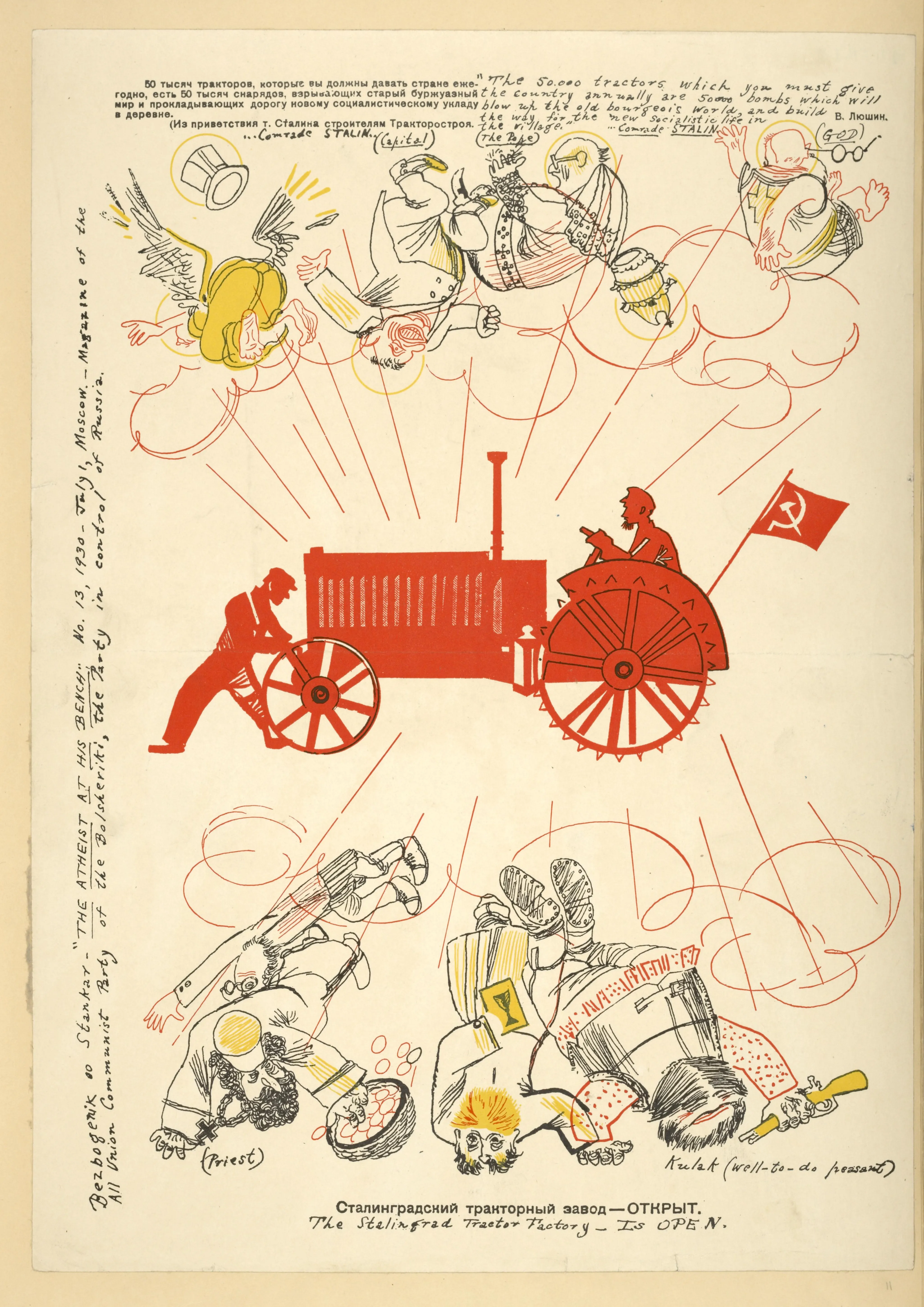
Magazine 'Bezbozhnik u stanka', 1930, no. 13: 'The Stalingrad Tractor Factory is open' — period propaganda image. Source: Wikimedia Commons, public domain.
What is this about?
Between 1928 and 1932 the Soviet Union was building giant tractor plants from nothing: Chelyabinsk (ChTZ), Kharkiv (KhTZ), Stalingrad (STZ). The familiar face of this story is agricultural — mechanizing a backward peasant economy. The less familiar face is this: while these plants were still under construction, did the Soviet technical-planning bureaucracy already assess what they could produce if war came?
The answer here is narrow and clear: yes — and we can show it, without exaggeration, through a single document. The document is a sub-commission protocol of the VSNKh (Supreme Council of the National Economy) dated 6 January 1930; its number is No. 17447сс (“сс” = top secret).
But take care: this is not the sensation “the Soviets secretly built a tank factory.” Two words must be separated from the very start — intent and capacity.
Intent vs. capacity: the spine of the story
The document shows one thing for certain: the planners assessed the tractor plants under construction — Chelyabinsk in particular — with respect to wartime tank and military tractor production, at the same time as construction and plant by plant.
What the document does not show is equally important: it is not a serial-production order. The plants did not begin producing tanks that day. The correct description is this — it is a pre-planning and “begin preparation” instruction oriented toward wartime use. The document says “construction of a special tank shop must begin now”; but it does not record that the shop was built. So the document proves intent and a first step, not established production capacity.
This distinction is the whole spine. The moment it is blurred, the story slides either into “Stalin’s brilliant foresight” propaganda or into the “the West built the Soviet war machine” conspiracy. Both are wrong.
How heavy is the document?
This is not an ordinary sub-commission paper. Present at the meeting, alongside the industrial managers, was the Chief of the Red Army General Staff, Shaposhnikov. That lifts the document’s weight up a notch. Still — to repeat — it is a preparation protocol, not a binding production order.
Which plant was to make what? (The most-confused point)
The picture the document draws is the opposite of the popular narrative. The tank’s main line is not the tractor plants:
- Medium tank: assigned firmly to the Kharkov Locomotive Plant (ХПЗ) and to Krasny Profintern in Bryansk.
- Heavy tank: the protocol cannot choose a plant; it remains undecided between two candidates.
- Chelyabinsk (ChTZ): only pre-planning and shop preparation for a wartime small tank (T-18) + medium tractor.
- Kharkiv Tractor (KhTZ): not a tank — a wartime Caterpillar-type tractor.
There is a vital warning here, often distorted along the Ukrainian axis in particular: the Kharkiv Tractor Plant (KhTZ) and the Kharkov Locomotive Plant (ХПЗ) are not the same thing. In the protocol it is the locomotive plant that produces the tank, not the tractor plant. The sentence “the Kharkiv tractor plant made tanks” confuses these two institutions.
Why did the plan stay “just a plan”?
The “begin preparation” language written for Chelyabinsk did not turn into production over 1930. Three separate documents show this for certain:
- In November 1930 the Politburo refers the same matter back to Osinski as a re-draft — that is, ten months later the matter is still open.
- Also in November 1930, Khalepsky writes that the Caterpillar-60 chosen for Chelyabinsk does not meet defense needs.
- In October 1930 Gosplan finds that the mobilization plan lags behind industry.
Moreover: the Kharkiv Tractor plant in fact produced the International 15/30 model, while the Caterpillar-60 line shifted to Chelyabinsk. So the matches in the 6 January plan changed within the year. This itself proves the document was “a preliminary plan, not a binding order” — and in fact strengthens the main thesis.
Is this something abnormal?
No. Planning civilian industry for wartime was ordinary state behavior for the great powers of the era. In that same year, 1930, the U.S. also had an Industrial Mobilization Plan; the wartime mobilization of civilian industry was a field of institutional planning. The “secret/top secret” stamp, too, was routine in Soviet defense-industry paperwork; on its own it is not the sign of a special conspiracy.
So where does this document’s original value lie? Not in sensation but in its earliness and concreteness: that a construction-concurrent, plant-specific dual-use pre-planning, with the participation of the General Staff level, is directly documented at a date as early as 6 January 1930. “Early” here is not in the sense of a race with other countries — it means early relative to the plant’s own life cycle: while the foundations were still being laid.
The American connection?
American engineering (the Albert Kahn circle, Amtorg) did play a role in the technical origin of these plants’ heavy-production infrastructure. But to be honest: not a single American firm appears in the protocol, and there is no documented causal link between American technology transfer and Soviet military planning. The American side being aware that some plants could convert to war production if needed is one thing; the claim that the U.S. state planned or coordinated this is another. The first is documented, the second is not. The separate story of pre-recognition commercial-technical transfer is the subject of another file (OWS-2026-005).
Why does it matter today?
A 1930 sub-commission decision is open to distortion in three directions in 2026 geopolitics: in the West, “civilian-masked militarization + innocent American firms”; in Russia, “Stalinist foresight” or the reverse, “dependence on the West”; in Ukraine, the confusion “the Kharkiv tractor plant made tanks.” This text closes all three distortions with three tools: by rejecting the causal link, by preserving the KhTZ ≠ ХПЗ distinction, and by placing the event in the context of normal state behavior.
In short, what do we know and not know?
Certain: The protocol is real and its full text has been verified. An instruction to begin construction of a wartime tank/tractor shop for Chelyabinsk entered the record. This plan did not turn into a binding production decision over 1930. The tank’s main line is the locomotive plant. No American firm appears in the protocol.
Strong inference: The Soviet planning apparatus assessed the tractor plants with respect to wartime military production, early and plant-specifically.
Hypothesis (the text’s original claim): This documentation — so early, so plant-specific, with General-Staff participation — is itself this study’s original contribution to the literature.
Sources (summary)
Main document: Protocol No. 17447сс, 6 January 1930 (Russian State Archive of the Economy РГАЭ Ф.2097/1/1077; critical edition: Становление ОПК СССР 1927–1932, Moscow 2008, pp. 400–402). Supporting documents: the Politburo decision of 5 November 1930; the Khalepsky report of 11 November 1930; the Gosplan finding of 24 October 1930. Independent peer-reviewed confirmation: Sonia Melnikova-Raich, “The Soviet Problem with Two ‘Unknowns’… Part I: Albert Kahn,” IA: The Journal of the Society for Industrial Archeology 36/2 (2010): 57–80. (The facts of this source are used; its interpretive frame is not.)
This popular text is the simplified counterpart of the forensic/peer record. For the full labeled claim inventory, the verbatim Russian quotations, and the falsification standard, see the forensic version.