


02 · Dossiers
- Code
- OWS-AA-002
- Status
- Locked
- Version
- 1.1
- Evidence level
- Mixed source
- Risk level
- Medium
- Last updated
- 28 June 2026
- Red-Team status
- Bağımsız red-team Tur 1 + aksiyomatik denetim tamamlandı
Interface Analysis · Pilot 2: Reagan 1981–1986 — Apocalyptic Discourse and Military Buildup
Reagan unites a president who believed in Armageddon with the largest peacetime military buildup in history — the most favorable case for breaking the main thesis ("theopolitical discourse does not enter the core, it stays in the shell"). This pilot tests that case and confirms the thesis: the core (budget-doctrine-decision) is theopolitically empty (D0–D1); theopolitical effect appears only in the shell, at the coalition/legitimacy layer. Even NSDD-75's ideological leg is secular liberal-democratic, not dispensationalist. Evidence is the arbiter.
Epistemic labels: [FACT] = verified fact · [STRONG INFERENCE] = strong inference · [HYPOTHESIS] = hypothesis · [SPECULATION] = speculation · [UNVERIFIED] = could not be verified
Reagan 1981–1986 — Apocalyptic Discourse and Military Buildup
Bridge-Breaker Test: Does Theopolitical Discourse Enter the Core, or Stay in the Shell?
Status: Locked (v1.1) · Evidence: Mixed sources · Risk: Medium · Red-Team: Round 1 + axiomatic audit complete
0. Case Identity
| Field | Content |
|---|---|
| Case name | Reagan military buildup and Armageddon discourse, 1981–1986 |
| Policy domain | US defense budget / Cold War re-hardening / executive strategy |
| Core event | The largest peacetime defense budget increase in history + the same president’s open apocalyptic/biblical discourse |
| Principal actors | Ronald Reagan, Caspar Weinberger, Richard Pipes (lead author of NSDD-75), Anthony Dolan (speechwriter), William Clark |
| Relevant institutions | White House, NSC, Department of Defense, OMB, National Association of Evangelicals (NAE) |
| Case question | Did theopolitical discourse touch the core of the capacity engine (budget–institution–decision), or did it remain within a separable discourse frame (legitimacy/coalition)? |
| Why this case | The case that appears closest to the core. A president who believes in Armageddon + the largest buildup in history, in a single person, in a single period. If the bridge is to break anywhere, it breaks here. |
1. Prior Epistemic Lock
Each factual sentence is marked with one of these labels: [FACT], [STRONG INFERENCE], [HYPOTHESIS], [SPECULATION], [UNVERIFIED]. Each intermediate verdict is marked with a contact level on the fixed D-Ladder v1.0.
D-Ladder v1.0 (fixed measuring instrument)
| Level | Threshold (pure depth — not channel) | Evidence type |
|---|---|---|
| D0 | No contact | — |
| D1 | Discursive contact; no link to decision/institution/output | Speech text |
| D2 | Contact with an intermediate mechanism (mobilization/coalition). Sub-label: -I intent · -F function · -I/F both | Speech / memo / outcome |
| D3 | Program priority changed (timeline, resource, choice of alternative, overcoming bureaucratic resistance with theopolitical justification) | Decision/priority record |
| D4 | Theopolitical justification entered the primary decision document | NSC minutes / presidential note |
| D5 | Counterfactual necessity: without that element the decision would not have emerged | Explicit internal document |
Strand distinction (pre-written falsification condition)
[FACT] Strand 1 — Manichaean-moral theopolitics: coding the Soviet in the language of moral-cosmic evil (good/evil, atheist empire, spiritual crisis). Strand 2 — Dispensationalist eschatology: Armageddon, Israel’s eschatological role, prophetic timeline, Daniel/Ezekiel/Revelation linkage.
[STRONG INFERENCE] Rule: If there is no Strand 2 evidence, only the narrow Armageddon claim falls; the broad theopolitical claim (Strand 1) does not automatically fall and is tested separately. The function of this distinction is not to conceal evidence but to separate out which type of theopolitics is operating.
2. C1 — Discourse and Synchronization
Main question: To what extent, and at which layer, did the state’s official/strategic language align with theopolitical-evangelical language in this case?
C1-A | Core side: the language of budget and strategic doctrine
[FACT] Between 1980–1985 national defense budget authority increased by 51% in real terms; an annual average of 8.6%.1 Annual real increases: 1981 11.4% · 1982 12.1% · 1983 8.7% · 1984 3.7%.2
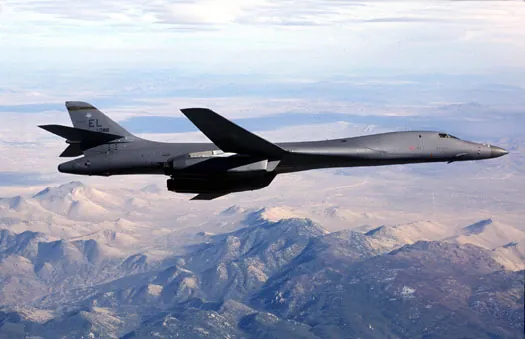
[FACT] The justification for the budget is entirely Cold War–strategic in the documents. Three goals are recorded: strengthening against the possibility of war, holding European allies, forcing the Soviets to the table. Reagan’s own formula: “Defense is not a budget issue; you spend what you need.”3
[FACT] NSDD-75 (17 January 1983; lead author Harvard’s Richard Pipes, oversight by NSC adviser William Clark) establishes three goals: reversing Soviet expansionism, pushing the Soviet system internally toward pluralism, negotiation on a reciprocity basis. Instruments: military, economic, political, and ideological.45
[STRONG INFERENCE] Critical point: NSDD-75 has an “ideological” leg — but this leg is secular liberal-democratic: individual dignity and freedom, free press, free trade unions, free market, political democracy. Not dispensationalist or biblical. That is, even the ideological layer of the capacity engine is theopolitically empty.64
C1-B | Shell side: Evil Empire / NAE discourse (Strand 1)
[FACT] 8 March 1983, National Association of Evangelicals speech (“Evil Empire”). The text was written by speechwriter Anthony Dolan; he tried for a full year to insert the phrase “evil empire” into the text, and staff including David Gergen repeatedly removed it.78
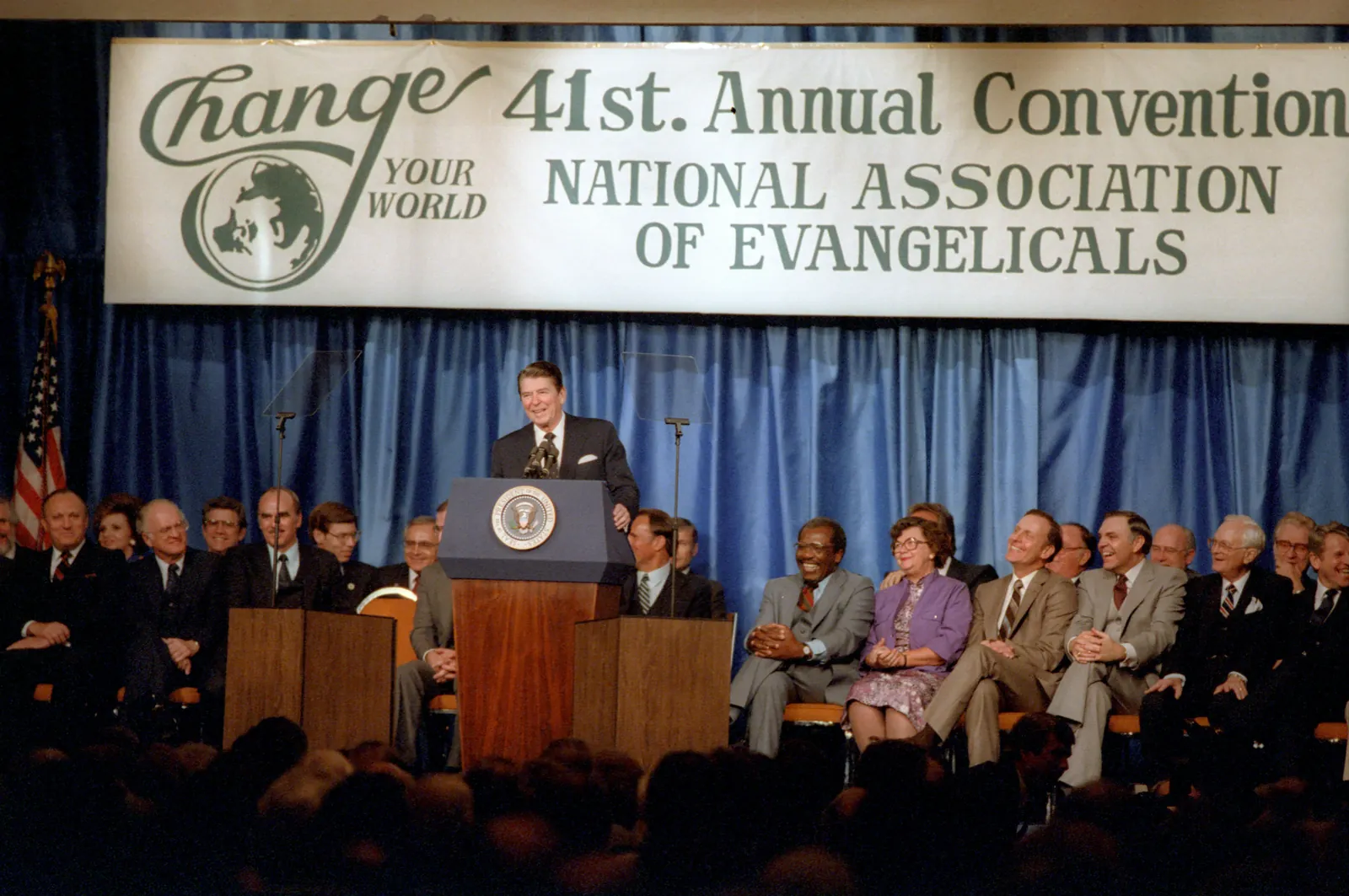
[FACT] The speech directly targets the nuclear freeze; Reagan asks the audience to oppose freeze proposals. The frame is Manichaean-moral (good/evil, “atheist totalitarianism”, a Screwtape/C.S. Lewis reference) — not dispensationalist.910
[FACT] The discourse came not from strategy but from the speechwriter. NSC staffer Sven Kraemer’s focus was arms control; he did not even flag the phrase “evil empire”. Shultz: the phrase “took on a life of its own; the speech had not been put through a careful or systematic process.”11
[STRONG INFERENCE] The timing concretizes the discourse-shell/strategy-core relationship: NSDD-75 was coded on 17 January 1983; Evil Empire gave its moral-rhetorical face to the public on 8 March 1983; the Soviets reacted on 17–18 March. The discourse is the legitimacy face of the codified strategy — not the cause that produced it.5
C1-C | Dispensationalist strand (Strand 2) — separate and special
[FACT] The Armageddon strand is distinct from Evil Empire and largely private: a phone call to AIPAC director Tom Dine (18 October 1983), People magazine (December 1983), the Jim Bakker program (1980), to James Mills (1971). Dugger/Cuomo compile 11 public/private statements.1213
[FACT] This strand was not translated into doctrine/budget and was rejected once it produced a cost. White House staffer Holladay says “in a generic sense”; dispensationalist theologian John Walvoord says “Reagan has no theological commitment to this teaching”; in the 1984 debate Reagan retreats with “I never said we should plan according to Armageddon.”1413
[STRONG INFERENCE] The claim that “it drives policy” is not evidence but an attack produced by the anti-nuclear left’s Christic Institute during the 1984 election campaign; the academic literature regards it as sensational.15 Without falling into the genetic fallacy: campaign intent does not cancel the existence of the statements — but their existence does not prove policy causation either.
C1 Preliminary Assessment
[STRONG INFERENCE] The core language (budget + NSDD-75) is entirely strategic and secular; neither theopolitical strand enters the core language. The Manichaean strand operates in the shell (coalition/legitimacy); the dispensationalist strand stays in the private sphere. What we face is not a ‘decision taken through theopolitical language’ but a ‘secular-strategic core + a separable moral-discourse shell layered on top afterward.’
Evidence label: Predominantly [FACT]. · C1 depth: Core D0–D1 · Manichaean strand D1–D2 · Dispensationalist strand D0–D1.
3. C2 — Public Opinion and Mobilization
Main question: Did theopolitical/evangelical discourse produce measurable pressure or opportunity — and did this touch the budget core or the coalition shell?
C2-A | Was the discourse a deliberate coalition instrument? (D2-intent)
[STRONG INFERENCE] Yes. The Evil Empire/NAE speech exemplifies the president’s effort to strengthen his electoral coalition: it is an attempt to explain to social conservatives why they should support a “peace through strength” foreign policy — that is, ever-increasing defense spending.16 This is the evidence sought for D2-intent.
C2-B | Did intent produce a result? (D2-functional — contested)
[FACT] The evidence of effect is contradictory. On one hand: the speech was a short-term failure; NAE members continued to overwhelmingly support the freeze, and in May 1983 a nuclear freeze resolution passed the House of Representatives.16 On the other hand: some assessments count the discourse as contributing to the decline of the freeze movement.17
[STRONG INFERENCE] Intent (D2-I) is supported; function (D2-F) could not be proven. The freeze resolution again passing the House weakens the short-term mobilization success of the discourse. Marked as an open research area.
C2-C | Is there contact with the core?
[STRONG INFERENCE] No. The mobilization discourse operates at the coalition/public-opinion layer; there is no evidence that it touched a budget line, a weapon-system choice, or an NSDD priority. The causal arrow is downstream: the buildup was decided on strategic grounds, and the discourse was deployed afterward to sustain the coalition.
C2 depth: Manichaean strand D2-I (certain) / D2-F (contested). Core contact: none.
4. C3 — Institutional Carriers
Main question: Through which carrier actors and institutional lines did theopolitical discourse and pressure enter the decision environment? (Carriage is a CHANNEL concept — the C3 axis — separate from the D axis of depth.)
C3-A | Carrier map — and the sharp contrast with Jerusalem
[STRONG INFERENCE] The load-bearing finding of this case is negative. In Jerusalem 2017–18 there was a visible chain of actors carrying theopolitical pressure into the decision environment (CUFI/Hagee → Pence/Friedman/Kushner → decision circle). In Reagan’s military buildup there is no such chain carrying theopolitics into the budget/strategy decision.
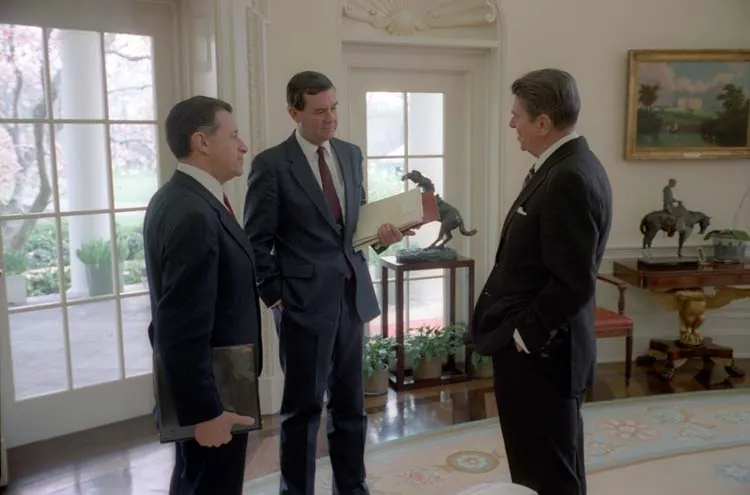
[FACT] The only visible ‘carrier’ is Anthony Dolan — but he is a DISCOURSE carrier (speechwriter), not a decision carrier; what he carried was the Manichaean frame, not dispensationalism; and the pragmatists (Gergen) resisted in order to remove him from the text.87
[FACT] The architects of the strategy/budget decision are strategic, not theopolitical, actors: Richard Pipes (NSDD-75), William Clark, Caspar Weinberger, the Joint Chiefs. There is no theological language in the decision documents.45
[FACT] Even the evangelical leadership did not carry the apocalyptic nuclear line: Jerry Falwell explicitly rejected ‘the extreme worldview that demands nuclear Armageddon.‘13
C3-B | Is there a dual language?
[STRONG INFERENCE] Partly, but different from Jerusalem’s. In Jerusalem the same goal was deliberately carried in two separate vocabularies (theological for the base, secular for the state). In Reagan, the secular-strategic language (NSDD-75) and the moral discourse (Evil Empire) come from different PRODUCERS (Pipes vs Dolan) and stand at different layers; they were not synchronized by a common carrier chain.
C3 depth: Institutional carriage to the core D0–D1. The absence of a carrier chain is the main axis of divergence from Jerusalem.
5. C4 — Decision Preparation and Influence
Main question: Did theopolitical discourse enter the decision-preparation process or the decision justification?
[STRONG INFERENCE] For the budget/strategic core, no. The buildup had been coded with NSDD-32 (May 1982) and NSDD-75 (January 1983) before the Evil Empire speech;418 the discourse did not change the existing priority, it defended it. The program-priority threshold (D3) does not open: timeline, resource, or choice of alternative did not change for theopolitical reasons.
[FACT] There is no theopolitical justification in the decision documents (NSDD-32/75) → no D4. There is no counterfactual internal document showing that without theopolitical belief the decision would not have emerged → no D5.
C4 depth: Core D0–D1. D3/D4/D5: none.
6. Synthesis
6.1 Alternative-explanation test
[STRONG INFERENCE] The buildup is fully explained without the theopolitical variable: Soviet SS-20 deployment, the perception of a ‘window of vulnerability’, the bipartisan trend that began with Carter’s late-period increases (1979),3 the strategic modernization agenda of NSDD-32/75.4 The theopolitical variable adds nothing to budget causation.
6.2 Counterfactual (no longer an assumption)
[STRONG INFERENCE] The source of budget causation is the NSDD-75 strategy, and this precedes and is independent of the Evil Empire speech. If the discourse were removed, the strategic buildup stands; the reverse is not true.
6.3 Chronology filter
- 1979: Carter late-period defense increases (groundwork)3
- 1981: Reagan accelerates the momentum (Weinberger, $220 bn)3
- May 1982: NSDD-32 (national security strategy)18
- 17 January 1983: NSDD-75 (Soviet strategy coded)4
- 8 March 1983: Evil Empire / NAE (moral discourse goes public)11
- May 1983: House passes the nuclear freeze resolution (mobilization failure of the discourse)16
[STRONG INFERENCE] The strategy was coded BEFORE the moral-discourse peak. The discourse follows the strategy; it does not drive it.
7. Final Case Conclusion Card
Multi-object D-verdict (D-Ladder v1.0)
| Object | Verdict | Basis |
|---|---|---|
| Defense budget (technical core) | D0–D1 | CBO +51% real; NSDD-32/75 strategic+secular |
| Strategic doctrine | D1 | NSDD-75 ideological leg secular-democratic (Pipes) |
| Public/coalition (Manichaean strand) | D2-I (certain) / D2-F (contested) | Ohio thesis (intent); freeze resolution passed again (outcome rotten) |
| Dispensationalist strand (Armageddon) | D0–D1 | Private conversation; did not enter doctrine; president rejected |
| Middle East / Lebanon / Israel output | Pending — separate file | Output level; sibling of Jerusalem, not forced in this file |
Final verdict
[STRONG INFERENCE] In the Reagan 1981–86 case, theopolitical discourse did not touch the core of the capacity engine (budget-doctrine-decision); the most favorable case (a president who believes in Armageddon + the largest buildup) remains at D0–D1 in core penetration. Theopolitical influence is seen only in the shell (coalition, D2-intent), and even there its functional result is contested. The discourse that does the coalition work is Manichaean anti-communism; the dispensationalist/Armageddon strand entered no decision layer. The bridge thesis — ‘the core is theopolitically empty, the shell is theopolitically full’ — is confirmed in this case.
Comparison with Jerusalem
| Reagan 1981–86 | Jerusalem 2017–18 | |
|---|---|---|
| Highest depth | D2-I (does not reach D3) | D3-candidate (reaches) |
| Causal direction | Discourse defends existing priority (downstream) | Discourse pushes a specific decision (upstream) |
| Institutional carrier (C3) | None (only speechwriter) | Present (Pence/Friedman/CUFI) |
| Core (D4–D5) | None | None |
[STRONG INFERENCE] The instrument distinguishes the two cases — which is what a good instrument should do. Neither enters the core; but Jerusalem climbs one rung higher because there the actors carrying theopolitics were pushing a specific decision.
Main risk
- Reading Manichaean discourse as a theopolitical core-driver (mistaking the shell for the core).
- Hardening D2-intent into D2-functional or into program-priority (D3).
- Mixing the two strands (Manichaean / dispensationalist) and tying Armageddon evidence to the budget.
Open research areas (marked, not blocking the seal)
- D2-functional: the actual mobilization effect of Evil Empire — must be tested with the freeze vote map + period polling. Intent present, result contradictory.
- Middle East / Lebanon / Israel object: output level; deferred to a separate file as the sibling of Jerusalem.
Short score line
Reagan 1981–86 = Budget-core D0–D1 · Manichaean strand D2-I · Dispensationalist strand D0–D1 · no D3 · no D4 · no D5.
Appendix: Audit Note
The file passed an independent red-team round and an axiomatic review; D2-I/D2-F orthogonality was identified, institutional carriage (channel) was moved off the depth axis to C3, and the measuring-instrument version (D-Ladder v1.0) was fixed. NSDD-75 content was independently verified (ideological leg secular-democratic; lead author Pipes).
Bibliography
Footnotes
-
Congressional Budget Office, “Defense Spending: What Has Been Accomplished” (Staff Working Paper, April 1985). https://www.cbo.gov/sites/default/files/99th-congress-1985-1986/reports/doc12a-entire.pdf ↩
-
Christian Science Monitor, “More, more, more for defense” (February 2, 1984). https://www.csmonitor.com/1984/0202/020217.html ↩
-
Miller Center, University of Virginia, “Ronald Reagan: Foreign Affairs”. https://millercenter.org/president/reagan/foreign-affairs ↩ ↩2 ↩3 ↩4
-
Office of the Historian, FRUS 1981–1988, Vol. III, Soviet Union, “Preface”. https://history.state.gov/historicaldocuments/frus1981-88v03/preface ↩ ↩2 ↩3 ↩4 ↩5 ↩6
-
Washington Times, “Crucial Cold War secret” (January 13, 2008). https://www.washingtontimes.com/news/2008/jan/13/crucial-cold-war-secret/ ↩ ↩2 ↩3
-
CSIS, “Going on the Offensive”. https://www.csis.org/analysis/going-offensive-us-strategy-combat-russian-information-warfare ↩
-
“Evil Empire speech,” Wikipedia. https://en.wikipedia.org/wiki/Evil_Empire_speech ↩ ↩2
-
Harrison Smith, “Anthony Dolan… passes”. https://jewishworldreview.com/0325/dolan_obit.php ↩ ↩2
-
Voices of Democracy, “Reagan, ‘Evil Empire,’ Speech Text”. https://voicesofdemocracy.umd.edu/reagan-evil-empire-speech-text/ ↩
-
Washington Examiner, “Twenty-Eight Years Ago Today…”. https://www.washingtonexaminer.com/news/641436/ ↩
-
Office of the Historian, FRUS 1981–1988, Vol. IV, Document 15. https://history.state.gov/historicaldocuments/frus1981-88v04/d15 ↩ ↩2
-
NYRB / AP, “Reagan and the Apocalypse” (January 19, 1984). https://www.nybooks.com/articles/1984/01/19/reagan-and-the-apocalypse/ ↩
-
TIME, “Religion: Armageddon and the End Times” (November 5, 1984). https://time.com/archive/6700165/religion-armageddon-and-the-end-times/ ↩ ↩2 ↩3
-
Christianity Today, “Critics Fear that Reagan Is Swayed…” (1984). https://www.christianitytoday.com/1984/12/critics-fear-that-reagan-is-swayed-by-those-who-believe-in/ ↩
-
University of Bristol, undergraduate dissertation (2009). https://www.bristol.ac.uk/history/media/docs/ug-dissertations/2009green.pdf ↩
-
Ohio University, doctoral dissertation, “An Evil Empire: The Rhetorical Rearmament of Ronald Reagan”. https://etd.ohiolink.edu/acprod/odb_etd/ws/send_file/send?accession=ohiou1273107940&disposition=inline ↩ ↩2 ↩3
-
EBSCO Research Starters, “Reagan’s Evil Empire speech”. https://www.ebsco.com/research-starters/history/reagans-evil-empire-speech ↩
-
Ronald Reagan Presidential Library, “NSDD Digitized Reference Copies”. https://www.reaganlibrary.gov/reagans/reagan-administration/nsdd-digitized-reference-copies ↩ ↩2