


02 · Dossiers
- Code
- OWS-2026-005
- Status
- Locked
- Version
- 0.6.1
- Evidence level
- Mixed source
- Risk level
- Medium
- Last updated
- 24 June 2026
- Red-Team status
- Çok-AI red-team + birincil-kaynak denetimi (v0.6.1)
Diplomatic Non-Recognition, Commercial Recognition
For sixteen years Washington did not recognize the USSR — yet in those same years American firms built key pillars of Soviet heavy industry. How do you build industry for a state you do not recognize?
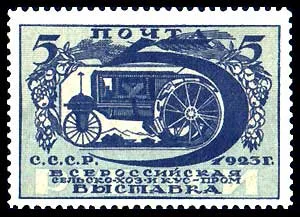
1923 Soviet postage stamp: a Ford Fordson tractor at the Moscow agricultural exhibition — the state officially showcasing American technology. Source: Wikimedia Commons, public domain.
0. Operative definitions (binding)
- “Gray zone”: used only when four conditions hold together — (1) diplomatic non-recognition persists; (2) commercial/technical transactions are de facto possible; (3) the state extends no normal diplomatic protection (“at their own risk”); (4) the state maintains targeted restrictions (war materiel, capital export/bond flotation).
- “Enforcement gap / targeted restriction” (in place of “tolerance”): the US state (a) lacked a comprehensive architecture to police private civilian exports/credit (pre–Johnson Act 1934; the 1922 regime was voluntary consultation), yet (b) applied active restriction in targeted areas. This is NOT equivalent to “active facilitation” or “state intent.” Temporal boundary: the gap is specific to the 1920–1933 window; it closes in 1934 (Johnson Act + Export-Import Bank’s exclusion of the USSR).
- “Diplomatic normalization” (in place of “legitimation”): the 1933 recognition was not a retroactive endorsement of the prior de facto relationship but its placement on a legal-diplomatic footing.
- “Structural tension” (in place of “paradox,” in the analytic body): not a logical contradiction, but the simultaneity of non-recognition and large-scale private-sector industrial transfer.
1. Central question and thesis
[THESIS] The US did not diplomatically recognize the USSR until 1933; nonetheless, in the late 1920s–early 1930s American engineering firms, equipment makers, and commercial intermediaries played a visible and measurable role in building Soviet heavy industry. Question: through which legal/commercial/institutional channel did this transfer flow, and was the 1933 recognition the beginning of this relationship or its diplomatic normalization?
[ANSWER — STRONG INFERENCE] Recognition neither initiated nor enlarged the de facto commercial-technical relationship; it merely placed it on a legal-diplomatic footing. Support:
- Trade peaked before recognition: US-Soviet exports peaked in 1930-31 ($114m and $104m). (Mercer Law Review)
- The post-1933 “hope of a dramatic upsurge” collapsed because the failure of debt/claims talks prevented the Export-Import Bank from extending credit to the USSR; the second Export-Import Bank (July 1934) was expanded “for all countries save the Soviet Union.” (history.state.gov milestone; FRUS 1933-39)
- The Johnson Act (1934) barred private loans to defaulting states; Bullitt used this as negotiating leverage on Litvinov. (FRUS 1933-39 d21)
[FACT — documentary anchor] The State Department’s 7 July 1920 announcement states that those trading with Russia do so “on their own responsibility and at their own risk,” and that the usual protection extended to citizens cannot be expected. (FRUS 1920 v.III d881)
2. Disciplinary spine (non-negotiable)
- [FACT] Non-recognition plus trade is not “covert collaboration”; trading without recognition was ordinary in the 20th century. The US was the last great power to recognize the USSR (Germany 1922, Britain/France 1924).
- [TO CHECK — over-pattern, two-directional] (a) Avoid “hidden hand” language: the striking feature is scale/quality, not conspiracy. (b) The INVERSE excess: do not reduce everything to “commercial rationality” and erase the ideological/geopolitical dimension. Kahn’s 1931 AIA statement and the Moritz Kahn anecdote are not mere observation but in-firm recognition of military convertibility. Hold the tension.
- [FACT] The financier was Soviet gold/grain export revenue (even during famine); a commercial transaction, not an ideological gift. Strong peer-reviewed statement: Link writes that importing Western machinery/technology/personnel in exchange for food and grain “was the heart of the Soviet industrialization strategy… the link that connected the lethal collectivization of Soviet agriculture to the simultaneous massive buildup of heavy industry — forced collectivization extracted the grain necessary to raise the foreign exchange with which to purchase Western machinery.” (Link, “Soviet Fordism in Practice”) → cuts the “America built it” trap; anchors the Holodomor linkage for the UK register.
- [FACT — peer-reviewed (v0.6.1)] The buyer of the grain was mostly not the US: by far the largest buyer of Soviet grain in 1930-33 was the UK (~2 million tonnes in 1932-33). Chain: US (built the capacity) ← hard currency ← grain → UK (the main paying buyer). (Davies-Wheatcroft line / peer-reviewed article discussing Kondrashin 2018, Tandfonline) → This hardens the “multi-actor co-production” spine and makes the simple “America = perpetrator” reading impossible: the actor that built the capacity (US private sector), the one that financed it (Soviet grain export), and the one that paid for it (largely the UK) are distinct.
- [FACT — enforcement gap + targeted restriction] The state was neither passive nor coordinating: (a) no comprehensive architecture to police general civilian export/credit (pre–Johnson Act 1934; 1922 voluntary-consultation regime); (b) targeted restriction existed — war-materiel shipment (FRUS d881) and the foreign-bond objection regime (1922). → Not “tolerance” (intent) but structural enforcement gap + targeted restriction, closing in 1934.
3. Chronology
| Date | Event | Significance | Label |
|---|---|---|---|
| after 7 Nov 1917 | Wilson avoids direct official contact with the Bolshevik government | Non-recognition begins | |
| 7–8 Jul 1920 | State Dept.: trade reopened; “recognition neither granted nor implied”; “at their own risk”; war-materiel restriction maintained | Documentary basis of structural tension + gray zone | FRUS 1920 v.III d881 |
| Feb 1922 | Gold via Sweden/Denmark to US = Soviet food payment (Russian gold) | Financing mechanics, early confirmation | FRASER, Fed. Reserve Bulletin |
| 3 Mar 1922 | State Dept.: foreign-loan regime = voluntary consultation, not mandatory | Anchor of the enforcement gap | FRASER |
| May 1924 | Amtorg incorporated as a New York company (consolidation 27.5.1924) | Soviet state’s US legal shell is born | 65 F.2d 583 |
| 8 May 1929 | Kahn–Amtorg (Bron) STZ design contract | Engineering channel via Amtorg | Melnikova-Raich I |
| 31 May 1929 | Ford–Amtorg–VSNKh GAZ contract; “in the absence of official relations, without full legal protection” | Largest single contract | Melnikova-Raich II; Link |
| 9 Jan 1930 | Kahn second contract | Scale at its peak | Melnikova-Raich I |
| 1930–1931 | US-Soviet exports peak: $114m / $104m | Trade peaks BEFORE recognition | Mercer Law Review |
| Aug 1931 | Stalin/Kaganovich: hard-currency shortage, halt US orders, shift to Europe | Sequencing set by Soviet currency/plan | Stalin-Kaganovich Correspondence (via Link) |
| 29 May 1933 | Amtorg Trading Corp. v. Commissioner: “our government has not recognized… Russia” (in the opinion) | Non-recognition in the legal record | 65 F.2d 583 |
| 16 Nov 1933 | Roosevelt-Litvinov: recognition | Non-recognition ends | FRUS 1933 v.II d585-588 |
| 1934 | Johnson Act + 2nd Export-Import Bank “save the Soviet Union” | Enforcement gap closes; post-recognition trade falls | FRUS 1933-39 d21; milestone |
| 26 Feb 1934 | Amtorg v. United States, 71 F.2d 524 (CCPA): despite the “agent of an unrecognized state” argument, Amtorg has standing as a NY legal person | Dual status confirmed by a second ruling | 71 F.2d 524 |
| 30 Jun 1944 | Stalin → Johnston: “about two-thirds of large industry built with US help” | Late admission; “America built it” trap (balanced) | FRUS 1944 Europe v.IV d883 |
4. Three levels — re-labeled
| Level | Actor | Significance | Label |
|---|---|---|---|
| Washington state | No recognition; no comprehensive enforcement architecture (until 1934); targeted restriction | Political interlocutor delayed; oversight limited, gap periodic | [FACT] |
| Soviet state’s US legal shell: Amtorg | NY company (suable legal person) + Commissariat of Foreign Trade control; “de facto delegation / quasi-embassy” | A legal fiction bypassing non-recognition (institutional decoupling) | |
| American private firms | Kahn, Ford, Austin, GE | Washington policy ≠ private-sector behavior |
[STRONG INFERENCE] This re-labeling strengthens rather than weakens the spine: the party organizing the transfer is clearly Soviet (built the channel, financed it, sequenced it); the “American side” reduces to Washington (not recognizing) + private firms (selling for profit). The “America built it” trap thereby closes further. Two court rulings (65 + 71 F.2d) confirm Amtorg’s dual status: not a mere state agency, but under demonstrable Soviet control.
5. Verified facts (label tiers)
- [FACT — primary] Amtorg = NY company; consolidation 27.5.1924; ~90% of shares in trust for the Bank of Foreign Trade (registered ratio); the Soviet state’s ultimate beneficial interest is judged indeterminate at 11–54% (economic interest), since the Bank’s own ownership is complex (syndicates/cooperatives/private capital); private interests are “substantial.” (65 F.2d 583)
- [FACT — primary/passage] Amtorg standing: despite the amicus argument that an “agent of an unrecognized state” cannot sue, the court treats Amtorg as a NY legal person; records non-recognition by judicial notice. (71 F.2d 524, CCPA)
- [FACT — primary + peer-reviewed] Amtorg dual status: an American corporation subject to US law + controlled by the Commissariat of Foreign Trade; “de facto trade delegation / quasi-embassy” before 1933. (65 F.2d 583 + Melnikova-Raich II)
- [FACT — primary] Enforcement gap: the 1922 State Dept. foreign-loan regime is voluntary consultation; the department cannot compel bankers to consult, does not pass on commercial merit, assumes no responsibility. (FRASER 3.3.1922)
- [FACT — primary] Financing mechanics, early confirmation: in Feb 1922 Soviet gold (via Sweden/Denmark) flows to the US as food payment. (FRASER)
- [FACT — primary] Post-recognition restriction: Johnson Act 1934 bars private loans to the USSR; Bullitt uses it as leverage on Litvinov. (FRUS 1933-39 d21)
- [FACT — peer-reviewed] Recognition did not grow trade: export peak 1930-31; the post-recognition upsurge failed (debt collapse + Ex-Im exclusion). (Mercer Law Review; milestone)
- [FACT — primary] Late admission: Stalin → Johnston (1944), “about two-thirds of large industry with US help/technical assistance.” (FRUS 1944 Europe v.IV d883)
- [FACT — peer-reviewed, independent cross-confirmation] Ford contract (31.5.1929) terms: all licenses/patents/blueprints for Models A/AA (9 years, including improvements); Ford to provide “a complete plant lay-out and working project with machinery specifications” (100,000 vehicles/yr, two 7-hour shifts); 50 Soviet engineers/workers trained at Ford yearly; Vesenkha pays all costs + imports 72,000 knocked-down Model-A’s over four years (factory price +15%); Soviet-made Fords barred from export. (Link, “Soviet Fordism in Practice,” on BFRC Acc.572/17/11.14 — independently overlaps Melnikova-Raich II; full contract text not opened.)
- [FACT — peer-reviewed] Private-firm behavioral difference: GM offered a “large export agreement” but was uninterested in building an indigenous Soviet industry; Ford was more forthcoming → level-3 behavior independent of state policy. (Link)
- [FACT — peer-reviewed (v0.6.1)] Ukrainian industrial siting (basis for UK register): the Kharkov Tractor Plant (KhTZ) was built with American technical assistance as a First-Plan site to produce a copy of an International Harvester tractor, under Vato’s supervision. (Link; American Heritage) Note: Zaporizhstal/DniproHES were not opened in this file; the UK popular text must not use those specific items, or must soften them.
- [FACT — secondary/case-record (v0.6.1, basis for EL register)] Amtorg’s logistics network: between 1932-36 shipments left Leningrad and Odessa for American ports; marine insurance was placed in Moscow with the Soviet State Insurance Department (Gosstrakh). (Amtorg v. United States, 23 F.Supp. 715, S.D.N.Y. 1938, rev’d on other grounds 103 F.2d 339) The personnel network also included “Old Russia émigrés / White emigration” as translators and technicians. (Link)
- [FACT — archive-cited relay] Kahn–STZ (8.5.1929) $130,000 + 4%; Kahn 2nd (9.1.1930) $250,000/yr, 85% dollar/15% bond. (Melnikova-Raich I, RGAE/GARF — underlying archive not opened.)
- [FACT — peer-reviewed, ratio cautious] Payment source largely grain export; the ratio claim (“largely”) needs Soviet currency accounts → [TO CHECK]; the core (Soviet resources financed it) is solid. (Melnikova-Raich I; Link)
6. US-side awareness layer (A5) — limited
[FACT — peer-reviewed] American professional/business circles were aware of the military convertibility of civilian transfer: Knickerbocker (1931) “tank-type”; Kahn (1931 AIA) “planned for war-materiel production if needed”; the Moritz Kahn anecdote; the Austin memo “could easily be converted to the manufacture of implements of war.”
[CORRECTION — axiom] In place of the too-blunt “awareness ≠ intent”: Awareness and non-prevention may show that the state tolerated/could not police private trade; but they do not prove that the US state held positive intent/direction/coordination toward building Soviet military capacity.
6.1 The military threshold of the civilian-technical gray zone: the Christie/Khalepsky case [TO CHECK]
[FACT — archive-cited relay] Amtorg was required (June 1928) to contract with the Red Army Procurement Administration (the army could not contract American firms directly); in 1930 Khalepsky purchased two Christie M-1930 tanks with blueprints via Amtorg. (Melnikova-Raich II fn. 28 → RGVA f.31811/1/7; Mukhin 2001. Mukhin full text NOT OPENED — CyberLeninka captcha.)
[STRONG INFERENCE — boundary] This touches but does not break the falsification gate (§8): Christie was a private inventor whose design the US Army had rejected → private actor ↔ Soviet military organ; not US state coordination. But it strains the “civilian only” framing: the same commercial channel served a military product. Absent a US-state-coordination document, this is not a military-coordination thesis. (Publication formulation §11.2.)
6.2 Industrialization financing ↔ Holodomor: the causal chain and its limit (v0.6.1)
[FACT — multi-source, peer-reviewed] Grain exports during the famine years did not stop, they fell: 1930-31 ≈ 5.83M tonnes → 1931-32 ≈ 4.79M → 1932-33 ≈ 1.61M → 1933-34 ≈ 1.44M. Ellman: the 1932-33 exports (~1.8M tonnes) could have fed ~5 million people for a year; over 1M tonnes still went West in spring 1933 at the peak of starvation. (Nove series/MIT; Ellman; History Hit)
[STRONG INFERENCE — common ground of both schools] Surviving chain: (1) heavy-industry import program → hard-currency need; (2) capital markets closed (non-recognition → Johnson Act) → grain export as the main FX source; (3) grain procurement became an export-driven imperative, leaving insufficient domestic buffer; (4) when the 1932 harvest fell, the state continued exports + did not release strategic reserves to the famine zone; (5) → the lethality of the famine was aggravated by the export-priority policy imposed by industrialization financing.
[CORRECTION — formulation; the prior “no reserves” frame is wrong] Correct formula: not “no measures were taken” → after the famine was recognized the state curtailed some shipments, lowered Ukrainian quotas, extended rationing; but the measures were late/insufficient, exports were cut but not stopped, and existing reserves were prioritized for export + mobilization stock (Manchuria/Japanese threat) + urban rationing rather than the famine zone. This is a sturdier and less attackable charge (“allocation choice”) than “there were no reserves.”
[CONTESTED — keep labeled] The “Ukraine-specific deliberate genocide” layer: Wheatcroft/Getty/Kondrashin = an unintended, USSR-wide consequence of collectivization; Conquest/Applebaum/Snyder = deliberate/ethnically targeted (Jan 1933 border closure, total-food confiscation, blacklisting). The “export-while-starving” fact is used by both schools, with opposite readings. The article’s discipline: the mechanism may be asserted; intent (especially ethnic targeting) must stay [CONTESTED]. Presenting the mechanism as proof of intent shifts the file from evidence-hierarchy to an emotional register — exactly the move the Russian-side critic expects.
7. What is NOT proven / explicit rejection list
That the US state covertly coordinated Soviet tank industry; that no trade existed during non-recognition; that Amtorg was an embassy; that Kahn/Ford documents prove US military intent; that private-sector awareness equals state intent; that Christie shows a US state hand.
8. Falsification / boundary
- Criterion 1: If the US state is shown to have systematically banned Kahn/Amtorg-type transfer → “enforcement gap” weakens. (A single instance does not suffice; targeted restriction is already part of the thesis.)
- Criterion 2 (expanded): Any one of these shifts the file to a military file: (a) a US agency knowingly approving transfer for Soviet military production; (b) a US military/diplomatic body directing private firms toward Soviet military capacity; (c) an American firm reporting a Soviet military instruction to US authorities and obtaining approval; (d) the export regime knowingly exempting transfers despite their military value.
- Criterion 3: If scale/quality/Amtorg’s status cannot be distinguished from ordinary trade → the thesis falls to “normal trade under non-recognition.”
9. Source dossier (with status)
- FRUS 1920 v.III d881; FRUS 1933 v.II d585-588; FRUS 1933-39 d21; FRUS 1944 Europe v.IV d883.
- Amtorg v. Commissioner, 65 F.2d 583 (2d Cir. 1933); Amtorg v. United States, 71 F.2d 524 (CCPA 1934).
- State Dept. “Flotation of Foreign Loans,” 3.3.1922 (Fed. Reserve Bulletin Apr. 1922), FRASER.
- Melnikova-Raich I & II, IA 2010/2011, gwern.net.
- Stefan Link, “Soviet Fordism in Practice” (Forging Global Fordism); Ford contract BFRC Acc.572/17/11.14.
- Mercer Law Review, “U.S.-Soviet Trade”; history.state.gov Export-Import Bank milestone. [peer-reviewed/official.]
- Mukhin, Otechestvennaia istoriia 2001/3; RGVA f.31811/1/7. [CITATION EXISTS — no access.]
10. Rival frame: the Soviet-centric reading
[ALTERNATIVE FRAME — included] The same facts invert the subject: the USSR deliberately and systematically harnessed the private sector of a state that did not recognize it into the supply chain of its own plan (built the channel — Amtorg; financed it — grain/gold; managed the bargaining — Bron; dictated sequencing — Stalin/Kaganovich). Here the “gray zone” is not America’s internal contradiction but the Soviets’ strategic opportunity space.
[STRONG INFERENCE] This reading does not collapse the thesis; it strengthens the spine (“not the US state but the private sector”) and adds armor against the “America built it” trap. The correct position is the third: a multi-actor co-production — Soviets the active organizer, American private sector the willing supplier, different intents and gains converging on one outcome. The Soviet historiography’s erasure of the Stalin-Johnston admission marks this asymmetry.
11. Publication defense line (Sun Tzu synthesis)
11.1 Two fronts and the keep
- Revisionist/Suvorov school (“the West built the Soviet war machine”): meet with the keep — 1920s America lacked the legal architecture to ban private exports (Johnson Act came in 1934). This is not a “hidden hand” but an enforcement gap (now primary-anchored + temporally bounded). Say “lacked enforcement capacity” (structure), not “looked the other way” (intent).
- The trivializer (“normal trade, no paradox”): the originality is not the trade’s existence but the transformation of an unrecognized regime, via a New York company it itself founded, into an actor suable under US domestic law (legal fiction / institutional decoupling) — proven by two court rulings.
11.2 Christie passage — publication sentence (shield, not bait)
“Amtorg’s 1930 purchase of Christie tanks shows not that the US state armed the Soviets militarily, but that Washington at the time lacked the legal-institutional mechanism to prevent private actors from exporting a military product (including designs its own army had rejected) — an enforcement-gap exception, not interstate military coordination or a Lend-Lease precursor, but a commercial transaction independent of US state policy.”
(The sentence’s subject is “enforcement gap,” not “tank” — resisting decontextualized quotation.)
11.3 Multilingual register matrix (core thesis fixed, examples and emphasis localized)
| Lang | Risk | Register tuning |
|---|---|---|
| RU | ”America built/destroyed it” nationalism | Foreground Soviet agency + gold/grain financing; “capacity building” not “technology transfer”; cold-pragmatic |
| UK | Holodomor + “Western-financed Soviet imperialism” | Foreground Moscow/VSNKh centralism over the periphery; the price of grain; structural-critical |
| EN | ”gray zone” reads as journalism; anachronism | ”institutional decoupling / legal fiction”; 65+71 F.2d status; enforcement-gap time window (anachronism armor); dry-institutional |
| TR | Cold War flat reading | Strip Cold War terminology; situate in 1920s “statism vs. free market”; Kahn/Ford as “heavy-industry giants seeking capacity” |
| EL | Black Sea/Pontus network reading | Mark Amtorg also as a Leningrad/Odessa logistics-human network; commercial-network tone |
SOURCE NOTE
Melnikova-Raich (2010/2011) provides first-rate primary documentation; however, its interpretive frame leans on Sutton’s thesis of an externally “jump-started Soviet war machine.” This dossier draws on the source’s factual record without adopting that frame. Stefan Link’s reading of global Fordism / illiberal modernism is more compatible with the civil-industrial-diffusion line argued here.