


02 · Dossiers
- Code
- OWS-2026-003
- Status
- Locked
- Version
- 2.0
- Evidence level
- Mixed source
- Risk level
- Medium
- Last updated
- 23 June 2026
- Red-Team status
- Bağımsız birincil-kaynak denetimi tamamlandı; 3 iddia düzeltildi (forensik v5.3 senkron)
Two Princes, One Overlord — What Was the Difference Between Nevsky and Danylo?
Two Rurikid princes, Nevsky and Danylo: an East–West choice — or geography and power? What 13th-century sources establish, and what modern discourse adds.
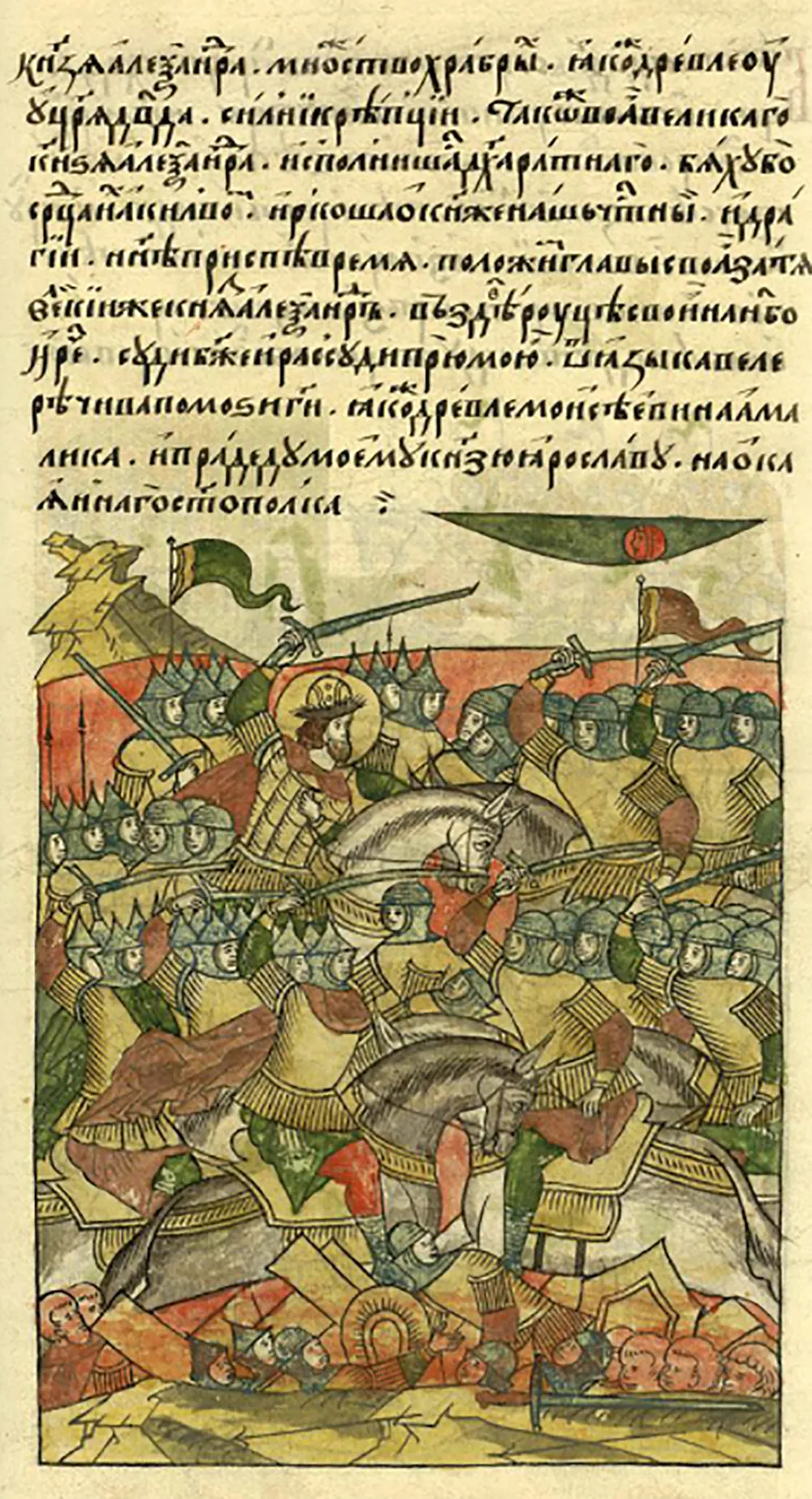
The Battle on the Ice (1242), miniature from the Illuminated Chronicle, c. 1565 — a late depiction made three centuries after the event. Source: Wikimedia Commons, public domain.
INTRODUCTION AND METHOD
This study compares two thirteenth-century Rurikid princes — Alexander Yaroslavich Nevsky and Danylo Romanovych — not through the “collaborator ↔ resister” or “East ↔ West” opposition offered by modern discourse, but on the ground that the contemporaneous sources actually establish. The thesis rests on four load-bearing axes, and the order of reading is deliberately built from the strongest: first what actually happened, then where the myth diverged, then how modern discourse instrumentalized it, and last the ground of kinship.
The method follows a few principles. Claim and evidence are kept apart; the evidential weight of a claim — whether it is an established fact, a strong inference, a weak possibility, or a reading the source never constructs — is stated explicitly within the text. The silence of a source is not taken as definitive absence: the absence of a statement in a source is not proof that the thing did not happen, but only the finding that the source does not establish it. The following inferential leaps are rejected from the outset: from benefit to intent, from kinship to alliance, from simultaneity to coordinated plan, from contact with the West to a choice of civilization, from a single late source to fact, from succession to causation. Wherever possible, core claims have been traced to a primary document, a facsimile, or a reliable critical edition; a verification loop made up only of secondary transmission is not treated as sufficient.
One lens must be admitted at the outset. This study reads the thirteenth century through a modern analytical lens — geography, capacity, leverage, tactics. That lens differs from the era’s own theological and dynastic categories (divine punishment, dynastic honor, Orthodox legitimacy, personal loyalty), and it is not “truer” than theirs. The claim is not to possess a better lens; it is that looking through a different lens makes visible the civilizational patterns that modern discourse naturalizes. The actors’ mindset was largely otherworldly; the lens of the analysis is materialist — the reader should keep that distinction in mind.
Two methodological traps were guarded against in particular. The first is circularity: in a genealogical dispute, picking the school that supports the thesis and treating it as “evidence.” In the matter of Nevsky’s mother’s identity, the school that supports the close-kinship thesis was not chosen; instead, a requirement of demonstrability at the contemporaneous-primary level was imposed, and this selected not the conclusion convenient to the thesis but the one that does not break the backbone (§4). The second is that the comparison pair itself was chosen by modern discourse: the pair of “two princes who adapted” is a selection that renders invisible those who did not adapt — such as Mikhail of Chernigov, who resisted and was executed in the Horde; this should be kept in mind as a survivorship bias.
Core claims were put through an independent primary-source check, in which three claims were corrected; the corrections are worked into the text, and the points that remain open are named, one by one, at the end.
§1 — HORDE PRAGMATISM
”What actually happened” — what the contemporaneous sources establish, and what they do not
When we read the two princes’ conduct toward the Horde through the contemporaneous sources, the picture that emerges does not sit on the modern opposition. They are two Rurikid princes who both de facto accepted subjection to the Horde and both sought leverage within that subjection. The difference is real; but in the contemporaneous sources it appears not as a choice of civilization but as a difference of geography, capacity, access to leverage, and timing — and this is a strong inference supported by the available evidence.
We use the term “subjection to the Horde” throughout with the qualification it carries: this was not a legally stable, institutional overlordship but a relationship of variable intensity, resting on personal and military power; it manifested for Nevsky as administrative-fiscal integration (census, tax, levy), and for Danylo as intermittent campaign and devastation, at different intensities.
There is contemporaneous and direct evidence of the shared ground of subjection — and of the asymmetric tactical response laid over it. Nevsky personally brought the 1259 Novgorod census, protected the census-takers, and punished those who resisted; the Novgorod First Chronicle records this directly.1 Danylo went to the Horde in 1245/46 and performed the kumys ritual and the formulas of obedience; the Galician-Volhynian Chronicle relates this journey, and Carpini, as an independent Western witness, confirms his direct contact with Danylo and Vasylko shortly afterward.23 The chronicler’s outcry that “Tatar honor is worse than evil” is an expression not of the event but of the chronicler’s value judgment: submission is a fact, the tirade an interpretation.
Subjection was not a static block but a pulse that fluctuated with the weight of the power facing it. Danylo was able to resist Kuremsa, a weak local temnik, while submitting “without a fight” to Burundai, who represented the systemic power of Berke.4 The difference between where he could resist and where he surrendered is not proximity to Rome but the weight of the Horde power facing him. On Nevsky’s side, the sequence of journeys and campaigns is not certain in the contemporaneous sources; according to a view reported by Fennell, Alexander was not even in a position to set the Nevryuy campaign in motion — the sources conflict here.5
The crux is this: both modern counter-labels fail to be constructed in the contemporaneous sources; each comes from a late or secondary interpretation.
| NEVSKY (“collaborator”) | DANYLO (“Western resister”) | |
|---|---|---|
| What the contemporaneous source says | The Laurentian only says “стареишиньство” (seniority/precedence) and accession to the throne; there is no causal “reward” frame6 | The Galician-Volhynian Chronicle has no “exit from the Horde” phrasing; subjection continued and deepened after the coronation7 |
| The claim’s actual source | ”He denounced his brother” appears only in Tatishchev (18th c.); Karamzin called it “fabrication”8 | The “exit” reading comes from the popular layer and papal rhetoric; the campaign was never carried out9 |
The contemporaneous chronicle lines up events in sequence but does not construct causal intent. The denunciation narrative about Nevsky cannot be established in the early sources; the conclusion that Danylo did not break with the Horde rests not only on the silence of the source but on the fact that subjection actually continued after the coronation — two distinct kinds of evidence, one shared conclusion: the contemporaneous source does not construct the opposition.
The real axis of the difference is geography. Danylo’s western border gave him access to papal, Hungarian, and Polish leverage; Nevsky’s northeastern position did not, and in the Baltic the West was a threat. That Danylo conducted his subjection to the Horde and his papal diplomacy in the same period (1246–48) is factually established;310 but defining this as a deliberate “lateral diplomatic balancing” strategy is a layer inferred from the fact yet not declared by the sources — and therefore it remains at the level of a strong inference and is not raised to established fact. This distinction is the backbone of the text.
Counter-theses tested. “Nevsky triggered the campaign by denouncing his brother” could not be established: it rests only on the late Tatishchev narrative and is absent from contemporaneous and early sources (the 1259 administrative integration is a separate and established fact). “Danylo was a resister who broke with the Horde” collapsed: his surrender to Burundai and the razing of his walls show the opposite. “Both submitted equally and fully” was qualified: subjection was periodic, access to leverage asymmetric. “Nevsky triggered the Nevryuy campaign with intent” likewise could not be established, because the contemporaneous chronicle does not construct intent. The only thing left standing is a resemblance in periodic-pragmatic maneuver — but not a complete one.
§2 — LATE MYTHS
The event is contemporaneous and real; the dramatic layer is late — by a different mechanism in each figure
By the zero line that §1 established, the strongest dramatic narrative around each figure is not constructed in the contemporaneous primary sources; these are a late layer.
The Nevsky myth — real event, late scale and drama. The Battle on the Ice did happen and had consequences: the eastward expansion of Livonia was halted, and Novgorod’s access to the Baltic was preserved.5 The distortion lies in the scale and the drama.
| Myth element | Contemporaneous primary | Late layer |
|---|---|---|
| Mass drowning under the ice | Livonian Rhymed Chronicle: the knights fell on the grass; Novgorod Chronicle: “they fell,” no drowning1112 | 15th–16th c. allusion → crystallized by Eisenstein 193813 |
| Scale | Rhymed Chronicle 20 brothers dead / 6 captured (the order only); Novgorod 400 Germans; no absolute total1112 | ”Tens of thousands” — unsupported |
| Birger Jarl in command | Birger was not jarl in 1240 (jarl ~1248); the jarl of the time was Ulf Fase14 | 15th c. retrojection |
| The epithet “Nevsky” | Absent in the contemporaneous sources; he did not bear it in his lifetime15 | First ~15th c.; 1547 canonization |
When we accessed the early-redaction Жития text directly, the thesis that the myth crystallized late was strengthened: in the early text there is no breaking of the ice, no submersion, and no подломи- root; what there is is the breaking of spears (not of the ice), a simile of the frozen lake “stirring,” and the image of ice covered with blood and thereby rendered invisible.16 So the early seed of the ice-breaking motif is even thinner than supposed — a literary image of motion, not of fracture. The claim that “Eisenstein invented it from nothing” is again rejected (there is a literary ground); the correct statement is: the mass-drowning scene was crystallized in the 1938 film.
The Danylo myth — real event, late meaning and interpretation. The fact of the coronation is solid; the crown’s connection to Rome is clear; that the rite was conducted by the legate Opizo de Mezzano, however, is an indirect inference via the Galician-Volhynian Chronicle.17 The distortion lies in the meaning assigned to it.
| Myth element | Contemporaneous primary | Late / partisan layer |
|---|---|---|
| Crown = “exit from the Horde” | The chronicle constructs no exit language; the crown is not an exit; subjection deepened7 | Popular “choice of civilization” |
| Crown = “Catholic conversion" | "от всѣхъ епископъ СВОИХЪ” — his own Orthodox structure was preserved18 | Długosz (15th c., contradictory)19 |
| Effective crusader aid | A summons bull existed on 14.05.1253; no campaign followed; Béla IV sent nothing in 1254920 | ”The West supported him” frame |
| ”primo rege Ruthenorum” | A Teutonic charter (Burchard 1254); not papal21 | Mistakenly assumed to be papal in origin |
The reading “Roman diplomacy = Catholicization or a choice of civilization” lacks any primary basis and is not supported by the sources. The chronicle constructs no direct link between Burundai’s pressure and the move toward Rome; that the pressure was the direct punishment for the Roman move is a weak possibility — the union had already collapsed by 1257, and the real triggers were Lithuanian raids and the Mongol pattern of punishment. For the causal claim “he turned to Rome, the Horde punished him” there is a sequence of events, but causation cannot be established.
The distortion mechanism of the two myths differs. Each enlarges a real core with a late layer; but one distorts quantity (scale, drama), the other meaning (civilization, religion). This distinction of mechanism is itself an analytical lens, not a distinction the sources construct. The asymmetry is preserved here too: the text does not equate the two myths as “both late, therefore symmetric.”
Counter-theses tested. “Mass drowning under the ice is contemporaneous” collapsed: neither the Rhymed Chronicle nor the Novgorod Chronicle constructs breaking or drowning. “Birger Jarl commanded at the Neva” collapsed: an anachronism (jarl ~1248; the jarl of the time was Ulf Fase). “Danylo’s crown was a Catholic conversion” was not supported: his own bishops conducted the rite and the Orthodox structure was preserved. “Effective crusader aid arrived” collapsed: no campaign came. “Eisenstein invented the drowning from nothing” was qualified: there is a simile of motion in the early text, but no fracture. The opposite-direction claim that “the event was trivial or never happened” is also rejected: the event is real and had consequences; the deviation lies in scale and meaning.
§3 — MODERN DISCOURSE
How the two figures were elevated into opposed symbols — parallel but asymmetric instrumentalization
A change in the field of evidence must be admitted at the outset. The previous two sections rested on thirteenth-century primary sources; the base of this section is contemporary education-policy products (textbooks, state commemorative calendars, popular discourse). This is a kind of evidence different in nature; the rigor available in the chronicles and the base of the discourse analysis here are not of the same hardness. This difference is admitted without concealment. The strength of the section is that it measures, against the zero line of §1 and §2, where modern discourse diverged.
Modern discourse is not coded as a single monolith: “Russia’s official historical discourse” and “Ukraine’s nation-building historical schools” are treated separately, with their internal variety. The scope limit matters: all the rulings of this section pertain only to the layer actually examined — sampled official discourse, approved or mandatory textbooks, and the popular sources enumerated; no generalization is claimed at the level of “the Russian/Ukrainian education systems” or “Russian/Ukrainian society.” Every sentence should be read with this limit.
Russia’s official historical discourse. In the state vein, Nevsky is constructed as a defender of Orthodoxy and of civilization against the West; this is a structural, not marginal, frame (in the content architecture of the Medinsky textbook, eastern pressure and western assault are in separate chapters, while the preface stresses a самобытность — a distinctiveness — between East and West).22 The relationship with the Horde is affirmed within a frame of “shrewd survival”; the 1259 census is visible but presented with a positive value charge — which is in tension with the value-neutral contemporaneous fact of §1. The internal variety is real: there is tension between Eurasianist and Westernizing veins, the most polarizing frame is in the state vein, and the academic vein is more measured. A critical nuance: Russia’s discourse does not push Danylo to the opposite pole; under the name “Daniil Galitskiy” it claims him as a failed but Russian prince («два русских князя»).23
Ukraine’s nation-building historical schools. In these schools Danylo is constructed as “the only king in history” and as an early emblem of integration into Europe; the origin of this frame is not new — it is documented in the nineteenth-century intellectual discourse of Galicia.24 The “exit from the Horde” reading of the crown is strong in the popular layer and soft in the measured textbook. These schools too are not homogeneous: a balanced textbook openly gives the submission, the razing of the walls by Burundai, and the failure of Western aid;25 so the claim that “Ukrainian schools suppress the negative core” is not supported by this material. The sharpest polarization is in the popular and state-media layer, in the post-2022 hardening of the “Galitskiy → Romanovych” correction.26
The frame is parallel, but the production mechanism is asymmetric:
| Axis | Russia’s official discourse | Ukraine’s nation-building schools |
|---|---|---|
| Its own figure | Nevsky = defender of Orthodoxy/civilization | Danylo = the first king turning toward Europe |
| The counter-figure | Draws Danylo into itself (a Russian prince) | Pushes Nevsky to the opposite pole |
| Production apparatus | A single mandatory state textbook (приказ № 556; ФЗ № 371-ФЗ) — documented by official decree27 | An approved-multiple system (several approved books for the history of Ukraine; the approving body İМЗО; наказ № 124) — documented by list28 |
A unit warning is essential here, because the comparison easily becomes misleading. The number of books approved in Ukraine by one decree (for example ~127 books for the 7th grade) covers all subjects — algebra, language, biology, geography — not only history; so “one mandatory book ↔ 127 books” compares apples to oranges. Compared in the same unit, the picture is this: for the History of Ukraine course there are several approved books (Пометун/Освіта; Щупак/Оріон, etc.), as against a single mandatory book for Russia’s History of Russia course at the same level. The difference lies not in the multiplicity of book count but in the centralization of the apparatus.
The parallelism of the frame is real but rests largely on one leg: each side’s official/mandatory textbook elevates its own figure — this is solid. The second leg — that each side turns an Andrey–Danylo anti-Horde alliance into established fact — could not be documented with a double textbook citation for either side (the Russian side is in a popular-portal and “commentary” frame, the Ukrainian side is textbook-adjacent but without a citation); so this point remains at the level of an inference and is itself asymmetric.29 The parallelism is not a full symmetry.
The production asymmetry is a mechanism, not a moral verdict. The structure of the production apparatus is documented at the level of official decrees: on one side a single mandatory state textbook, on the other an approved-multiple system. But the inference that this structural asymmetry produces the asymmetry in myth-production does not follow directly from the decrees — the decrees prove the structure of the system, not how that structure shapes the mythmaking; this link remains an inference. What is at stake is a structural-institutional difference, not a moral verdict that one side is more cynical or manipulative. Both sides instrumentalize selective memory; what differs is the centralization of the apparatus. This is a diagnosis, not an accusation.
This structure must be named once, and in rejection: to call it a “mirror” is misleading. The two figures are not mirrors of each other; they are different objects lit by the same modern projector. The analytical weight lies not in the “mirror” but in the parallel-but-asymmetric retrospective instrumentalization.
Counter-theses tested. “Modern discourse fabricated the core from nothing” was not supported: “fabrication” falls away, and what remains is “the instrumentalization of selective memory.” “Ukrainian schools suppress the submission” collapsed: the balanced textbook gives the submission and Burundai. “The Russian textbook dropped the drowning motif, so there is a symmetric self-correction” was not supported: the motif is absent on the primary page, but so is any myth-marking, whereas older books did carry the motif.30 That these counter-theses did not fire equally is direct evidence that the structure is not a fully symmetric parallelism. The text does not say “both sides do the same thing.”
§4 — KINSHIP AND OPPOSITION
Were the two figures kin — and does the modern polarization suppress a kinship?
This axis is the most conditional leg of the study, and it declares three things at the outset: the backbone of the study does not depend on it (the thesis stands on §1, §2, and §3); the core claim here is conditional; and the conclusion reached is a deliberate choice of the branch that does not break the backbone.
That the two figures descend from a common Vladimir Monomakh line is certain; what is disputed is whether a closer tie — through Mstislav Mstislavich “Udatny” — can be established. Danylo’s wife Anna is Udatny’s daughter; this filiation is beyond doubt in the chronicle.31 The tie was not static but fluctuating: in 1221 Udatny abandoned his son-in-law Danylo and chose a Hungarian prince as heir, and in 1225/26 they were reconciled with great gifts.32 There is kinship, but no automatic alliance follows from it.
The bridge hangs on a single question: who was Nevsky’s mother? The contemporaneous source does not name her directly; modern genealogy splits into three schools — Kuchkin (Rostislava-Feodosia, Udatny’s daughter), Baumgarten (the daughter of Igor Glebovich of Ryazan; rejected today), and Dąbrowski (the daughter of Mstislav Romanovich of Kiev).333435
At this point two possibilities diverge, and the branch the study carries is chosen openly. The early Жития tradition (late 13th c.) names the mother only by her baptismal name — «от матере Феодосии» — and does not give her origin; Kuchkin himself acknowledges that this source is silent.36
The first possibility — close kinship — cannot be established at the primary level, but it is not impossible either. Had it been established, Nevsky would have been Anna’s nephew and the cousin of Lev Danylovych. But the tie Kuchkin constructs is inferential, not a primary link. A late compilation — Летописец Переяславля Суздальского — names the mother «Ростислава, дочь Мстислава Мстиславича»;37 had it been accepted, the bridge would stand, but it is a late compilation, and a single late source is not treated here as established fact. This possibility remains “historically possible,” but it is not the branch the study rests on.
The second possibility — the common Monomakh line — is solid on factual ground, and it is the branch the study carries. The statement “the early source names the mother only by her baptismal name and does not give her origin” is not an evidential weakness but a fact. The demonstrable kinship of the two figures descends to the common Monomakh line — real, but politically weak in meaning. Therefore the claim “two close kin were made into opposites” remains weak on this leg; whereas the finding of “polarization” continues to stand in §3 and §2.
Counter-theses tested. “The mother was certainly Udatny’s daughter, the bridge is solid” could not be established (at the primary level): the contemporaneous source is silent, and all that is in hand is a late compilation and an inference. “Not naming her is an evidential weakness” was rejected: not naming is a fact, and it selects the second possibility. The opposite-direction claim “the two figures are not kin at all” is also rejected: the common Monomakh line is certain. “The Udatny tie was a static, strong alliance” was qualified: the tie fluctuated (abandonment in 1221, reconciliation in 1225–26).
OPEN LIMITS
The study declares its own limits rather than concealing them. The limits explicitly marked are:
-
The printed page-coordinate of the early Жития is missing. The negative core of the ice passage (no breaking, no drowning) was verified against the primary text; only the column/page coordinate in the printed volume was not found in the electronic metadata, and so it remains open — the text in hand, the coordinate missing.16
-
A double citation for the Andrey–Danylo alliance could not be secured. That this alliance is turned into established fact by both sides could not be documented with an actual textbook citation for both; the parallelism of the frame rests largely on one leg (the elevation of one’s own figure).29
-
Close kinship for Nevsky’s mother could not be established at the primary level. The facsimile of the late compilation could not be opened, and its page number was taken from a secondary citation; and because the contemporaneous-primary source does not name the mother, close kinship could not be established.3736
-
The causal link of the production asymmetry is at the level of inference. The difference of institutional apparatus is documented by official decrees; but the link that this structure produces the asymmetry in myth-production remains an inference — the decrees prove the system, not the mythmaking. Moreover, a full comparative education-policy survey covering all years and all grades was not carried out.
-
There is no quantitative basis for the close-kinship probability. A rough estimate of the historical likelihood of this possibility is in circulation, but this figure has no quantitative basis and remains speculative. The branch the study carries is nevertheless the demonstrable common-Monomakh branch.
-
Remaining bibliographic coordinate gaps (not material to the substance). The document number and Vatican regesta folio of the 1253 bull, Wyngaert’s 1929 Latin critical edition for Carpini (could not be accessed; but not critical, since two other Latin editions exist), and the specific coronation year argued by Pashuto are open at the coordinate level. These do not carry the argument.
CONCLUSION
The two princes are two Rurikids maneuvering pragmatically within a subjection to the Horde of variable intensity; with the present source base, the best explanation is to read the difference between them along the axis of geography, capacity, access to leverage, and timing — this is what is safer than reading it as a choice of civilization, not a definitive verdict that “the difference is this.” The contemporaneous sources do not construct this difference in the form of an East–West civilizational duality. Danylo’s Western dimension (the crown, papal diplomacy) is real, but it did not remove the Horde’s overlordship and is not constructed in the contemporaneous sources as a clean European choice; Nevsky’s integration with the Horde order, by contrast, is documented at the contemporaneous level by the 1259 census.
Modern Russia’s official discourse and Ukraine’s nation-building schools selectively magnify these real but limited cores and elevate them into opposed symbols; this is not a fully symmetric fabrication but a retrospective instrumentalization whose mechanism and balance are asymmetric. The independent check strengthened this asymmetry at three separate points and tied the kinship axis — without breaking the backbone — to the demonstrable, weak-but-real branch of the common Monomakh line.
FOOTNOTES
BIBLIOGRAPHY
A. Primary sources
Chronicles / annals
- Novgorod First Chronicle (Новгородская первая летопись), ed. А.Н. Насонов, М.–Л. 1950.
- Laurentian Chronicle (Лаврентьевская летопись), ПСРЛ т. 1.
- Galician-Volhynian Chronicle / Hypatian recension (Ипатьевская летопись), ПСРЛ т. 2, СПб 1908; Eng. trans. G. Perfecky, 1973.
- Летописец Переяславля Суздальского, ПСРЛ т. 41, М. 1995 (late compilation; facsimile not opened).
Hagiography
- Alexander Nevsky Жития, early redaction; БЛДР т. 5 (XIII век), СПб.: Наука, 1997 (ed. В.И. Охотникова); critical edition Ю.К. Бегунов, М.–Л.: Наука, 1965, с. 187–194.
- В.П. Мансикка, Житие Александра Невского: Разбор редакций и текст, СПб. 1913.
Diplomatic documents
- The Burchard von Hornhausen charter, 1254; Codex diplomaticus Poloniae t. III (ed. Rzyszczewski–Muczkowski), Warszawa 1858, nr 30, s. 63–64; original Czartoryski / MNK Kraków sygn. 27 Perg. Latin phrase from the facsimile: «excellenti viro Danieli Primo Regi Ruthenorum»; the 13th c. dorsal hand-note carries the same formula.
- Papal crusade summons bull, 14.05.1253; A.G. Welykyj, Documenta Pontificum Romanorum…, t. I, Roma 1953; the 1246–48 regesta: Archivio Apostolico Vaticano, Registra Vaticana vol. 21, Fol. 459v Nr. 172–174; cf. Berger, Les registres d’Innocent IV.
- Carpini, Historia Mongalorum, 1247; four primary editions: Dawson 1966 p. 70, Rockhill 1900 p. 32 (Eng.), Beazley 1903 p. 106, d’Avezac 1839 p. 769 (Lat.). The Daniil-Vasylko feast passage verified.
Contemporary education policy and textbooks (modern primary)
- В.Р. Мединский, А.В. Торкунов, История России, IX — начало XVI в., 6-й класс, ISBN 978-5-09-123947-8, Просвещение 2025.
- RF: Минпросвещения приказ № 556 (21.07.2023); ФЗ № 371-ФЗ (24.09.2022).
- Ukraine: МОН наказ № 124 (05.02.2024), № 356 (19.03.2024); İМЗО approved-book list.
B. Secondary / academic literature
- J. Fennell, The Crisis of Medieval Russia 1200–1304, London 1983.
- John H. Lind, “Early Russian-Swedish Rivalry: The Battle on the Neva in 1240…”, Scandinavian Journal of History 16:4 (1991), 269–295.
- A.V. Maiorov: “The Coronation of Daniel Galitsky…”, Studia Slavica et Balcanica Petropolitana 2011/1, 143–156; “Ecumenical Processes… Union between Russia and Rome”, Zeitschrift für Kirchengeschichte 126/1 (2015), 11–34; “The Alliance between Byzantium and Rus’… 1204”, Russian History 42/3 (2015), 272–303.
- В.А. Кучкин, “Александр Невский — государственный деятель и полководец…”, Отечественная история 1996/5, 18–33.
- N. de Baumgarten, Généalogies… (1908); D. Dąbrowski, Genealogia Mścisławowiczów, Kraków: Avalon, 2008 and Rodowód Romanowiczów książąt halicko-wołyńskich, Poznań–Wrocław 2002.
- М.С. Грушевський, Історія України-Руси, Т. 3, Львів 1905 (crown = 1253); М.Ф. Котляр, Данило Галицький, Київ: Наукова думка, 1979 (crown = 1253); В.Т. Пашуто, Очерки по истории Галицко-Волынской Руси, М.: АН СССР, 1950.
- N.M. Karamzin; V.N. Tatishchev — the historiographic trace of the “denunciation” narrative.
- Discourse and textbook analysis: Н.М. Сорочинська–О.О. Гісем, Історія України (grade 7), Тернопіль: Богдан, 2020; Н. Христан, “Князь та король Данило Романович…”, Науковий вісник… № 57 (2023), 92–98, DOI 10.31861/hj2023.57.92-98; Medinsky (as object of analysis).
Footnotes
-
Novgorod First Chronicle (Новгородская первая летопись), record of the 1259 census («даи нам сторожи»). Ed. А.Н. Насонов, М.–Л. 1950. ↩
-
Galician-Volhynian Chronicle (Hypatian recension), ПСРЛ т. 2, СПб 1908, стб. 732; Eng. trans. Perfecky 1973. ↩
-
Giovanni da Pian del Carpine (Carpini), Historia Mongalorum, 1247 (the Daniil-Vasylko meeting). Editions: Dawson 1966 p. 70, Rockhill 1900 p. 32 (Eng.), Beazley 1903 p. 106, d’Avezac 1839 p. 769 (Lat.). Carpini reports that Daniel and his brother Vasylko kept him, against his will, for eight days and met with him directly — an independent Western witness. (Carpini’s English is not the primary-language text but a translation; Rockhill’s rendering, «received us with great rejoicing…», uses different words, so it is treated here as a paraphrase, not a verbatim seal.) ↩ ↩2
-
Galician-Volhynian Chronicle, the Burundai campaign compared with Kuremsa; ПСРЛ т. 2. Against Kuremsa «тщетно», against Burundai «без борьбы вынудил». ↩
-
J. Fennell, The Crisis of Medieval Russia 1200–1304, London 1983. ↩ ↩2
-
Laurentian Chronicle (Лаврентьевская летопись), ПСРЛ т. 1; “стареишиньство” and accession to the throne, no causal “reward” frame. (1377 copy.) ↩
-
Galician-Volhynian Chronicle, the continuation of subjection after the coronation and the razing of the walls; ПСРЛ т. 2, стб. 827 ff. ↩ ↩2
-
V.N. Tatishchev, 18th c.; the sole source of the “denounced his brother” narrative. N.M. Karamzin marks it as “fabrication.” (Late historiography.) ↩
-
Papal crusade summons bull, 14.05.1253; no campaign took place. A.G. Welykyj, Documenta Pontificum Romanorum historiam Ucrainae illustrantia, t. I (1075–1700), Roma 1953 (document number not verified). ↩ ↩2
-
Papal regesta, the diplomacy of 1246–48; Archivio Apostolico Vaticano, Registra Vaticana vol. 21; the 1247 Daniil letters Fol. 459v Nr. 172–174; cf. Berger, Les registres d’Innocent IV (BEFAR). ↩
-
Livonian Rhymed Chronicle (Livländische Reimchronik), the knights falling “on the grass” (
ûf daʒ gras); 20 brothers dead / 6 captured. Ed. L. Meyer, Paderborn 1876. ↩ ↩2 -
Novgorod First Chronicle, record of the 1242 Battle on the Ice (Chudskoye/Peipus); «400 Germans», no under-ice drowning motif. Ed. А.Н. Насонов, М.–Л. 1950. ↩ ↩2
-
S. Eisenstein, Александр Невский (film), 1938; the iconic crystallization of the mass drowning under the ice; fed by the scattered allusions of the 15th–16th c. (Its origin is at the level of a strong hypothesis.) ↩
-
The Birger Jarl anachronism: Birger was not jarl in 1240 (jarl ~1248); the jarl of the time was Ulf Fase. Cf. Shaskolsky and standard prosopography. ↩
-
The late emergence of the epithet “Nevsky” (~15th c.; 1547 canonization). ↩
-
Alexander Nevsky Жития, early/Первоначальная redaction; БЛДР т. 5 (XIII век), СПб.: Наука, 1997 (ed. В.И. Охотникова); critical edition Ю.К. Бегунов, М.–Л.: Наука, 1965, с. 187–194. Primary text read (БЛДР т. 5, electronic): «…и трусъ от копий ломления… яко же и езеру померзъшю двигнутися, и не бѣ видѣти леду, покры бо ся кровию». That is, there is no подломися/потопе/под лед (drowning or ice-collapse); there is the breaking of spears, ice covered with blood, and the simile that “the frozen lake stirred.” The absence of the drowning motif is established by the primary text. For the literary template: В.П. Мансикка, СПб. 1913. (Only the column/page coordinate in the printed volume is missing.) ↩ ↩2
-
The coronation rite from Rome, by the hand of the legate Opizo de Mezzano; an indirect inference via the Galician-Volhynian Chronicle. ↩
-
Galician-Volhynian Chronicle, «от всѣхъ епископъ СВОИХЪ» — Danylo’s own (Orthodox) bishops; ПСРЛ т. 2. ↩
-
Jan Długosz, 15th c.; the late source of the “Latin oath / Catholic conversion” narrative, giving two contradictory versions. ↩
-
Béla IV, 1254: the promised aid did not come (“nothing was given but words”). ↩
-
The Burchard von Hornhausen charter, Raciąż, 24 IX 1254; issued by the Teutonic Vice-Master Burchard, with the seal of Andrew, bishop of Płock; the recipients Daniel and Siemowit. The Latin phrase was read from the primary-edition facsimile: «excellenti viro Danieli Primo Regi Ruthenorum» — Codex diplomaticus Poloniae t. III (ed. Rzyszczewski–Muczkowski–Bartoszewicz), Warszawa 1858, nr 30, s. 63–64. The title appears both in the main text of the document and in the contemporaneous dorsal archival note: «danieli pmo regi Rutenor[um]» (two layers of the same document, not a separate witness). Original: Czartoryski / MNK Kraków sygn. 27 Perg. Modern scholarly confirmation: A.V. Maiorov, Daniel Romanovich, Rex Coronatus of Rus (2018) gives the same phrase. ↩
-
В.Р. Мединский, А.В. Торкунов, История России, IX — начало XVI в.: 6-й класс, §18–19 and §24–25, ISBN 978-5-09-123947-8, 3rd ed., М.: Просвещение, 2025. ↩
-
The same series; Danylo claimed under the name “Daniil Galitskiy” as a “Russian prince” («два русских князя»). ↩
-
Н. Христан, “Князь та король Данило Романович в українському інтелектуальному дискурсі Галичини другої половини ХІХ ст.”, Науковий вісник Чернівецького національного університету імені Юрія Федьковича. Історія № 57 (2023), 92–98, DOI 10.31861/hj2023.57.92-98 — examines the origin, in the nineteenth-century intellectual discourse of Galicia, of Danylo’s transformation into a national symbol; it is evidence not of the contemporary textbook discourse but of the historical root of that frame. ↩
-
Н.М. Сорочинська, О.О. Гісем, Історія України (grade 7), Тернопіль: Богдан, 2020, ISBN 978-966-10-6118-6. Gives the submission, the razing of the walls by Burundai, and the failure of Western aid. ↩
-
The “Galitskiy → Romanovych” terminological shift; the post-2022 hardening. (A terminological-shift observation; no systematic survey was carried out.) ↩
-
Минпросвещения России, приказ № 556 (21.07.2023; Минюст рег. № 74502, 28.07.2023); письмо № АБ-3318/03 (07.08.2023); Федеральный закон № 371-ФЗ (24.09.2022). The normative basis of the single mandatory Medinsky-Torkunov textbook (the federal list). ↩
-
МОН України, наказ № 124 (05.02.2024) and № 356 (19.03.2024); the approving body İМЗО. Unit warning: the ~127 books approved for grade 7 by наказ № 124 cover all subjects (not only history); in the same unit, for the History of Ukraine course there are several approved books (Пометун/Освіта; Щупак/Оріон, etc.), as against Russia’s single mandatory book at the same level. ↩
-
For turning the Andrey–Danylo anti-Horde alliance into established fact, a double actual-textbook citation could not be secured; the Russian side is at the popular-portal and commentary level, the Ukrainian side textbook-adjacent but without a citation. (At the level of inference.) ↩ ↩2
-
Medinsky-Torkunov, grade 6, с. 131–132 — the under-ice drowning motif is absent and is not marked as “myth” either; older Russian textbooks (e.g. 2011) carried the motif. The “self-correction symmetry” is not supported. ↩
-
Galician-Volhynian Chronicle, Danylo’s wife Anna = Udatny’s daughter; the filiation is beyond doubt; ПСРЛ т. 2, стб. 732. Marriage ~1219 (Dąbrowski 1217). ↩
-
Galician-Volhynian Chronicle, стб. 732 (the 1221 abandonment, the Hungarian heir) and стб. 746 (the 1225/26 reconciliation «великими дарами»). ↩
-
В.А. Кучкин, “Александр Невский — государственный деятель и полководец…”, Отечественная история 1996/5, 18–33. The thesis that Nevsky’s mother was Udatny’s daughter; the early source is silent, the tie inferential. ↩
-
N. de Baumgarten (1908), Généalogies…; mother = the daughter of Igor Glebovich of Ryazan; rejected today. ↩
-
D. Dąbrowski, Genealogia Mścisławowiczów, Kraków: Avalon, 2008, ISBN 978-83-60448-55-7; Rodowód Romanowiczów książąt halicko-wołyńskich, Poznań–Wrocław 2002, ISBN 83-913563-8-8. Mother = the daughter of Mstislav Romanovich of Kiev. ↩
-
The early-redaction Жития (late 13th c. tradition) names the mother only by her baptismal name: «от матере Феодосии» — and does not give her origin. Kuchkin’s own observation: «о происхождении Феодосии ничего не сообщается». ↩ ↩2
-
Летописец Переяславля Суздальского, under 1213/14 «Ростислава, дочь Мстислава Мстиславича»; ПСРЛ т. 41, М. 1995, с. 131. A late compilation, not contemporaneous; the facsimile was not opened, the page number taken from a secondary citation. A single late source is not treated here as established fact. ↩ ↩2