


02 · Dossiers

- Code
- OWS-2026-004
- Status
- Locked
- Version
- 1.0
- Evidence level
- Mixed source
- Risk level
- Medium
- Last updated
- 28 June 2026
- Red-Team status
- Çok-AI red-team + epistemik etiket denetimi (FORENSIC_MASTER v2.4)
U.S. Foreign Policy 1776–2026 — Institutions, Ruptures, and Continuity
One criterion, 250 years, most thresholds eliminated. Continuity is carried not in a fixed ideology but in a capacity engine of three interlocked layers; most candidates reduce to ruptures of discourse. On the foreign-policy axis the only core rupture is the 1941–1949 founding cluster. Evidence is the arbiter.
U.S. Foreign Policy 1776–2026
Institutions, Ruptures, and Continuity — A Comparative Historical Analysis

Executive Summary
This study examines U.S. foreign policy between 1776 and 2026 through the questions of continuity, rupture, and load-bearing structure. It is a conclusion-oriented summary; the justification of the judgments is established in the Part Four synthesis and in the relevant sections.
[STRONG INFERENCE] The study’s central thesis: continuity in U.S. foreign policy is carried not in a fixed ideology but in a capacity engine that can be redirected beneath changing languages of legitimation. This engine consists of three interlocked layers (command-decision, military-logistical projection, budgetary-monetary resource-conversion) and is overlaid by a detachable discourse frame. [STRONG INFERENCE] Genuine rupture is the simultaneous reorganization of this engine at the budgetary, institutional, legal, and decision levels; a change in the discourse frame alone is not a rupture.
[FACT] The classification of thresholds falls into five distinct categories:
| Threshold | Class |
|---|---|
| 1941–1949 founding cluster | Core rupture (four legs: military / economic / security / alliance) |
| 1971 Nixon Shock | Preservation-through-transformation (retrospective, falsification-conditional) |
| 1991 and 2016 | Discursive rupture (same structural type; different trigger) |
| 2001 | External axis: split rupture · Internal axis: core (separate object, security state) |
| 2022–2026 | Open/cautious, two-faced (maturation + new threshold) — [UNVERIFIED] |
[STRONG INFERENCE] On the foreign-policy axis the sole core rupture is the 1941–1949 founding cluster; there is no other core. The core effect of 2001 occurs not in the foreign-policy apparatus but in a separate object (the security state).
The method rests on three instruments: an object-specified core criterion tied to the foreign-policy apparatus, a three-layer falsification standard (reversal / attenuation / splitting), and sentence-level epistemic tagging. The study claims no methodological invention; the contribution is to apply and integrate, in an object-specified manner, the tools of established historical institutionalism (Mahoney-Thelen, Capoccia-Kelemen) and Zakaria’s capacity mechanism to the 1776–2026 case of U.S. foreign policy.
General Framework and Methodology
This study is a comparative historical analysis examining U.S. foreign policy across the 250-year span from 1776 to 2026 through the questions of continuity, rupture, and carrier channel. The aim is not to write an exhaustive history but to construct a criterion that distinguishes genuine rupture from discursive rupture, and continuity from surface resemblance, and to apply that criterion to concrete historical material. The central question: what in U.S. foreign policy has genuinely changed, and what has merely been reproduced beneath shifting threat-objects and languages of legitimation?
The study comprises four parts. Part One (1776–1945) establishes the framework and tests the basic continuity and rupture candidates for the first time. Part Two (1945–1991) applies the framework to the Cold War order. Part Three (1991–2026) tests whether the change in threat-object transformed institutional capacity. Part Four synthesizes the three periods comparatively.
1. Object of Analysis
[FACT] The primary object of analysis in this study is the U.S. foreign-policy apparatus: foreign doctrine, external security architecture, alliance structure, military deployment, and externally oriented executive war power. The “rupture” class of a threshold is determined by measuring its effect on this object. [STRONG INFERENCE] If a threshold produces major transformation in the plane of U.S. domestic law, internal security, or the citizen-state relationship but not in the foreign-policy apparatus, it is recorded not as a foreign-policy core rupture but as a core rupture in a separate object (the security state), with an explicit tag. Classification performed without fixing the object is invalid, because it yields opposite results from the same criterion.
2. Primary Unit of Analysis and Evidence Hierarchy
[FACT] The primary unit of analysis is the doctrinal text and the statutory regime; the test objects are military deployments, trade regulations, war-power practices, and changes in institutional function. Presidential messages, constitutional and statutory texts, budget and appropriation records, official strategy documents, and judicial decisions are taken as primary evidence. Institutional reports, committee documents, and data on donation and personnel transfer are used as secondary evidence.
[FACT] In analyzing the capital-state relationship, the distinction “beneficiary / coordination / command” is defined as an instrument: an actor’s benefiting from a decision, coordinating it, and issuing it require different evidentiary burdens. [FACT] However, this distinction is not systematically tested in this study; capital-state transfer is deliberately left as an open field, no claim is constructed in the body, and it is placed on the subsequent research agenda (see Part 4 and the research agenda). The instrument is only defined here, for use when this field is later tested.
3. Epistemic Discipline
Each factual sentence is marked with a tag that openly carries its evidentiary burden. In this forensic version the tagging is sentence-level and parenthetical:
- [FACT] — a documented claim resting directly on a primary source.
- [STRONG INFERENCE] — a strongly supported inference derived from reading several periods/pieces of evidence together.
- [HYPOTHESIS] — a plausible proposition with weak evidentiary burden, awaiting verification.
- [SPECULATION] — an assessment on thin evidentiary ground, explicitly held at the level of conjecture.
- [UNVERIFIED] — a claim that cannot be confirmed against a source or could not be tested in this study.
Tag exemption. Tags apply to factual claims. Definitional sentences, framing and methodological explanations, section transitions, and statements about the text’s own structure carry no tag, as they make no factual claim; the absence of a tag in these sentences is not an exception but the scope limit of the register. The moment a sentence makes a verifiable claim about the world, a tag becomes mandatory.
Double-marking prevention. If a sentence declares its evidence-status in prose with enough clarity to map one-to-one onto one of the forensic tag levels (e.g., “this finding is at the hypothesis level”), no separate parenthetical tag is added. If the declaration is ambiguous (semi-modal, open-ended), the tag is mandatory. Test: does the sentence map onto a single tag level (may be untagged) or onto two or more levels (tag mandatory).
[STRONG INFERENCE] The tagging discipline is lost in no version; only its form changes. In the public, fluent version the same evidence levels are carried by embedding them in modal language rather than parentheses (it is established / very likely / it may be argued / not certain, but / could not be verified). At no point is a language of certainty exceeding the evidence level used.
4. Core Rupture Criterion
[FACT] A threshold is a core rupture if it produces simultaneous and permanent reorganization in the foreign-policy apparatus at the levels of budget, institution, legal authority, and decision center. The criterion is applied with a three-layer falsification standard:
- Reversal — could the subsequent period reverse this change? If it could, it is not core.
- Attenuation — is the effect as deep and simultaneous as claimed?
- Splitting — is the effect a rupture on some planes and continuity on others?
[STRONG INFERENCE] Critical record: if institutional/budgetary transformation occurs in the internal-security or citizen-state object but not in the foreign-policy apparatus, that threshold does not enter the foreign-policy core list; it is recorded separately as internal-vertical expansion (see §5-B).
5. Expansion Taxonomy
[STRONG INFERENCE] Not every “expansion” carries the same weight. Three types are distinguished, each with its observable criterion and falsification condition:
A) External-horizontal expansion. The carrying of foreign-policy logic to a new geographic/overseas plane. A new base or theater of operations forms; the foreign-policy core (decision architecture, alliance structure) is not rebuilt. Falsification: if the event rebuilds the decision/institutional architecture, it is not this type. Class: split/partial rupture.
B) Internal-vertical expansion. The carrying of the external-security order’s logic to the plane of domestic law / internal security / surveillance: open-ended executive authority, domestic surveillance capacity, the fall of the wall between foreign intelligence and domestic investigation, a permanent law of exception. Falsification: if the transformation remains confined to external operations and the internal architecture does not change, it is not this type. Class: core rupture in the security-state object; split rupture in the foreign-policy object (the two objects are recorded separately).
C) Construction of a new order. Not the carrying of the existing order but the building of a new external institutional-strategic architecture: a new alliance system, new external institutions, a permanent strategic decision architecture. Falsification: if the event does not build a new external architecture but carries the existing one to another plane, it is not this type. Class: foreign-policy core rupture.
6. Load-Bearing Structure: Capacity Engine and Discourse Frame
[STRONG INFERENCE] Continuity is not carried by separate channels that can each vary independently. Executive-centered decision capacity does not operate without a budget; a budget produces no external power without flowing to the military-logistical core; the financial-monetary architecture forms no leverage without budget-and-executive. These are not separate engines but interlocked operating layers of a single capacity engine.
Capacity engine (internally interlocked layers; NO separate carrier attribution is made to the layers):
- Command/decision layer — executive-centered decision capacity.
- Projection layer — the military-logistical core.
- Resource-conversion layer — budgetary-monetary continuity; including the financial architecture.
+ Discourse frame (detachable, variable): the language of legitimation that re-overlays the engine from period to period.
[STRONG INFERENCE] The thesis’s load-bearing contrast is not intra-channel but between the capacity engine and the language of legitimation. The discourse frame shows in natural experiments that it is detachable from capacity: in 2016 the executive rhetoric broke off while capacity (NATO membership, defense budget, deployment) persisted; in 1991 the anti-communist legitimation collapsed while capacity persisted; in 1917→1919 the Wilsonian discourse rose but, owing to the Senate’s rejection, capacity did not consolidate. [STRONG INFERENCE] What detaches is not legitimation itself but the particular discourse frame; the engine requires some legitimation fuel, but the particular blend (anti-communism ↔ war on terror ↔ great-power competition) is interchangeable.
[STRONG INFERENCE] The financial-monetary architecture is part of the resource-conversion layer, not a separate carrier channel; however, as a network-chokepoint coercion mode (gathering information over the network and cutting off access) it carries a qualitatively different function from military-logistical coercion, and this is recorded separately.
7. Classification Categories
[FACT] Thresholds are divided into five categories:
- Core rupture (construction of a new order): simultaneous, permanent rebuilding on four planes in the external apparatus.
- Split/partial rupture: expansion to a new plane while the existing core is preserved (external-horizontal).
- Discursive/legitimation rupture: the discourse frame changes, the capacity engine persists.
- Preservation-through-transformation: a founding rule is deliberately abandoned at a moment of crisis, capacity is preserved.
- Confirmation point / continuity core / negative control: threshold types that produce no rupture.
[STRONG INFERENCE] The fourth category — preservation-through-transformation — rests on the conversion mechanism in historical institutionalism (Mahoney & Thelen, 2010); the difference is this: conversion operates at one level (the rule is preserved, its function changes), whereas preservation-through-transformation operates at two levels (the founding rule is abandoned, capacity is preserved under another form). This category cannot be assigned to a threshold prospectively; it is assigned only when it is shown retrospectively that capacity was in fact preserved. Falsification condition: if, after the founding rule is abandoned, central-decision and external-economic-leverage capacity is permanently preserved → preservation-through-transformation; if capacity comes under external discipline or the center is lost → core decline. Without this negative condition the category becomes unfalsifiable.
8. Falsification Condition of the Whole Thesis
[STRONG INFERENCE] The thesis is cleanly falsifiable: if a period is shown in which the capacity engine collapsed but continuity was carried by the discourse frame, OR a period in which the discourse frame stayed fixed while capacity collapsed, the thesis “continuity is carried in capacity” is falsified. [FACT] Across the 1776–2026 range no collapse of the capacity engine is observed; the discourse frame has changed repeatedly. [STRONG INFERENCE] This supports the thesis without making it a tautology: the falsifying configuration is defined and its occurrence is possible — it has simply not occurred in this period.
9. Distinctions of Discourse, Institution, and Authority
Throughout the study two intersecting distinctions are preserved. The first is the discourse / institution / material-infrastructure distinction: change in official language, change in institutional structure, and change in material capacity (budget, base network, deployment) are not taken to be the same thing; rupture on one plane may coexist with continuity on another. The second is the legal-authority / de-facto-effect distinction: the binding legal ground of a doctrine or statute and its de-facto enforcement power may not coincide; legitimation production and enforcement capacity are measured separately. These two distinctions are the diagnostic instruments used in operating the core rupture criterion of §4 and the taxonomy of §5.
Part One: 1776–1945
Survival, Continental Expansion, and the Construction of Structural Rupture
I. Periodic Skeleton
Period 1.1 (1776–1815): Survival and Structural Uncertainty
To understand this period’s foreign policy, one must first see the early Republic’s actual constraint: the new state lacks the capacity to risk direct military conflict with the great European powers. This constraint sits at the base of the distant foreign-policy posture that later periods would read as “principle” or “ideology,” as a structural necessity.
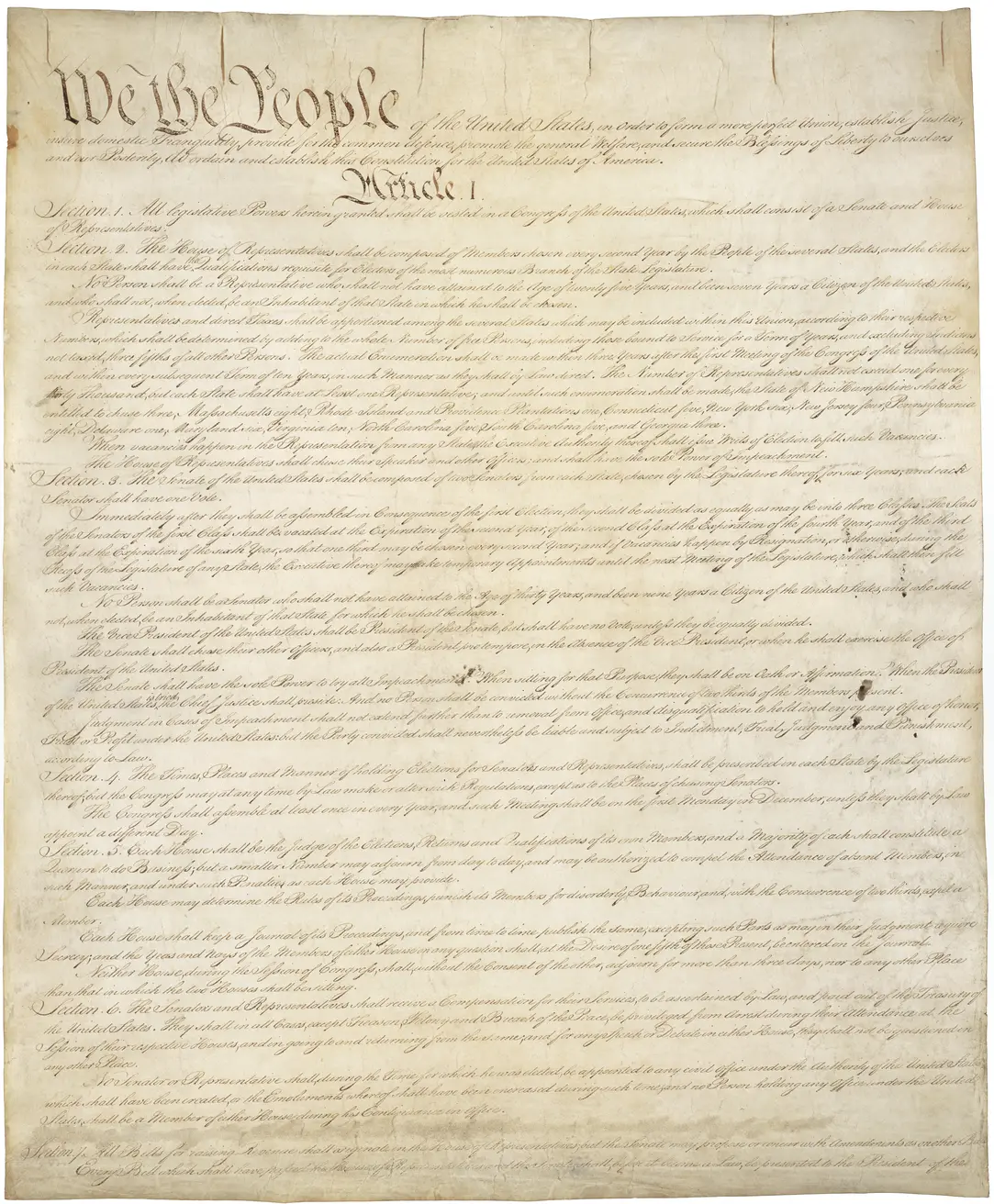
[STRONG INFERENCE] The founding period’s foreign policy is the product not of a purely ideological preference for neutrality but of a limit on military, fiscal, and commercial capacity. That said, it must be kept in view that the capacity constraint and the assessment of strategic opportunity coincided at the same time, and that the two do not exclude each other. Washington’s advice in the Farewell Address to avoid permanent alliances deserves to be read in the category of external systemic constraint.
The institutional structure has not yet settled. The Department of State was established in 1789 but remained small; the sphere of influence of congressional committees is as large as, or even larger than, that of the Secretary of State. [FACT] The Jay Treaty (1794) documents this period’s institutional tension: the executive negotiates but meets sharp Senate opposition. [STRONG INFERENCE] This is the first documentable instance of the continuity of executive-legislative tension.
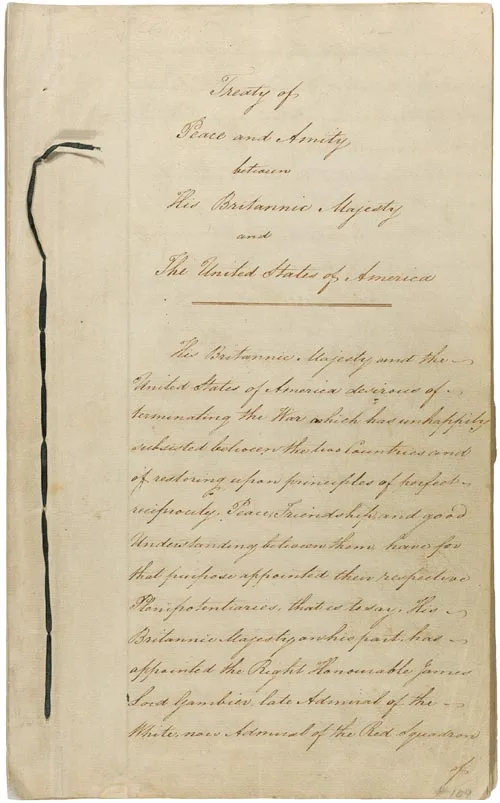
The War of 1812 is both a period-closing and an instructive test case. [FACT] The declaration of war comes from Congress; the influence of the commercial circles pressuring the Madison administration and of the congressional bloc known as the “War Hawks” can be traced through primary sources. [FACT] The war’s outcome (Treaty of Ghent, 1814) produced no clear territorial gain or loss but de facto fixed the United States’ independence and borders in North America. [STRONG INFERENCE] 1812/1815 is not the period’s genuine rupture but a structural confirmation point: a test of whether the Western Hemisphere could in fact be defended against the British threat. The genuine rupture will come at the start of the next period with the Monroe Doctrine.
Period 1.2 (1815–1865): The Monroe Doctrine, Continental Expansion, and a Dual Structure
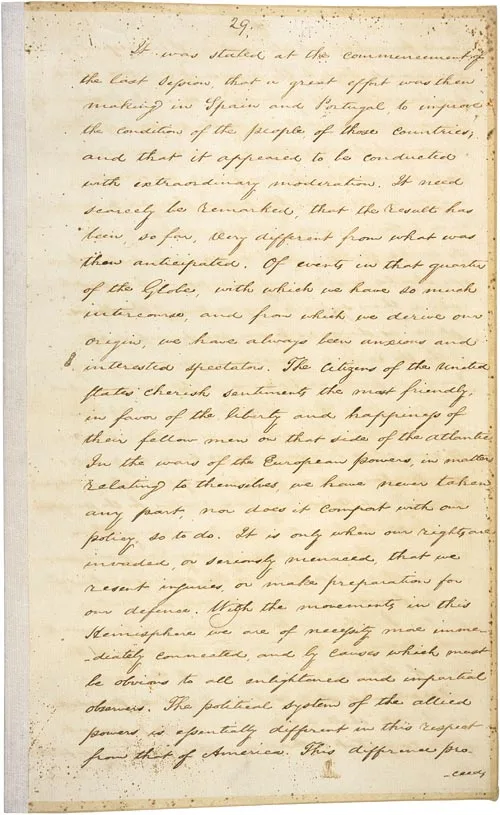
This period’s foreign-policy logic rests on two mutually reinforcing axes: the Monroe Doctrine (1823) and continental expansion. [STRONG INFERENCE] As the analysis shows, although both were presented in different ideological languages, they reflect the same geographic priority — North America and the Western Hemisphere.
[FACT] The Monroe Doctrine was presented in the format of a Presidential Message; it is not a statute but an executive doctrine document. This form matters: taking effect without need of congressional approval yet resting on no binding legal ground, this doctrine is a concrete example of the distinction between legitimation production and legal authority. [STRONG INFERENCE] Although the doctrine’s binding enforcement capacity was limited at first, its retrospective legitimation-producing power was high; from 1823 on it was reproduced by different instruments in every major presidency. This repetition constitutes one of the first strong candidates for the continuity pattern.
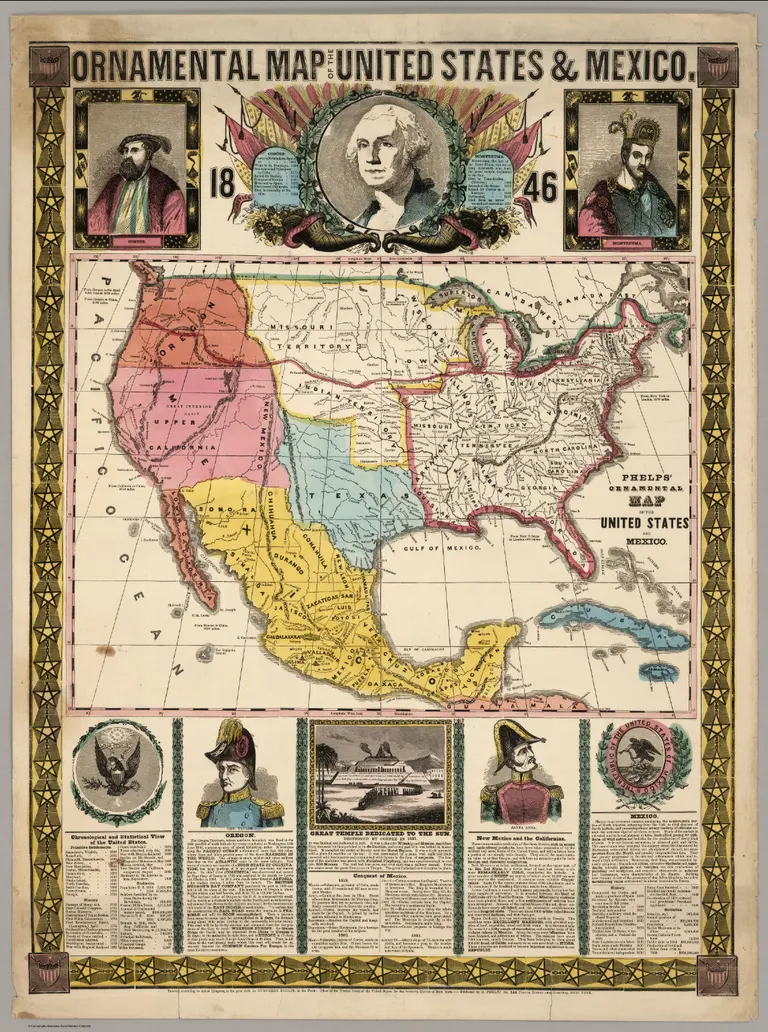
[FACT] Continental expansion advances in this period through statute, budget, and decision mechanisms alike: the annexation of Texas (1845), the Oregon Treaty (1846), the Mexican War (1846–1848), and the territorial gains that followed. [STRONG INFERENCE] The Manifest Destiny discourse is in this period a legitimation language serving both mass mobilization and vote-production in Congress; but the de facto mechanism of expansion operated through law, budget, and military deployment. This is an early example of the distinction between discourse frame and capacity (§6): language mobilizes, while material channels carry the actual expansion.
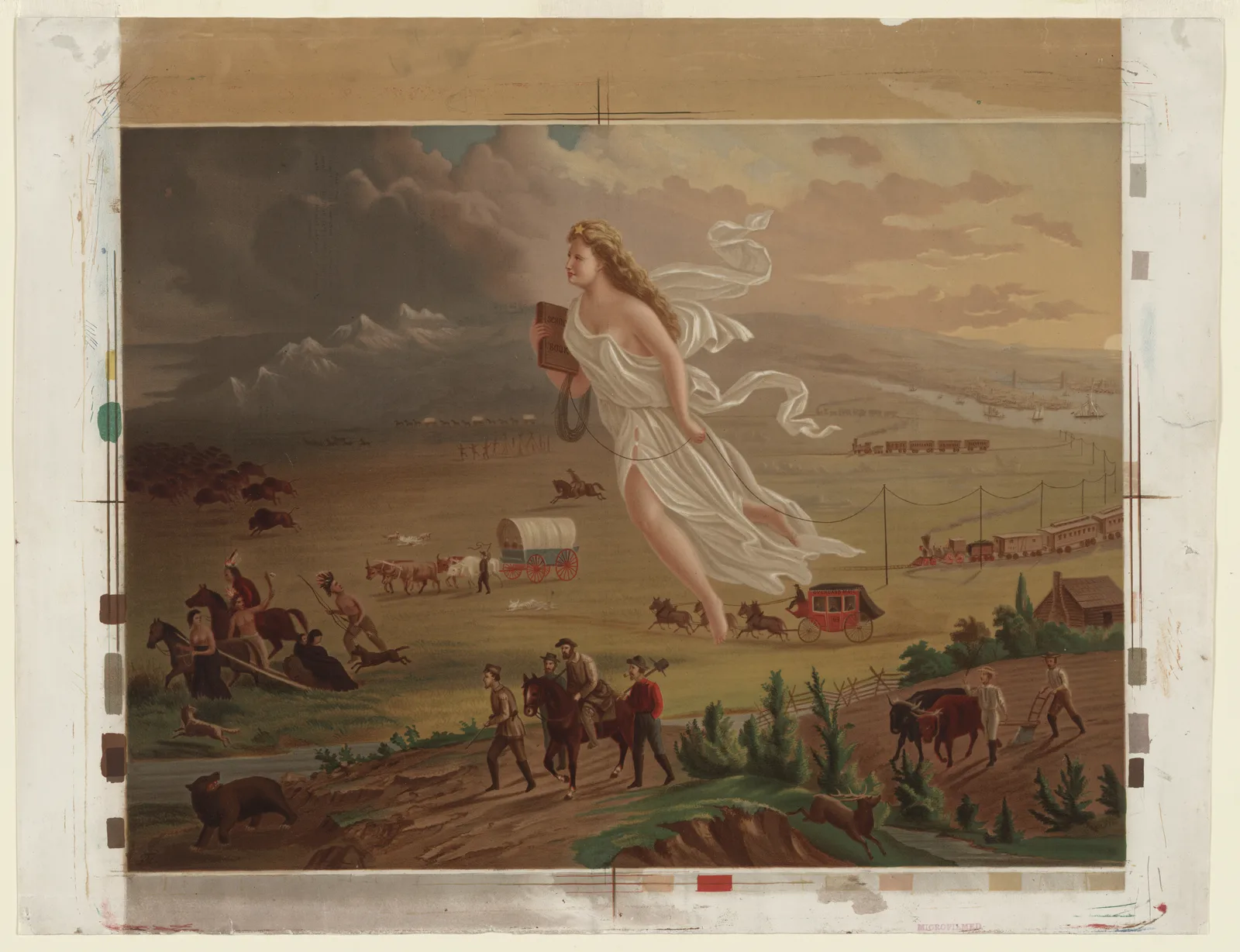
[FACT] The Civil War period (1861–1865) produces an instructive anomaly for foreign policy. The Lincoln administration sought throughout the war to ensure that Europe — especially Britain and France — would not recognize the Confederacy; in this process Secretary of State Seward took on a critical diplomatic role. [STRONG INFERENCE] The Civil War period is the period in which foreign policy was de facto steered by domestic crisis and foreign-policy agency was lowest; it should be recorded as the negative-control instance of the internal-external interaction test.
Period 1.3 (1865–1917): Between Expansion and Withdrawal
This period, owing to its internal heterogeneity — since it followed a different course before and after the 1890 Mahan turn in particular — requires being separately tested later in two sub-phases, 1865–1890 and 1890–1917.
This period is the one in which the concept of “isolationism” is applied in the most misleading way. [STRONG INFERENCE] The United States’ keeping its distance from European alliances does not mean keeping its distance from global interventionism; expansion in the Western Hemisphere and the Pacific and sea-power investment intensify in this period.
[FACT] The institutional effect of Mahan’s sea-power theory (1890) can be traced through primary and secondary evidence: the Navy budget underwent periodic jumps from the 1880s on, naval-base policy changed, and naval architecture was transformed. [STRONG INFERENCE] The Mahan effect operated through the institutional rather than the discursive channel — the primary evidence is not the doctrinal text but the change in budget and deployment. Tightening this linkage into a single chronological table as the triad of doctrinal text, budget jump, and naval-base policy is left to a later stage under the heading of parallel material periodization.
1898 is this period’s load-bearing threshold. [FACT] The Spanish-American War and the subsequent annexation of the Philippines are the United States’ first acquisition of permanent overseas territory geographically detached from the mainland. Applying the three-layer falsification standard: Reversal cannot be passed — in the subsequent period the United States maintained its presence in the Pacific and did not relinquish the Philippines until 1946. Attenuation applies partly — the rupture is genuine in terms of external expansion, not in terms of rapprochement with Europe. Splitting applies, and this matters — 1898 transformed not hemisphere policy but Pacific policy; the Monroe-based hemisphere logic did not change, and the rupture remained confined to the carrying of military-geographic expansion farther afield. [STRONG INFERENCE] 1898 is therefore external-horizontal expansion (§5-A) and is classified as a split/partial rupture: it splits a pattern taken to be a single continuity, showing hemisphere protection and Pacific expansion as two separate axes operating by different mechanisms.
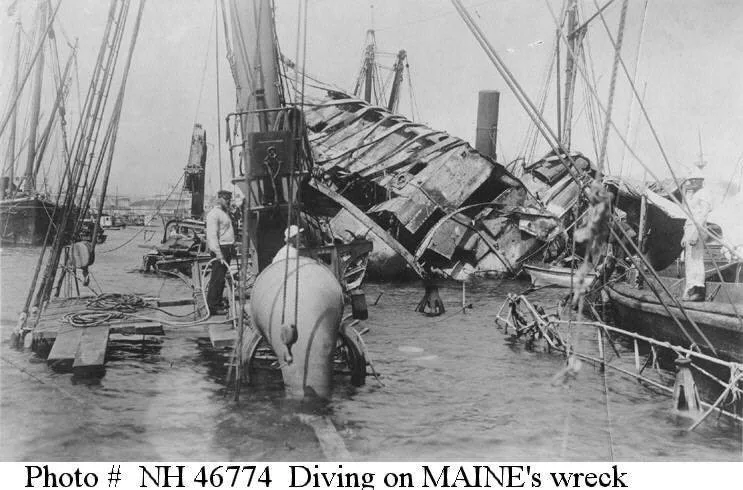
[FACT] In the 1898–1917 period the Roosevelt Corollary (1904) declares that the President has the authority to intervene in the Western Hemisphere without congressional approval; this is the de facto extension of the Monroe Doctrine by executive hand. [STRONG INFERENCE] That step is an example of how executive interpretation can produce functional rupture without the statutory text changing; it is a concrete case of the legal-authority / de-facto-effect distinction (§9).
Period 1.4 (1917): Genuine Rupture or Temporary Deviation?
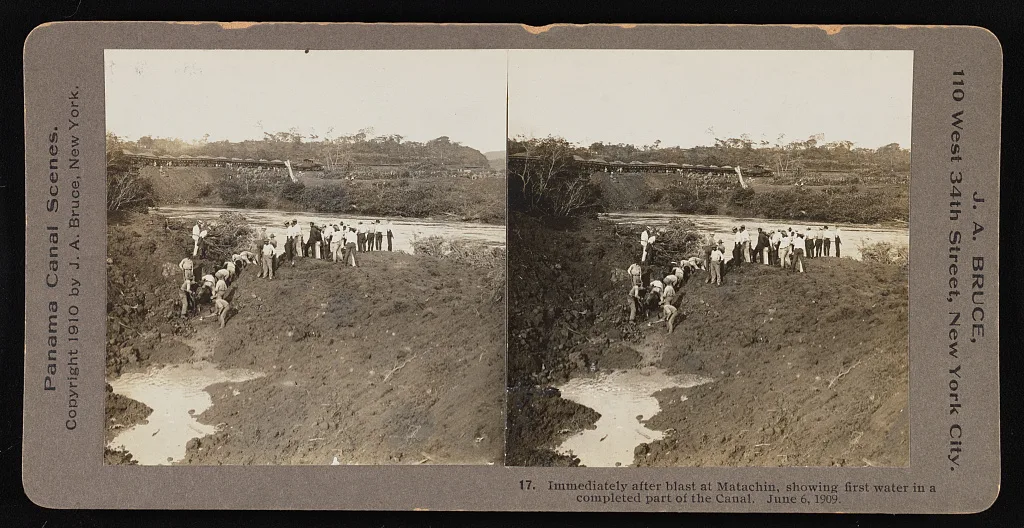
[FACT] Evidence for genuine rupture: the United States actively participated in a European war for the first time; Wilson’s “make the world safe for democracy” discourse offered a new universalist language in foreign-policy legitimation; the war bureaucracy underwent de facto expansion. [FACT] Evidence for temporary deviation: after the war the Senate rejected the Treaty of Versailles and membership in the League of Nations (1919).
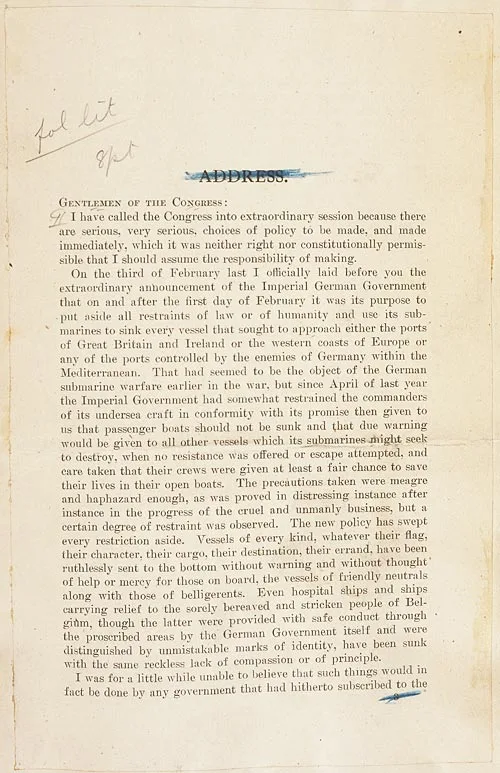
[STRONG INFERENCE] 1917–1919 began as an attempt at rupture on the institutional and legitimation levels; but with the legislative brake engaging, the rupture remained partial. This is a case in which the discourse frame moved on its own and could not consolidate capacity (§6): the universalist language rose, the institutional capacity did not settle owing to the Senate’s rejection.
[FACT] Inter-period negative control: when 1919–1939 is traced, the posture of keeping distance from European alliance politics is seen to become dominant again. The Neutrality Acts of 1935–1937 are one of the clearest instances of Congress directly setting the direction of foreign policy. [FACT] These acts restricted the President’s sale of arms or credit to belligerent states and prohibited the presence of U.S. citizens on ships bound for war.
Period 1.5 (1941–1945): Structural Rupture and Intra-War Transformation
[FACT] Legal level: the 1941 Lend-Lease Act opened legal ground for Roosevelt’s transfer of arms to Britain and the Soviets before Pearl Harbor; this is the de facto termination of the neutrality regime.
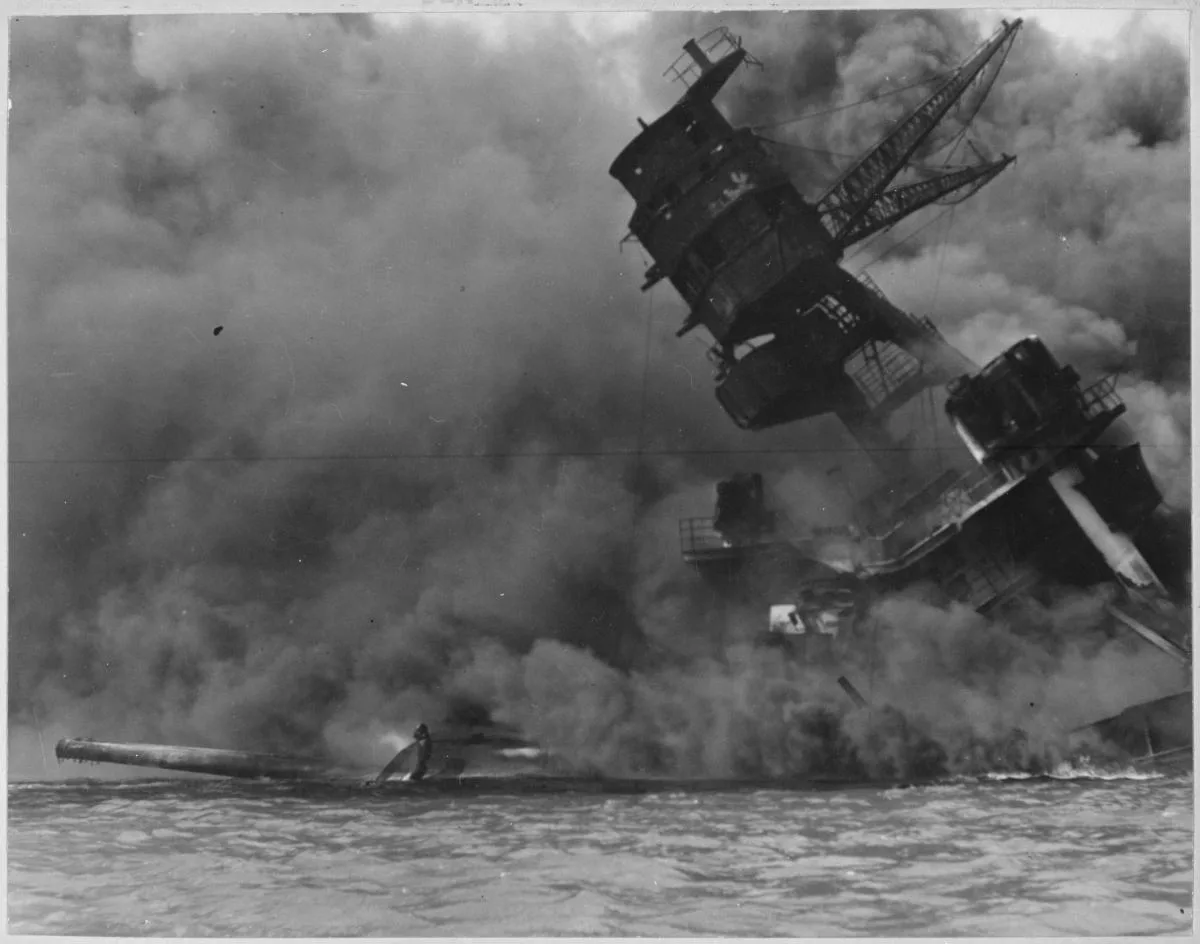
[FACT] Institutional level: during the war the federal bureaucracy expanded dramatically; the OSS (forerunner of the later CIA) became operational; the foundations of the military-industrial relationship were laid in this period. [FACT] Budgetary level: defense spending rose above thirty percent of GDP; this ratio declined after the war but, unlike after 1919, never returned to its prewar level. The extent to which the wartime mobilization turned into the permanent post-1945 national security state requires a separate institutional-permanence test; that test is carried out in Part Two.
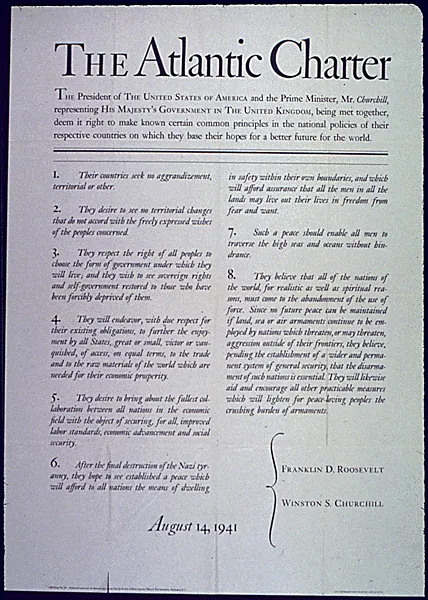
[FACT] Decision center: Roosevelt conducted de facto war preparation before Congress’s formal declaration of war (the Atlantic Charter, August 1941; shoot-on-sight orders against submarines, September 1941). [STRONG INFERENCE] This is one of the most documented instances of the executive pulling the de facto decision center ahead of the legal framework.
[FACT] Three-layer falsification test: Reversal cannot be crossed — NATO, the Marshall Plan, and the Cold War configuration produced continuity. Attenuation applies partly, but the postwar permanence of the institutional reorganization limits this reading. Splitting applies: the 1941 rupture operated quickly at the military and institutional level, more slowly at the ideological level.
[STRONG INFERENCE] 1941 is the strongest genuine rupture of this 169-year period; it produced a cluster of change operating simultaneously and permanently at the budget, institution, decision-center, and strategy-document levels. [STRONG INFERENCE] 1941 should be read not as a core on its own but as the first leg (military-war mobilization) of the 1941–1949 founding cluster. The cluster’s economic (1944/45), security (1947), and alliance (1949) legs are treated in Part Two.
II. Answers to Sub-Questions
Sub-Question 1.1: The Presidency–Congress Balance
[FACT] Periods in which Congress was decisive: the 1812 declaration of war, the 1819–1820 trade laws, the 1919 rejection of Versailles, the 1935–1937 Neutrality Acts. Periods in which the executive came to the fore: the proclamation of the Monroe Doctrine (1823), the limited briefing of Congress by the Tyler-Polk pair in the Texas annexation process, the Roosevelt Corollary (1904), Wilson’s 1917 message to Congress, Roosevelt’s executive practices in 1939–1941.
[STRONG INFERENCE] In crisis periods the executive comes to the fore; after the crisis the congressional brake engages. But this oscillation is not symmetric: not every executive expansion has been fully reversed; in areas such as diplomatic practice and budgetary flexibility, institutional accumulation is seen to work, as a periodic tendency, in the executive’s favor.
[FACT] Weak-link test: the moment the congressional brake was bypassed most quickly is the pre-1941 Roosevelt practices. Legal weak link: ship transfers carried out by executive order on the ground of “national-security urgency.” Institutional weak link: bilateral negotiations conducted without briefing the Congressional Foreign Affairs Committee. Operational weak link: the start of de facto war practice in the Atlantic before public support had formed.
Sub-Question 1.2: State, War Bureaucracy, Commerce/Capital, and Public Opinion
[FACT] The Department of State remained small throughout this period; the diplomatic service completed its professionalization only in the early 20th century. [STRONG INFERENCE] The institutional weight of the bureaucracy is relatively limited; the Secretary of State’s influence depends mostly on the personal relationship with the Presidency.
[HYPOTHESIS] Commercial and capital circles may have formed pressure fields shaping the foreign-policy agenda, especially in the 1815–1898 period; secondary-level traces exist in this direction. A primary-level evidence set to determine the concrete contribution of capital-state transfer to the foreign-policy direction in the 1865–1917 period could not be constructed in this study; this field requires research deepened with proxy indicators and budget-personnel transfer data (see §2 instrument definition; III. Open Research Areas).
[STRONG INFERENCE] Public-opinion and media effect is observed most distinctly in the 1898 and 1917 ruptures. Mobilization, legislative pressure, and legitimation packaging are three separate mechanisms through which public opinion can enter the decision channel; but which of these served the primary function in which rupture could not be disaggregated in this study.
[STRONG INFERENCE] The war bureaucracy appears in this period not as a permanent power center but as a structure that expands in crisis and contracts after it; after 1941 this picture will change fundamentally.
Sub-Question 1.3: Recurring Ideological Narratives
[STRONG INFERENCE] Commerce and prosperity language: shows almost uninterrupted continuity; it is the most strongly supported candidate of the continuity pattern. Republican-liberty and anti-monarchism language: is decisive especially in the early period, but the same vocabulary was used for both interventionist and withdrawalist policies; this elasticity weakens its tie with the decision channel.
[STRONG INFERENCE] Civilization and Anglo-Saxon supremacy language: intensifies in the 1865–1917 period in the Philippines debates and South America policy; it appears simultaneously in congressional debates, executive texts, and the period’s press — it is the field where legitimation production and historical narrative overlap.
[FACT] Wilsonian universalism and democracy-spreading language: emerged sharply in 1917, found no institutional ground after the 1919 Senate rejection, but was brought back onstage by different instruments in the 1940s. [HYPOTHESIS] It may be argued that this language operated as an “intermittent pattern” between 1917 and 1945 — that is, a legitimation source reactivated under certain conditions; raising this to the level of a structural feature requires cross-period verification.
Sub-Question 1.4: Genuine Ruptures
[STRONG INFERENCE] 1812/1815: not a genuine rupture but a structural confirmation point. Civil War (1861–1865): not a genuine rupture in terms of foreign policy; a negative-control period in which domestic crisis temporarily suspended foreign policy. 1898: split/partial rupture (external-horizontal); it transformed the Pacific axis without changing the hemisphere pattern. 1917: discursive rupture, institutional continuity; left half-finished by the 1919 Senate rejection. 1941: the period’s genuine and most comprehensive rupture; the military leg of the 1941–1949 founding cluster.
Sub-Question 1.5: The Carrier Channel of Continuity
[FACT] Three rival explanations were tested. Continuity through institutions: the Department of State remained weak in this period; the institutional channel is not strong enough to carry continuity. Continuity through legislation: some frameworks became permanent, but the legislative brake at times interrupted continuity. Continuity through strategic culture: Western Hemisphere priority, sea-power investment, and trade-route protection recurred with similar instruments under different administrations and discourses.
[STRONG INFERENCE] The 1776–1945 foreign-policy continuity is a pattern carried predominantly by strategic culture and material-institutional capacity together: the reproduction of certain geographic priorities and instrument-logics despite institutional and ideological change. [HYPOTHESIS] The observable indicators of this hypothesis: recurring geographic-allocation intensities in successive periods (Western Hemisphere and Pacific), periodic jumps in naval and budget allocations, the geographic continuity of deployment and base choices, the similar repetition of trade-route protection decisions under different administrations. This finding is at the hypothesis level; it will be strengthened by a systematic comparison of whether the same geographic priorities were supported by similar budget decisions in successive periods.
[STRONG INFERENCE] The carrier structure observed in this period is the early, not-yet-institutionalized form of the capacity engine (§6) that will mature in later sections: decision capacity expands in crisis but is not fully reversed, material infrastructure (navy, bases) accumulates, the discourse frame (republican liberty, Manifest Destiny, universalism) changes. The engine’s full institutionalization will come with the 1941–1949 cluster.
III. Open Research Areas
Capital-state transfer is insufficiently tested in this study; a primary-level evidence set to determine the channel effect of commercial and capital circles on foreign-policy decisions could not be constructed. The splitting finding of 1898 awaits verification; carrying the distinction to the level of a structural feature requires a periodic comparison of doctrinal texts, military deployment, and budget separation. The public-opinion–decision chain link could not be clarified in this study; which of the mobilization, legislative-pressure, and legitimation-packaging channels served the primary function in which rupture could not be separated. Parallel material periodization remained incomplete; the relation of the material ground between the 1880s naval investments and the 1898 rupture is a separate deepening heading. The 1919–1929 field-shift test was not taken up; whether intervention through financial mechanisms was sustained in this period of apparent military withdrawal should be tested at a subsequent stage.
Part Two: 1945–1991
The Architecture of Global Hegemony, the National Security State, and the Institutionalization of Continuity
This part’s primary task is to answer the question marked in Part One: through which institutions, laws, budget structures, and ideological languages did the rupture opened in 1941 turn into a permanent order after 1945? The methodological framework and epistemic discipline are the same as in Part One.
I. Periodic Skeleton
Period 2.1 (1945–1949): The Transition from War to the Cold War Order and the Completion of the Founding Cluster
This period’s basic question: did the executive-centered war order opened in 1941 acquire a permanent institutional form between 1945 and 1949?
[FACT] When the war ended, the temporary mobilization structures were rapidly liquidated; troop numbers fell, and the wartime production apparatus largely withdrew. [STRONG INFERENCE] This is the negative-control instance that concretizes the warning “mobilization is not identical with permanence”: while part of the capacity dispersed, the decision architecture became permanent.
[FACT] The economic leg of the founding cluster was established at the start of this period: in July 1944 the Bretton Woods Conference designed the IMF and the IBRD; for the United States the Bretton Woods Agreements Act took effect in 1945, placing the dollar-centered fixed-exchange regime on legal ground. [STRONG INFERENCE] Bretton Woods meets the object-specified core criterion: institution (IMF/IBRD), law (IMF Articles of Agreement + Bretton Woods Agreements Act), decision center (the Treasury’s turning into the founding center of the external-economic order). [STRONG INFERENCE] But passing the criterion does not make it a separate core rupture; a cluster leg too can meet the criterion. Bretton Woods is the economic-monetary leg of the 1941–1949 founding cluster — part of the successive but single founding logic of the 1941 military mobilization, the 1944/45 economic order, the 1947 security architecture, and the 1949 alliance legs.
[STRONG INFERENCE] Bretton Woods also establishes the monetary operating form of the capacity engine’s resource-conversion layer: the dollar’s reserve status and the dollar-centered payment infrastructure are part of the budgetary-monetary continuity (the third layer), not a separate carrier channel. [STRONG INFERENCE] That this layer is interlocked with the engine’s other layers is visible in the dollar status’s dependence on the security umbrella: the large part of safe U.S. assets is held by countries with a military tie to the United States (Weiss, 2022) — that is, monetary leverage is not independent of the military-logistical core. The infrastructure of the financial architecture’s network-chokepoint coercion mode (cutting off network access) was established in this cluster, while its weaponization matured in later periods; this maturation is traced in Period 2.4 and in Part Three.
[FACT] The National Security Act (July 1947) institutionalized the CIA and the National Security Council (NSC) and organized the national military structure under a single roof; the Department of Defense took its official name with this framework’s completion in 1949. [STRONG INFERENCE] The 1947 act produced an asymmetric transition that, while liquidating the war mobilization, made the security decision infrastructure permanent: the military crowd dispersed, the decision architecture was preserved.
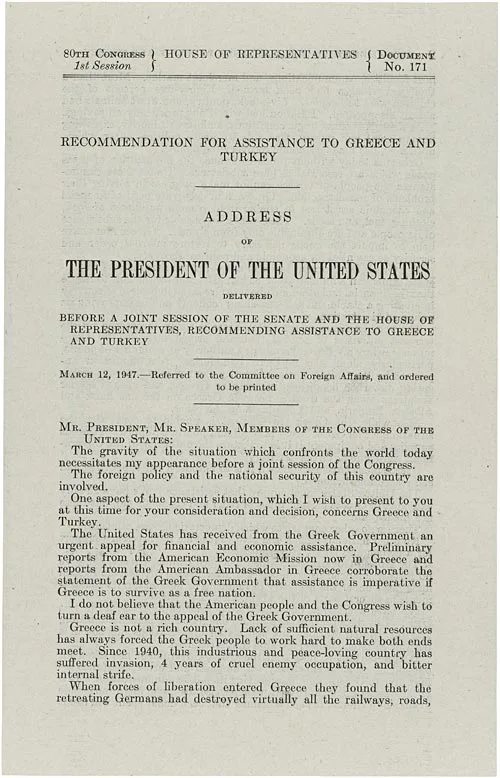
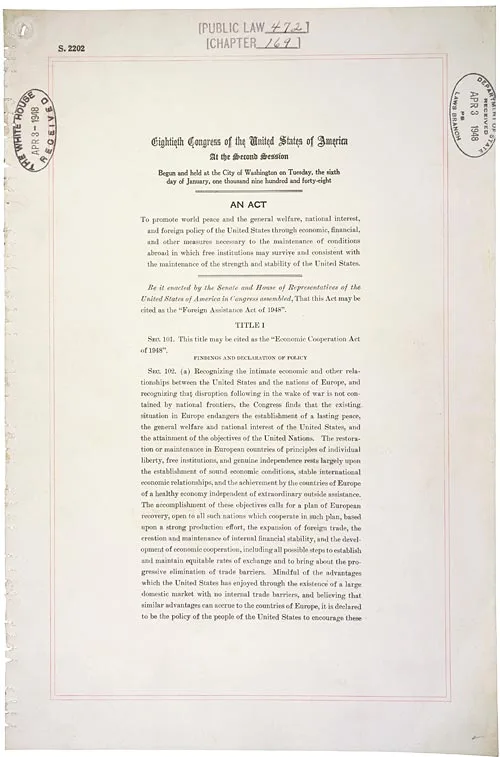
[FACT] The Truman Doctrine (March 1947) foregrounds the language of security, the Marshall Plan (June 1947) the language of economic reconstruction. [STRONG INFERENCE] Although the two documents use different legitimation vocabularies, they share the same geopolitical priority — the protection of Western Europe against Soviet influence; this is an early example of the capacity orientation staying fixed while the discourse frame can change (§6).
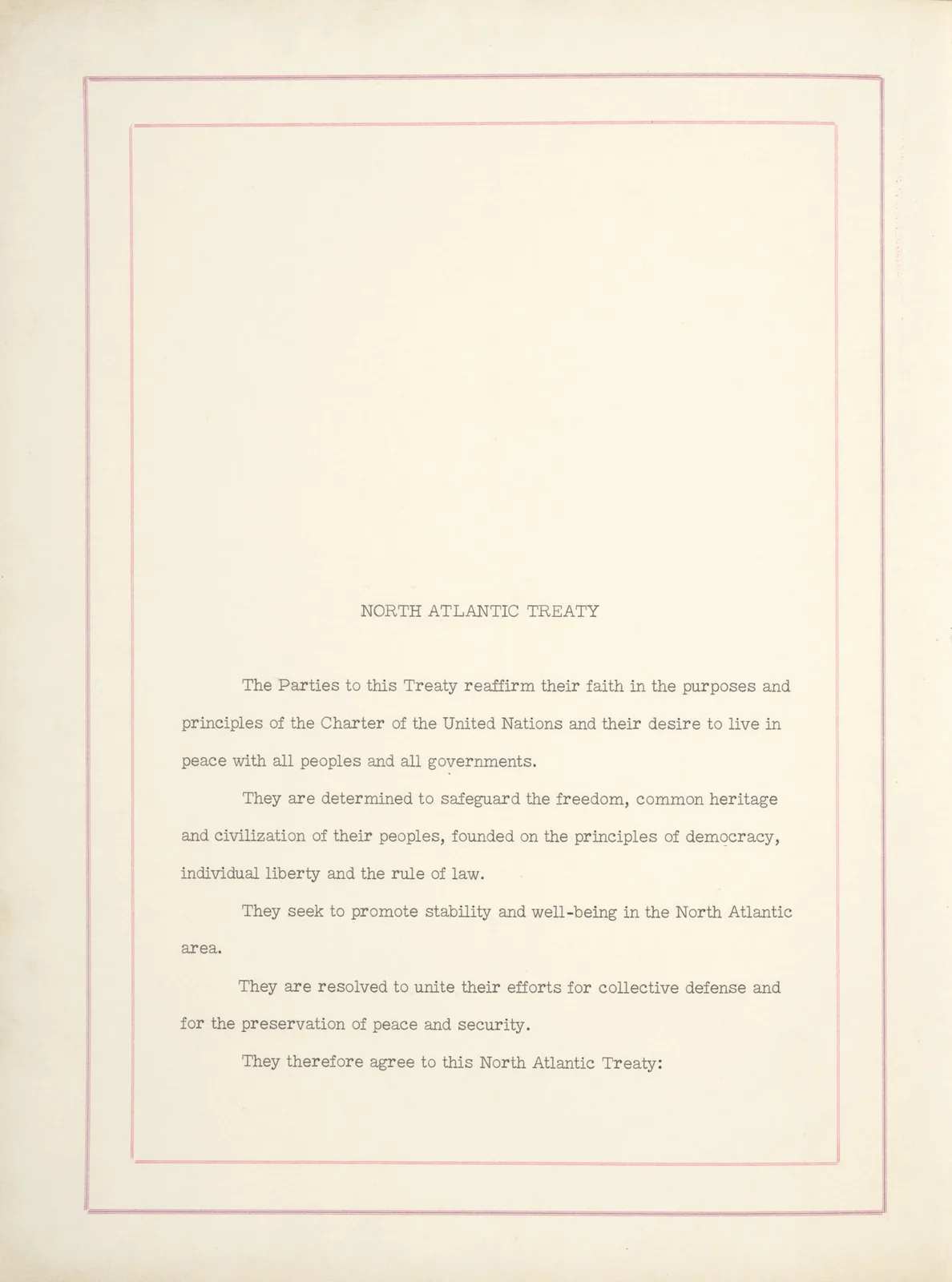
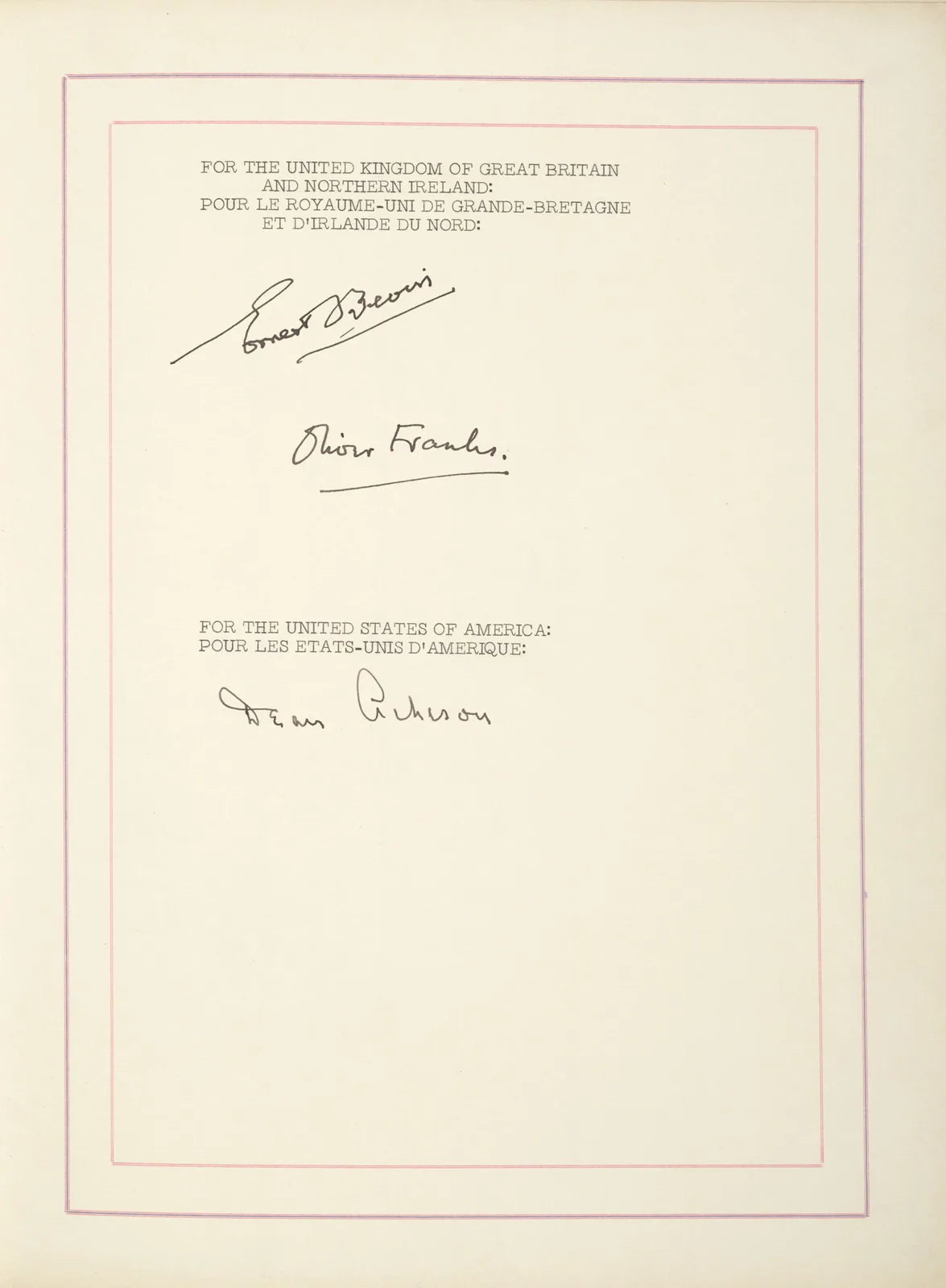
[FACT] The founding of NATO (April 1949) is the first permanent military alliance established in peacetime in U.S. history. [STRONG INFERENCE] The “keeping distance from European alliances” pattern that had run since 1783 crosses the reversal threshold in 1949: NATO membership genuinely splits this pattern. [STRONG INFERENCE] But the splitting is not one-directional: avoidance of building a multilateral permanent alliance structure in Asia and the Middle East continued in this period.
Period 2.2 (1950–1968): Containment, Hot Wars, and the Intervention Regime
This period’s basic question: was the containment doctrine, established in the language of defense, turned into an intervention regime?
[FACT] NSC-68 (April 1950) is an executive document that dramatically expanded the scope of the Soviet threat and proposed quadrupling the share of defense spending. [FACT] Before the document took effect the Korean War began; the war functionally accelerated NSC-68’s budget demands. [STRONG INFERENCE] NSC-68 is a threat frame prepared before the decision; Korea produced the political ground necessary for this frame to be put into practice. [HYPOTHESIS] Korea may be read as the threshold event that triggered the implementation of a transformation agenda already on standby; separating this from an external-shock interpretation requires additional testing. (The second instance of this mechanism — 9/11 → the 2001 AUMF — is connected in Part Three, and the claim is raised once the dual-case is established.)
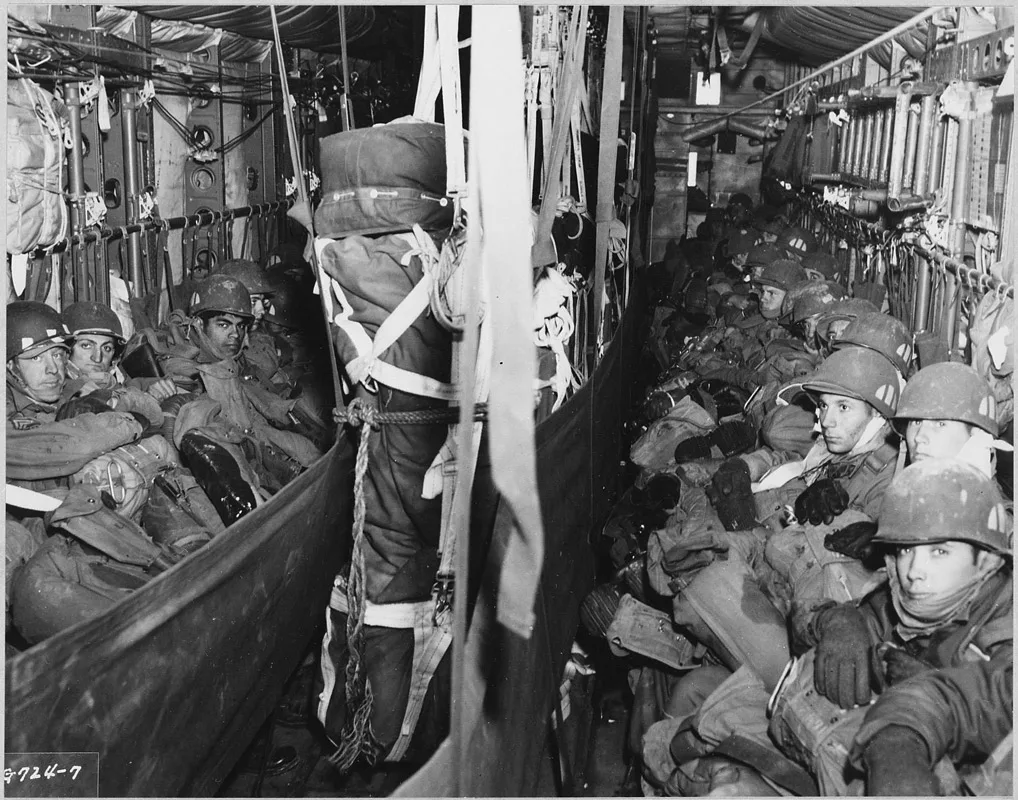
[FACT] The Korean War (1950–1953) is the first major military engagement conducted without a declaration of war; Truman used a “police action” frame and did not directly use Congress’s war-declaration power. [STRONG INFERENCE] The weak link identified in Part One for the pre-1941 Roosevelt practices — de facto war preparation outside Congress — goes a step further here: de facto war was conducted without congressional approval being sought.
[FACT] The Eisenhower period (1953–1961) is marked by the “New Look” doctrine, which preferred nuclear deterrence and covert-operation capacity over large ground forces. [STRONG INFERENCE] This preference reflects the systematization, in the postwar period, of a shift toward indirect instruments instead of direct military intervention. [FACT] The covert operations in Iran (1953), Guatemala (1954), and Cuba (1961) are this period’s primary test cases; however, since the primary evidence on the full decision chain of these operations is partly classified, it could not be fully constructed in the study and was left to the open research area.
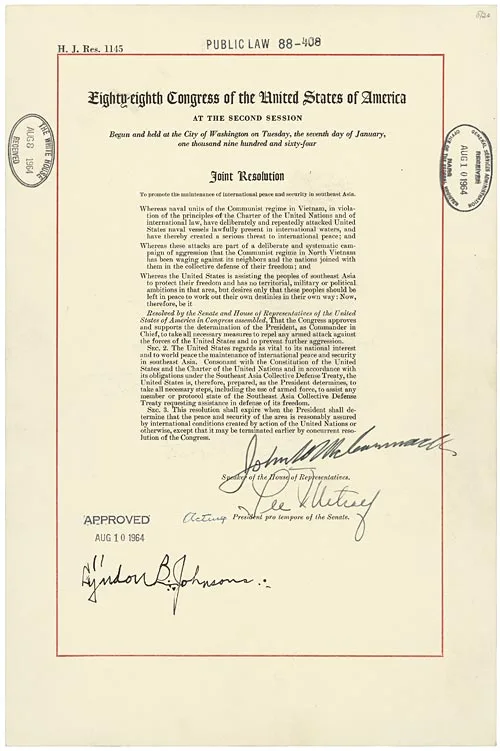
[FACT] The Gulf of Tonkin Resolution (August 1964) is not a declaration of war but a delegation of authority to the executive; rather than closing the gap between legal form and de facto function, it widens it. [STRONG INFERENCE] Tonkin is the threshold at which Congress authorized rather than oversaw the executive, and the oversight brake became symbolic.
Period 2.3 (1968–1979): Erosion, Recalibration, and Preservation-through-Transformation
This period’s basic question: a genuine braking, or a change of form in executive capacity?
[FACT] The War Powers Resolution (1973) provides that the executive may not use military force for longer than 60 days without congressional approval; Nixon vetoed the law, and Congress overrode the veto. [STRONG INFERENCE] Three-layer test: reversal cannot be passed — in the subsequent period no president fully complied with the law; attenuation applies — in some engagements it produces a de facto notification ground; splitting applies — while it works partly in small-scale operations, it is systematically exceeded in large engagements. [STRONG INFERENCE] The 1973 law is not a genuine brake but a notification regime of limited scope and selective application.
[FACT] The Nixon Doctrine (1969) declares that the security burden will be transferred to regional allies. [STRONG INFERENCE] This is the doctrinalization of the shift from direct military projection to a model of proxy and burden-sharing. [STRONG INFERENCE] Détente (1969–1979) did not formally abandon the containment doctrine; SALT I (1972) did not stop capacity competition — détente is less a change of direction than a diversification of instruments.
1971 — The Nixon Shock: preservation-through-transformation. [FACT] On 15 August 1971 the United States unilaterally suspended the dollar’s convertibility to gold; this initiated the end of the 1944 Bretton Woods fixed-exchange regime. [STRONG INFERENCE] Four-plane test: no new external institution was established, no new external authority regime was produced (a crisis interpretation of existing executive-economic authority), and the decision was taken within a narrow executive-Treasury-Fed circle. Therefore 1971 is neither construction of a new order (Type C) nor internal-vertical (Type B) expansion. [STRONG INFERENCE] 1971 is the core instance of the preservation-through-transformation class: the founding rule (the gold link) was deliberately abandoned, but the dollar-centered capacity was preserved (Vernengo, 2021).
[STRONG INFERENCE] The capacity was reproduced in the 1970s through petrodollar arrangements. [UNVERIFIED] The claim that this consolidation rested on a single secret 1974 agreement cannot be verified against a source; the study takes as its basis a multiple-arrangement reading rather than a single-agreement one (Spiro, 1999) and passes no judgment on the myth.
[STRONG INFERENCE] This classification is retrospective, not prospective: 1971 is not a guaranteed maneuver designed from the outset but the unraveling of a fragile Cold War bargain, and one of the options was the United States’ not winning preservation (Gavin, 2004). Preservation is not a guaranteed design but a realized outcome; the class is assigned only when it is shown retrospectively that capacity was in fact preserved. [HYPOTHESIS] 1971 is the purest instance of the thesis’s “abandon the rule in crisis, preserve the capacity” mechanism, and at the same time its falsifiability test.
The class’s falsification condition is written out explicitly: if, after the founding rule is abandoned, central-decision capacity and dollar-based external-economic leverage are permanently preserved → preservation-through-transformation; if this capacity comes under external discipline or the center is lost → core decline. In short: if abandoning gold did not preserve the dollar, the thesis collapses. Without this negative condition, the class drifts into the form “continuity whether the rule is preserved or broken” and becomes unfalsifiable.
Period 2.4 (1979–1991): Re-hardening and Late-Cold-War Hegemony
This period’s basic question: was the structure partly limited in the 1970s re-fortified in the 1980s?
[FACT] The Carter Doctrine (January 1980) declares the Gulf region to be a vital U.S. interest. [STRONG INFERENCE] This carries a functional resemblance to the Monroe Doctrine’s Western Hemisphere logic: the geographic priority expands, but the basic logic — a military response to a threat against a region deemed vital — stays the same. It is an example of the geographic-axis expansion of the continuity pattern. (The criterion-based full classification of the Carter Doctrine is given in Sub-Question 2.7.)
[FACT] In the Reagan period the defense budget rose by about fifty percent in real terms. [STRONG INFERENCE] The Reagan period revives the military-budgetary momentum that was relatively limited in the 1970s; this supports the finding that the 1970s “braking” was not a genuine rupture but a periodic adjustment.

[FACT] The Iran-Contra scandal (1986–1987) documents that the executive, de facto exceeding Congress’s explicit prohibition, conducted covert-operation financing. [STRONG INFERENCE] Iran-Contra is one of the rare instances in which the operational weak link is supported by primary evidence: the covert financing channel operated outside the ordinary budget and oversight processes, in the invisible part of the decision chain.
[STRONG INFERENCE] In the dissolution of the USSR (1989–1991), the three-layer test: reversal is partly passed (the disappearance of the Soviet threat leaves the containment doctrine without an object); attenuation is strong (the base network, intelligence capacity, and intervention practices did not shrink); splitting applies (the ideological frame collapsed, the institutional structure persisted). [STRONG INFERENCE] 1989–1991 produces a genuine rupture in the language of legitimation and a partial continuity in the institutional structure: the anti-communist discourse frame collapsed, the capacity engine persisted. [STRONG INFERENCE] This is one of the most documented natural experiments of the detachability of the discourse frame from capacity (§6) and is the same structural type as 2016 — the frame changed, the engine persisted; only the trigger differs (combined in Part Three).
II. Answers to Sub-Questions
Sub-Question 2.1: The Presidency–Congress Balance
[STRONG INFERENCE] The asymmetric-oscillation pattern identified in Part One operates in this period too; but the accumulation in the executive’s favor is more pronounced. [FACT] Moments in which Congress was decisive: the 1947 NSA negotiations, the Church Committee investigations (1975–1976), the War Powers Resolution (1973). Moments in which the executive came to the fore: Korea, the Tonkin Resolution, the CIA covert operations, the Reagan-period covert financing networks.
[STRONG INFERENCE] In each crisis executive capacity left a broader permanent ground than the previous one: the 1947 institutional framework was not de facto reversed by any congressional intervention, including the 1973 War Powers brake.
[FACT] Weak-link test: legal — the exceeding of the war-declaration power by delegation of authority or executive interpretation (Korea, Tonkin, Grenada, Panama); institutional — the structural limitation of the Foreign Affairs and Armed Services committees’ access to covert-operation information; operational — the disabling of budget and oversight procedures by covert financing channels in Iran-Contra.
Sub-Question 2.2: Institutions and Decision Centers
[STRONG INFERENCE] The NSC functions as a decision-preparation mechanism directly attached to the President, outside the official bureaucracy; the channel that filters which information reaches the President, and in what form, is not the State Department but the NSC. This is one of the well-documented institutional instances of the information-monopoly mechanism.
[FACT] The share of defense spending in GDP never returned, between 1950 and 1990, to its prewar (1940) level. [STRONG INFERENCE] The war mobilization became permanent at the budget level.
[FACT] The CIA’s covert-operation capacity was institutionalized in this period; the primary evidence is partly accessible (Church Committee reports, declassified materials), the full picture is of limited visibility. This field is left to the open research area not as an unverifiable fact but as an unconstructed evidence set.
Sub-Question 2.3: Legislation and Legal-Authority Regimes
[FACT] The 1947 NSA is this period’s framing statute; the Tonkin Resolution and subsequent authority texts are examples of this framework’s periodic expansion. [STRONG INFERENCE] In this period, for military engagement, not the war-declaration power but delegation of authority and the language of urgency, which expand the executive’s discretionary field, were used; the distance between legal form and de facto function increased relative to Part One. [STRONG INFERENCE] The existence of the War Powers Resolution did not eliminate the executive’s search for a legal framework; the executive used the law’s notification requirements as a legitimation instrument — the brake law turned into the executive’s legitimation packaging.
Sub-Question 2.4: Budget, Military Deployment, Material Infrastructure, and the Financial Axis
[FACT] The number of U.S. military bases abroad grew from practically zero in 1945 to hundreds in the 1950s and into a permanent global network in the 1960s; the navy, air power, and nuclear capacity produced a permanent budget requirement within the “triad deterrence” framework.
[STRONG INFERENCE] This period’s finding is that the base network, the budget flow, and the executive-decision capacity move together: the base network produced no external power without budget, the budget none without decision capacity; the three moved as one. This moving-together confirms the study’s capacity-engine framework (§6) and shows that the layers cannot be disaggregated as separate carriers — which layer is “strongest” cannot be established by primary evidence and is therefore not claimed.
[STRONG INFERENCE] The new element observed in this period is the maturation of the monetary operating form of the resource-conversion layer: the dollar’s reserve status and the global payment infrastructure acquire the form of a financial leverage. [STRONG INFERENCE] This financial leverage is not a separate channel — it does not operate without budget and decision capacity, it is interlocked with the engine — but it carries a coercion mode different from military-logistical coercion: cutting off network access (chokepoint) is a means of pressure separate from ground power (Farrell & Newman, 2019). [STRONG INFERENCE] The mode’s dependence on the engine is visible in the dollar status’s resting on the security umbrella (Weiss, 2022). [HYPOTHESIS] The full weaponization of this coercion mode matures not in this period but in the post-Cold-War sanctions regimes; its trace is followed in Part Three.
Sub-Question 2.5: Ideological Languages of Legitimation
[STRONG INFERENCE] Anti-communism is this period’s dominant legitimation language; it is the Cold War version of Part One’s “republican liberty” language and can be used for both interventionist and withdrawalist policies — this elasticity weakens the discourse’s tie with the decision channel. [STRONG INFERENCE] The defense of the free world and democracy runs from Truman to Reagan; it is the version of Wilsonian universalism that found institutional ground, and after 1947 the alignment between the ideological frame and the institutional structure is higher than in the previous period.
[HYPOTHESIS] Whether the language of development, aid, and modernization served to cloak geopolitical containment aims or a genuine development agenda cannot be adjudicated without being tested together with decision output and budget flow. [STRONG INFERENCE] The human-rights discourse becomes distinct under Carter and is used selectively under Reagan; the systematic exemption of certain allies from the language turns it from a consistent principle into a selective legitimation instrument.
Sub-Question 2.6: Capital, Commerce, and State Transfer
[FACT] The “military-industrial complex” warning in Eisenhower’s 1961 farewell address is one of the period’s most documented intra-elite signaling texts.
[FACT] This study has not constructed the primary-level evidence set on whether defense procurements and weapon-system decisions were shaped by industrial and employment priorities apart from the strategic-capacity calculation; capital-state transfer was deliberately left as an open field, and no claim was constructed in the body. [STRONG INFERENCE] The “beneficiary / coordination / command” instrument of §2 is defined precisely for use in this field; but since an actor’s benefiting from a decision and an actor’s issuing it require different evidentiary burdens, no strong judgment on “capital influence” is constructed without testing the distinction. [STRONG INFERENCE] The limited level that can be observed is that the financial architecture and military deployment supported the same geopolitical priorities by different instruments; that these are mutually reinforcing but separate mechanisms — at the level of interest alignment, not a command relationship.
Sub-Question 2.7: Genuine Ruptures and False Ruptures
[STRONG INFERENCE] 1947 NSA: genuine core rupture — the security leg of the 1941–1949 founding cluster; a permanent change in budget, institution, and decision architecture that has remained in force for over 75 years. Korea (1950–1953): not an exception but a model — by patterning the practice of military engagement without a declaration of war, it fortified the 1947 institutional rupture at the operational level. 1971 Nixon Shock: preservation-through-transformation — the founding rule (the gold link) was deliberately abandoned, the dollar-centered capacity preserved (Period 2.3). 1973 War Powers: not a genuine rupture but a limited notification regime. 1979 Carter Doctrine: tied to the criterion below. 1989–1991: the period’s strongest rupture candidate; but it produces a genuine rupture in the discourse frame and continuity in the capacity engine — 1941 built the structure, 1991 changed the structure’s legitimation frame but did not dismantle the engine.
[STRONG INFERENCE] The Carter Doctrine (1980) — tying to the criterion: under the object-specified criterion the Carter Doctrine is not a core rupture. Four-plane test: it establishes no new external institution, produces no new permanent authority regime, builds no new decision architecture; it extends the existing executive intervention authority to a new geography (the Gulf). This is the doctrinal form of external-horizontal expansion — in the same taxonomic neighborhood as 1898, not a core. [HYPOTHESIS] The “functional resemblance” to Monroe is an analogy at the mechanism level, not the structural level: both carry the logic of a military response to a threat against a region deemed vital, but the threat-object, geography, and period differ; the resemblance points to the geographic expansion of the continuity pattern, and the evidence does not carry it to the level of structural identity.
III. Open Research Areas
The evidentiary limit of CIA and covert-operation data is this part’s most critical methodological constraint; the Church Committee reports offer partial primary evidence, while the full decision chain of the 1950s and 1960s is still inaccessible. The measurable bounds of the military-industrial complex are insufficiently tested; the hypothesis explaining the permanence of the defense budget by political-economy dynamics should be tested in a separate research stage with budget-contract-decision chain data. The link between public opinion and the decision chain could not be disaggregated in this period either. The relation between dollar hegemony and military expansion was treated in the body within the capacity-engine framework but left to systematic testing at the quantitative-series level.
Part Three: 1991–2026
The Unipolar Moment, Threat Redefinition, and the Adaptation of the Security Architecture
The primary question of this part: once the Soviet threat disappeared, did the security state genuinely contract, or did the institutional capacity built since 1947 continue — generating new languages of legitimacy and new modes of operation — while the threat-object changed? Primary units of analysis: presidential doctrines, authorization statutes and AUMF regimes, intervention decisions, base-network and deployment data, intelligence and homeland-security architecture, sanctions and financial instruments, technology and cyber capacity.
This part partly covers the current period; for 2016–2026 the completeness of primary evidence is more limited than for earlier periods, and that limit is noted where relevant.
I. Periodic Skeleton
Period 3.1 (1991–2001): The Unipolar Moment and the Search for a New Legitimacy
[FACT] The Gulf War (1991) is the first major intervention coinciding with the end of the Cold War; UN Security Council legitimacy was sought and a broad coalition was assembled. [STRONG INFERENCE] This shows the temporary rise of the language of “international law and collective security” as the anti-communism discourse frame became dysfunctional; but whether this language determined the actual decision chain could not be disaggregated.
[FACT] Throughout the 1990s, intervention practices continued: no-fly zones in Iraq, Somalia (1993), Haiti (1994), Bosnia (1995), Kosovo (1999). The Kosovo intervention was carried out without a UN Security Council resolution. [STRONG INFERENCE] This shows that the language of “international legitimacy” was used as a selective instrument rather than a consistent principle.
[FACT] In 1999 Poland, the Czech Republic, and Hungary became NATO members; the Kosovo operation tested the alliance’s out-of-Article-5 operational capacity. [STRONG INFERENCE] NATO’s expansion of function and geography instead of being dissolved after the Cold War is the most documented example of the capacity engine (§6) persisting while the discourse frame collapsed.
[FACT] Between 1991 and 2001 the GDP share of defense spending declined; this is a limited negative control showing that partial retrenchment was possible. [STRONG INFERENCE] But the persistence of the base network, intelligence capacity, and intervention practices during the budget decline makes the distinction between budget and capacity visible — the budget can shrink while the engine persists.
Period 3.2 (2001–2008): 9/11, the Global War on Terror, and a Rupture Splitting Across Two Objects
[FACT] Enacted three days after the September 11 attacks, the 2001 AUMF granted the executive the authority to use force against states, organizations, and persons that planned, authorized, or harbored the attacks; the text contained no geographic or temporal limit. [STRONG INFERENCE] The 2001 AUMF is one of the broadest legislative instruments delegating advance, open-ended authority to the executive; Tonkin was confined to a single geography, the 2001 AUMF recognizes no boundary. But the object of this breadth must be disaggregated: the AUMF’s open-ended authority feeds a core transformation in the security-state object (domestic surveillance, exception law, institutional authority); on the foreign-policy axis it builds no new architecture, being an extension of the open-ended executive war authority established in 1947. Thus the qualifier “broad” does not move 2001 into the foreign-axis core — the core effect of the breadth lies in a different object.
[FACT] The Afghanistan intervention (2001) had a relatively strong legitimacy basis; the Iraq War (2003) was conducted with the “preemptive strike” doctrine and the claim of weapons of mass destruction. [STRONG INFERENCE] The Bush Doctrine’s preemptive-strike frame legitimizes the use of military force before a threat materializes.
[STRONG INFERENCE] The “crisis triggers what is ready” mechanism — second case and upgrade. The mechanism flagged in Part Two in the NSC-68/Korea relation — crisis does not create ready-standing capacity/agenda from nothing, it activates it — finds its second case here. Case 1: NSC-68 (a budget agenda ready in April 1950) + Korea (the June shock) → the implementation of the budget transformation. Case 2: the open-ended executive war authority accumulated since 1947 (ready institutional capacity) + September 11 (shock) → the 2001 AUMF, the broadest extension of that capacity. Because the same mechanism structure is observed in two different periods, this is no longer a single case; the mechanism is upgraded to [STRONG INFERENCE]. [HYPOTHESIS] The remaining nuance is honestly flagged: the “ready” element is a policy agenda (budget) in the first case and an institutional capacity (the authority architecture) in the second; the shared structure is at the abstract level — “crisis activates, does not create” — and holds at that level of abstraction, no more concrete identity is claimed.
[STRONG INFERENCE] 2001 — a split rupture on the foreign-policy axis; a core rupture on the security-state axis. When the three-layer test is applied to the foreign-policy apparatus: the 2001 AUMF is an unrevoked extension of the undeclared-war / open-ended executive authority architecture established in 1947 (the chain Korea 1950 → Tonkin 1964 → AUMF 2001). No new external institutional-strategic architecture was built; in this respect 2001 is a split/expansionary rupture on the foreign axis (the type A/B boundary), not in the “building of a new order” class of 1941/1947.
[FACT] By contrast, the Patriot Act (October 2001), DHS (November 2002; 22 federal agencies under one roof), and the domestic surveillance regime — by removing the legal wall between foreign intelligence and criminal investigation — produced a permanent and simultaneous transformation in the security-state object at the budget, institution, law, and decision levels. [STRONG INFERENCE] This is the core example of internal-vertical expansion (§5-B): a core rupture in the security-state object. [STRONG INFERENCE] But this is a core rupture outside the study’s primary object of analysis (the foreign-policy apparatus); it is not included in the foreign-policy core list, and is recorded as a separate object. The qualitative difference is this: 1947 built the outward-facing security state, 2001 turned it inward — and this inward turn is the core transformation of the security state, not of the foreign-policy apparatus.
[FACT] In the areas of targeted killing, Guantanamo, and “enhanced interrogation,” the Justice Department memos that constructed legality through executive legal interpretation are primary evidence. [STRONG INFERENCE] The exception regime in this period is produced through legal ambiguity: the executive can both claim compliance with the law and conduct operations beyond oversight.
Period 3.3 (2008–2016): Erosion, Smart Power, and the Light Footprint
[FACT] The Obama period foregrounded the language of withdrawal and multilateral order in official discourse; drone strikes in the same period reached a far higher frequency than under Bush. [STRONG INFERENCE] The discourse reflects the language of withdrawal, the practice a low-visibility high-frequency engagement: as visible military instruments decrease, covert and remote instruments increase — capacity changes form, it does not shrink.
[FACT] In the Libya intervention (2011) a UN Security Council resolution was obtained; the “civilian protection” authority evolved into a regime-change output. [STRONG INFERENCE] The distance between the authorization text and the actual operational target shows that the legitimacy wrapper can operate independently of the decision output (§9 legal authority / actual effect).
[FACT] The Snowden documents (2013) documented bulk data-collection operations — under PRISM and similar programs — covering U.S. citizens and foreign leaders. [STRONG INFERENCE] This is a rare primary-evidence set showing the expansion of the technical capacity of post-2001 domestic-foreign security integration. [HYPOTHESIS] The Pivot to Asia discourse became pronounced in this period, but the shift in budget and deployment data remained delayed and limited relative to the discourse — the distance between doctrine and implementation is reproduced.
Period 3.4 (2016–2020): Nationalist Rhetoric, Continuity Infrastructure
[FACT] During the Trump period U.S. NATO membership persisted, the military presence in Syria continued, sanctions regimes against Iran were expanded, and the defense budget grew. [STRONG INFERENCE] This period is the one in which the gap between discourse and institutional practice opened widest: while the executive produced discursive rupture, the function of the security bureaucracy largely persisted. [STRONG INFERENCE] Structurally this is the same type as 1991 — the discourse frame changed, the capacity engine persisted (§6); the two periods are differently triggered examples of the same class (discourse rupture): in 1991 an external condition (the USSR) collapsed the frame, in 2016 executive rhetoric changed it, and the engine persisted in both.
[HYPOTHESIS] It may be argued that the security bureaucracy maintained certain operational priorities despite the directives of the elected executive; but reading this as “conscious resistance” rather than “institutional inertia” requires a higher evidentiary burden. [STRONG INFERENCE] In China policy, the convergence of the technology, trade, and security axes becomes pronounced in this period; it is among the first systematic examples of the language of security expanding to encompass economic instruments.
Period 3.5 (2021–2026): Great-Power Competition, Geoeconomic Power, and the Two Faces of the Financial Axis
This period is still ongoing; the bulk of the judgments are kept at the inference and hypothesis level.
[FACT] The U.S. provided comprehensive arms, intelligence, and financial support to Ukraine without direct military intervention. [HYPOTHESIS] This carries a functional resemblance to the burden-sharing logic of the Nixon Doctrine; but the direct threat to European security concretizes the NATO commitments — the resemblance is at the mechanism level, structural identity is not proven.
[FACT] The 2022 CHIPS Act aimed to onshore semiconductor production and restrict advanced-chip exports to China; the October 2022 Export Control rule prohibited the transfer of the most advanced chip technology to China. [HYPOTHESIS] It may be argued that the conversion of economic instruments into a security instrument gained institutional and legal ground in this period; but this is a single-anchored trend reading about the current period, and a structural judgment requires the period to close and a second anchor.
[STRONG INFERENCE] The 2022 sanctions — a two-faced threshold. The 2022 Russia sanctions (SWIFT cutoff, freezing of central-bank reserves, export restrictions) cannot be flattened to a single reading. One face is maturation: it is the endpoint of the 78-year accumulation of the dollar-centered architecture built in 1944 and its chokepoint coercion mode (§6; Farrell & Newman, 2019) (Zarate, 2013; Farrell & Newman, 2023). The other face is a new threshold: in scope, speed, and coordination, CRS and Treasury assessments consider these sanctions unprecedented; the scale of the reserve freeze and the SWIFT cutoff are a new geoeconomic threshold (CRS IF12062). [HYPOTHESIS] Moreover, it is argued that overuse produces counter-dollarization/backlash (McDowell, 2023). [UNVERIFIED] Whether 2022 produced a permanent institutional rupture on the 1947 scale cannot be adjudicated in this study; the period is open and must be re-tested once it closes.
[HYPOTHESIS] AUKUS (2021) and the strengthening of the QUAD carry a functional resemblance to the founding of NATO; but these structures have not yet reached an equivalent level of legal and political bindingness — structural equality cannot be established. [HYPOTHESIS] The tension between the Pivot to Asia discourse and the actual allocation of resources/attention persists in this period too.
II. Answers to Sub-Questions
Sub-Question 3.1: The Presidential–Congressional Balance
[FACT] The 2001 AUMF is still in force today and has been expanded through executive interpretation against organizations that did not exist in 2001. [STRONG INFERENCE] The authorization text’s lack of a temporal and geographic limit makes permanent the executive’s capacity to read every new threat within this frame: the 1947 NSA had not been revoked, and the 2001 AUMF is not being revoked either. [FACT] Weak-link test: legal — the interpretive application of the AUMF expanding beyond the original threat; institutional — the limitation of intelligence committees’ oversight of covert operations by information asymmetry; operational — the management of the drone and cyber-operation decision chain within a narrow circle inside the executive.
Sub-Question 3.2: Institutions and Decision Centers
[STRONG INFERENCE] The creation of DHS is the merging of the domestic and foreign security architecture under a single institutional roof; it is the institutional expression of the inward turn, between 2001 and 2003, of the security state built outward-facing in 1947. (Because this transformation is recorded as a core rupture in the security-state object rather than the foreign-policy object, its classification was given in Period 3.2.)
[HYPOTHESIS] Cloud infrastructure, AI capacity, and data processing deepen the technology-security permeability through defense procurements. [FACT] Where this relation falls between “market contract” and “strategic coordination” could not be established with a primary-evidence set; the field is left open.
Sub-Question 3.3: Legislative and Legal Authority Regimes
[STRONG INFERENCE] The AUMF regime is the pattern of the executive resolving its concern for legal legitimacy by maximally limiting congressional oversight. [FACT] The sanctions regimes against Iran, Russia, North Korea, and China rest on the weight of the dollar in the international financial system. [STRONG INFERENCE] Sanctions are not legally counted as war; but in strategic effect they are an instrument of pressure — resting on the chokepoint mode of the resource-conversion layer (§6) — that produces results comparable to military pressure.
Sub-Question 3.4: Budget, Military Deployment, and Material Infrastructure
[FACT] After 1991 the defense budget relatively declined, after 2001 it expanded dramatically again; the base network changed geography in this period. [STRONG INFERENCE] Physical deployment is more variable, institutional capacity and budget more permanent. This finding makes visible a form-function distinction among the layers of the capacity engine (§6): even if the physical form of the projection layer (which base, which geography) changes, its function — permanent budget demand and operational-capacity generation — persists. [STRONG INFERENCE] The addition of remote-engagement capacity to the traditional base-ground force-navy triad transforms the content of the projection layer but does not change its place in the engine; this is not a claim about weight-ordering among layers, but a single layer changing form.
Sub-Question 3.5: Languages of Ideological Legitimacy
[STRONG INFERENCE] The language of liberal-order protection (1991–2001): as seen in Kosovo, it could be set aside when the UN veto mechanism did not work — it is a selective instrument used when the operational-legitimacy requirement is met. The war-on-terror language (2001–2008): it is the functional continuation of anti-communism; its elasticity is even greater because defining the threat as an organization/ideology rather than a state effectively removes the geographic and temporal limit. The selective use of democracy and human-rights discourse: its non-application to allies such as Saudi Arabia, Egypt, or Pakistan is a documentable pattern showing that the language derives from instrumental calculation, not principle.
[HYPOTHESIS] The language of great-power competition and technology security (post-2016): it does not replace the war-on-terror language, it is added to it; it may be argued that it tries to reproduce the unifying role anti-communism had in the Cold War, but whether it has gained institutional ground could not be fully tested.
Sub-Question 3.6: Capital, Technology, and State Permeability
[FACT] Defense procurements have concentrated in this period in an ever smaller number of large firms; personnel permeability is documentable. [HYPOTHESIS] The defense/intelligence contracts of AWS, Microsoft, and Google deepen the technology-security permeability; but whether this relation enters the “strategic coordination” frame — that is, whether it is interest alignment or command (§2 instrument) — could not be settled with primary evidence.
[STRONG INFERENCE] Within the post-2022 Russia sanctions, the joint application of SWIFT disconnection, the freezing of central-bank reserves, and export restrictions is the most comprehensively documented example in this project of the chokepoint coercion mode of the financial architecture (§6). This is the concrete core of the two-faced threshold treated in Period 3.5: the maturation of the monetary layer built in 1944 as a weapon, and at the same time a new threshold.
Sub-Question 3.7: Genuine Ruptures and False Ruptures
[STRONG INFERENCE] 1991: a legitimacy rupture, not a system rupture — the base network did not shrink, NATO expanded its function, intervention practice persisted. 2001: a split rupture on the foreign axis (AUMF = a 1947 extension, no new external architecture), a core rupture on the security-state axis (Patriot Act/DHS) — the two objects are recorded separately; it does not enter the foreign-policy core list. 2016: the project’s clearest discourse rupture, an example of institutional continuity; the same structural type as 1991. [UNVERIFIED] 2022–2026: a definitive answer to this question is epistemically impossible; the period is ongoing.
III. Open Research Areas
Whether the post-1991 “contraction” thesis fully collapses against the data has not been clarified in this study; systematically measuring the distance between budget and capacity requires a separate research stage. Whether the war on terror is temporary or permanent could not be fully tested; although the 2001 AUMF’s remaining in force points to institutional permanence, the shift of the legitimacy language toward great-power competition leaves open whether the architecture is changing form or declining. The real mechanism between technology firms and the security state is this study’s most pronounced evidentiary gap. Whether sanctions, finance, and technology restrictions are “war by other means” remains conceptually open; whether the China rivalry is a new threat or a new object of old containment has not been clarified in this period.
Part Four: Comparative Synthesis
Continuity, Rupture, and the Carrier Structure — 1776–2026
I. Introduction
This part adds no new events; it compares the findings of the first three parts on the same scale and separates what is continuity, what is rupture, and what is only a change of discourse frame. The distinctions used do not change: fact / inference / hypothesis; discourse / institution / material infrastructure; legal authority / actual effect; capacity engine / discourse frame.
II. A Comparative Map of the Ruptures
Classification is done according to the object-specified core criterion (§4): a threshold is a core rupture if it produces simultaneous and permanent reorganization in the foreign-policy apparatus at the budget, institution, law, and decision levels. Thresholds that do not meet this criterion are classified as split rupture, discourse rupture, preservation-through-transformation, confirmation point, or negative control.
[STRONG INFERENCE] Core rupture — a single cluster: 1941–1949. The four legs are sequential but parts of a single founding logic: 1941 military-war mobilization (Lend-Lease, OSS), 1944/45 international economic order (Bretton Woods, IMF/IBRD), 1947 national security architecture (NSC/CIA/DoD), 1949 alliance (NATO). This cluster is the only foreign-policy threshold producing simultaneous permanent reorganization across four planes.
[STRONG INFERENCE] Preservation-through-transformation — 1971. Gold convertibility was deliberately abandoned, the dollar-centered capacity preserved; it is assigned retrospectively, its falsification condition is open (if abandoning gold had not preserved the dollar, the thesis collapses).
[STRONG INFERENCE] Split ruptures. 1898: it opened the Pacific axis without changing the hemisphere pattern (external-horizontal). 2001 (foreign axis): the AUMF is an extension of the 1947 executive-war authority; it built no new external architecture — a split rupture. 1979 Carter Doctrine: the expansion of executive intervention authority to a new geography (external-horizontal), not a core.
[STRONG INFERENCE] Discourse ruptures. 1917: universalist discourse rose, institutional capacity did not settle due to the 1919 Senate brake. 1991 and 2016: the same structural type — the discourse frame changed, the capacity engine persisted; different triggers (the collapse of an external condition in 1991, executive rhetoric in 2016).
[STRONG INFERENCE] Confirmation / negative control. 1812/1815: it fixed North American independence, did not transform the pattern. 1861–65 Civil War: foreign policy pacified by a domestic crisis — negative control. 1973 War Powers: not a real brake, a selective notification regime.
[STRONG INFERENCE] Separate object — the security state. 2001 (domestic axis): the Patriot Act, DHS, and domestic surveillance produced a core rupture (internal-vertical) in the security-state object; but this is outside the study’s primary object (foreign policy) and does not enter the foreign-policy core list.
THRESHOLD TABLE
| Threshold / Period | Class | Category | Brief rationale |
|---|---|---|---|
| 1812/1815 | Confirmation point | 5 | Fixes independence, does not transform the pattern |
| 1815–1865 (Monroe) | Continuity core | 5 | A geographic-priority formulation; repeated reproduction |
| 1861–1865 (Civil War) | Negative control | 5 | Foreign policy pacified by a domestic crisis |
| 1898 | Split rupture (external-horizontal) | 2 | Preserves the hemisphere, opens the Pacific |
| 1917 | Discourse rupture (half, with the 1919 brake) | 3 | Discourse rises, the institution does not settle |
| 1941–1949 | Core rupture (founding cluster, four legs) | 1 | Simultaneous permanent re-founding across four planes |
| 1971 | Preservation-through-transformation | 4 | Rule abandoned, capacity preserved; retrospective/falsification-conditional |
| 1991 | Discourse rupture (same type as 2016) | 3 | The frame collapsed, the engine persisted |
| 2001 | Foreign: split · Domestic: core (separate object) | 2 + separate | AUMF = a 1947 extension; DHS/Patriot = security-state core |
| 2016 | Discourse rupture (same type as 1991) | 3 | Rhetoric broke off, the institution persisted |
| 2022–2026 | Open/cautious, two-faced — [UNVERIFIED] | open | Maturation + new threshold; the period has not closed |
III. The Carrier Structure of Continuity
[STRONG INFERENCE] Continuity is carried not by separate channels that can be ranked by weight, but by a single capacity engine. The engine consists of three locked layers — command-decision (executive-centered decision capacity), projection (the military-logistical core), resource-conversion (budgetary-monetary continuity, including the financial architecture) — and these layers are causally inseparable: the executive without a budget, the budget without flowing into logistics, the financial leverage without budget-decision, produces no external power. [STRONG INFERENCE] Therefore the question “which layer is the strongest carrier” cannot be answered with primary evidence and is not asked; continuity is carried in the engine as a whole.
[STRONG INFERENCE] The load-bearing contrast is not within-channel but between the engine and the discourse frame. The discourse frame shows in natural experiments that it is separable from the engine: in 1991 the anti-communist frame collapsed, the engine persisted; in 2016 executive rhetoric broke off, the engine persisted; in 1917 universalist discourse rose but the engine did not consolidate (with the Senate’s rejection). What is separated is not legitimacy itself but a particular discourse frame; the engine requires some quantity of legitimation fuel, but the particular blend (anti-communism ↔ war on terror ↔ great-power competition) is interchangeable.
[STRONG INFERENCE] The thesis’s falsification condition is clear: a period in which the engine collapsed and continuity was carried by the discourse frame, OR in which the discourse was fixed while the engine collapsed, would falsify the thesis. Across 1776–2026 no engine collapse was observed, the discourse changed repeatedly — the thesis is supported but is not a tautology, because the falsifying configuration is defined and possible.
[HYPOTHESIS] A limited observation on the decision-preparation channel: since 1947 the decision-preparation center has concentrated on the NSC/CIA/Pentagon line rather than the State Department, with State remaining a more variable actor operating with periodic weight. This is not a ranking among engine layers but an institutional observation about the decision-preparation locus, and it has not been firmly established with primary evidence.
IV. The Presidential–Congressional Balance: The Long-Term Model
[FACT] The periods in which Congress produced a real brake (the 1919 Versailles rejection, the 1935–37 Neutrality Acts) are not periods in which executive capacity shrank but in which a single policy channel was closed. The periods in which it functioned as a legitimating/symbolic brake are more widespread (the Tonkin delegation of authority, the War Powers notification regime, the 2001 AUMF open-ended authority).
[STRONG INFERENCE] The long-term model is not a one-directional shift but an asymmetric oscillation: the capacity the executive gains in a crisis is larger than what Congress takes back after the crisis. The mechanism of accumulation differs in each crisis, the direction of accumulation is constant. This is the most consistently repeated inference across the three parts.
V. Institutions Changed; Did the Decision Logic Change?
[STRONG INFERENCE] Institution names have changed (a weak State Department → the rise of the Pentagon/NSC/CIA → the addition of DHS/NSA/private contractors), but the basic pattern of the decision logic — geographic priority, threat definition, and the shaping of budget orientation in executive-centered decision-preparation channels rather than congressional pre-direction — has not changed. [STRONG INFERENCE] Official institutional change and decision-center change do not always coincide; when read from institution names rather than the decision-preparation channel, a misleading picture is produced.
VI. The Change of the Threat-Object and the Reuse of the Same Capacity
[FACT] Across the three parts the threat-objects succeeded one another: the British threat (1776–1815), continental rivalry/the hemisphere (1815–1898), imperial rivalry/the Pacific (1898–1941), the Axis threat and World War II mobilization (1941–1945), Soviet containment (1945–1991), terror/domestic-foreign fusion (2001–2016), great-power competition/China (2016–2026). Each transition carries its own conditions; the quality, geography, and instrument requirements differ seriously from period to period.
[STRONG INFERENCE] Nonetheless, at each threat change the capacity engine was repositioned rather than liquidated: executive-centered decision capacity expanded rather than dissolving, the military-logistical infrastructure changed geography but did not shrink in volume, the intelligence apparatus was directed first outward then inward then outward again, the budgetary core was never permanently liquidated in any transition after 1945. [HYPOTHESIS] Whether this pattern is a conscious strategic choice or institutional inertia cannot be closed with the current evidence set. [STRONG INFERENCE] The limit of continuity must also be recorded: Soviet containment (state-centered, geographic), the war on terror (non-state, geography-less), and the China rivalry (technology/supply/finance-weighted) cannot be reduced to a single pattern.
VII. A Comparison of the Languages of Ideological Legitimacy
[FACT] Seven legitimacy vocabularies were traced: republican liberty/anti-monarchism, Manifest Destiny, civilization/Anglo-Saxon supremacy, Wilsonian universalism, the free world/anti-communism, the war on terror, great-power competition/economic national security. [STRONG INFERENCE] These languages operate on four planes (public mobilization, legislative legitimacy, international alliance, moral framing) and their defining feature is their high elasticity: the same vocabulary could legitimize both intervention and abstention from intervention.
[STRONG INFERENCE] But elasticity does not render the discourse functionless: the 1935–37 Neutrality Acts effectively narrowed the executive’s space of options, and the open-ended threat definition of the war-on-terror language made possible the boundlessness of the 2001 AUMF. [STRONG INFERENCE] The discourse that narrows the space of options and the discourse that legitimizes a decision after the fact are two different mechanisms; which dominated in which period is a continuing question of legitimacy-language analysis.
VIII. Capital, Technology, and State Permeability
[STRONG INFERENCE] The methodological difficulty of this field is accepted from the outset: interest alignment, personnel permeability, and direct decision-steering are different mechanisms; movement in the same direction is not evidence of coordination (§2 instrument). [FACT] What this project actually shows: the concentration of defense procurements in a small number of large firms (primary evidence), Eisenhower’s 1961 warning, and the use of the financial architecture as a weapon in chokepoint mode in the 2022 Russia sanctions (the most comprehensively documented example). [FACT] What remains at the hypothesis level: explaining the permanence of the defense budget by political-economy dynamics, the conversion of the technology-security relation into strategic coordination, the direct steering of the decision channel by capital interests — these cannot be closed without being tested with primary evidence; they are the priority addresses of the subsequent research agenda.
IX. Final Judgment
[STRONG INFERENCE] In U.S. foreign policy the threat-objects have changed, the languages of legitimacy have transformed, the institution names have been renewed; but the capacity engine — executive-centered decision capacity, military-logistical infrastructure, the budgetary-monetary core — has come out longer-lived than every major rupture. [STRONG INFERENCE] On the foreign-policy axis the single core rupture is the 1941–1949 founding cluster; 2001 descends to a split rupture on the foreign axis, its core effect lying in a separate object (the security state). The genuine ruptures did not dismantle continuity; they restructured it and generally continued it by adding capacity.
[FACT] Three fields could not be closed as definitively proven: capital-state permeability, the public-opinion-decision chain, and the technology-security relation. In these fields the bulk of the findings are at the hypothesis and proxy-indicator level; the “coordination” versus “command” distinction must be preserved with the same rigor in the subsequent stage.
X. Originality and Positioning
[STRONG INFERENCE] The core intuitions of this study are not original: continuity operates beneath ideology (Williams, The Tragedy of American Diplomacy, 1959), executive authority accumulates in crisis (Schlesinger, The Imperial Presidency, 1973), the military-industrial core is permanent (Mills/Eisenhower), power arises from state capacity (Zakaria, From Wealth to Power, 1998). Its methodological frame too rests on established historical institutionalism: the typology of gradual change (Mahoney & Thelen, 2010), the critical juncture and counterfactual test (Capoccia & Kelemen, 2007), path dependence (Pierson; Collier & Collier). [STRONG INFERENCE] The application of these tools to U.S. foreign policy and security institutions is also not new: historical institutionalism has, for example, already been applied to the origin and continuity of the NSC (Mabee, 2011). [STRONG INFERENCE] The contribution is not to establish this theory or method; it is to apply and integrate them to the 1776–2026 case of U.S. foreign policy with an object-specified four-plane rupture threshold, the capacity/discourse distinction, and sentence-level epistemic tagging. The study openly acknowledges that the bulk of its results and tools overlap with the established literature; its claim is not a new method but a disciplined application and synthesis.
XI. The Subsequent Research Agenda
First priority: a systematic proxy-indicator analysis to test the decision-channel effect of capital-state permeability (the budget-contract-personnel triad). Second priority: a periodic comparison of the public-opinion-decision-chain link with a three-channel distinction (mobilization, legislative pressure, legitimacy wrapping). Third priority: cross-tabulating the parallel material-technological periodization with the geopolitical periodization (especially 1880–1900 and 2001–2026). Fourth priority: the re-testing, once the period closes, of whether the 2022–2026 period’s great-power-competition frame produces institutional permanence on the 1947 scale.
Bibliography
This bibliography is two-layered: (a) primary documents, (b) secondary/theoretical sources. The main bibliography carries only the references directly cited in the body; related literature not named in the body is collected under a separate sub-heading. Because the study’s originality positioning (Part 4 §X) openly rests, as content antecedents, on Williams, Schlesinger, Mills/Eisenhower, and Zakaria, and, as method foundation, on Mahoney-Thelen, Capoccia-Kelemen, Pierson, and Collier & Collier, these names are met with full citations. Items whose citation could not be verified in the raw sources of this compilation are marked [UNVERIFIED]. NOTE: All citations come from a search-based compilation; the validity of DOI/page/link requires independent verification before publication.
(a) Primary Documents
James Monroe, Monroe Doctrine (Seventh Annual Message to Congress), December 2, 1823. Avalon Project
An Act to Promote the Defense of the United States (Lend-Lease Act), March 11, 1941, Statutes at Large 55. GovInfo
Neutrality Acts: Public Resolution No. 67, August 31, 1935 GovInfo; February 29, 1936 amendment GovInfo; May 1, 1937 amendment GovInfo.
United Nations Monetary and Financial Conference, Bretton Woods… July 1–22, 1944: Final Act and Related Documents. World Bank archive
Proceedings and Documents of the United Nations Monetary and Financial Conference, Bretton Woods, July 1–22, 1944, Department of State Publication 2866, U.S. Government Printing Office, 1948. FRASER
Bretton Woods Agreements Act, ch. 339, 79th Congress, July 31, 1945. GovInfo
Truman Doctrine (Address to Congress), March 12, 1947 National Archives; Greece-Turkey Aid Act, May 22, 1947 GovInfo.
National Security Act of 1947, July 26, 1947, Statutes at Large 61. GovInfo
Economic Cooperation Act (Marshall Plan), April 3, 1948 GovInfo; National Archives.
A Report to the National Security Council — NSC-68, April 14, 1950. Truman Library; FAS
Gulf of Tonkin Resolution (Public Law 88-408, 78 Stat. 384), August 7, 1964. [FACT] National Archives — Milestone Documents — full transcript + primary citation; fetch-verified 27.06.2026. Statutes at Large primary citation: GovInfo STATUTE-78-Pg384. [archive: https://web.archive.org/web/20260627121203/https://www.archives.gov/milestone-documents/tonkin-gulf-resolution]
Richard Nixon, “Address to the Nation Outlining a New Economic Policy: The Challenge of Peace,” August 15, 1971. FRASER
War Powers Resolution, Public Law 93-148, November 7, 1973. GovInfo
Dwight D. Eisenhower, “Farewell Address,” January 17, 1961. National Archives
Jimmy Carter, State of the Union Address (Carter Doctrine), January 23, 1980. [STRONG INFERENCE] FRUS 1977–1980, vol. I, Doc. 138 — history.state.gov — full address text; primary citation: Public Papers: Carter, 1980–81, Book I, pp. 194–200; search-verified 27.06.2026. [archive: https://web.archive.org/web/20260627121958/https://history.state.gov/historicaldocuments/frus1977-80v01/d138] Secondary: Miller Center.
Authorization for Use of Military Force (2001 AUMF), Public Law 107-40, September 18, 2001. GovInfo
USA PATRIOT Act, Public Law 107-56, October 26, 2001. GovInfo
U.S. Treasury / OFAC Directive 4, “Treasury Prohibits Transactions with Central Bank of Russia…,” February 28, 2022. home.treasury.gov — jy0612 — search-verified 27.06.2026. [archive: https://web.archive.org/web/20260627130221/https://home.treasury.gov/news/press-releases/jy0612]
White House / G7, “Joint Statement on Further Restrictive Economic Measures,” February 26, 2022. The American Presidency Project — search-verified 27.06.2026. [archive: https://web.archive.org/web/20260627130410/https://www.presidency.ucsb.edu/documents/joint-statement-further-restrictive-economic-measures]
U.S. Treasury, “FACT SHEET: Disrupting and Degrading — One Year of U.S. Sanctions on Russia,” February 25, 2023. U.S. Treasury
CHIPS and Science Act, Public Law 117-167, August 9, 2022. GovInfo
Export Control rule / BIS advanced-chip rule, October 2022. [FACT] official BIS announcement: BIS press release, October 7, 2022 — fetch-verified 27.06.2026. [archive: https://web.archive.org/web/20260627124435/https://www.bis.gov/press-release/commerce-implements-new-export-controls-advanced-computing-semiconductor-manufacturing-items-peoples] [STRONG INFERENCE] rule text: Interim Final Rule, Federal Register 87 FR 62186–62215 (FR Doc. 2022-21658), October 13, 2022, federalregister.gov — search-verified 27.06.2026. Scope is also corroborated via CRS IF12062 (see (b)).
(b) Secondary / Theoretical Sources (directly cited in the body)
Content antecedents (continuity, capacity, expansion)
William Appleman Williams, The Tragedy of American Diplomacy, 1959. University of Chicago Press
C. Wright Mills, The Power Elite, 1956. Marxists Internet Archive
Arthur M. Schlesinger Jr., The Imperial Presidency, Houghton Mifflin, 1973. Internet Archive
Fareed Zakaria, From Wealth to Power: The Unusual Origins of America’s World Role, Princeton University Press, 1998. Open Library OL29567171M · WorldCat oclc 37437597 — search-verified 27.06.2026.
Method foundation and closest antecedents (historical institutionalism, critical juncture)
James Mahoney & Kathleen Thelen (eds.), Explaining Institutional Change: Ambiguity, Agency, and Power, Cambridge University Press, 2009/2010. Cambridge Core
Giovanni Capoccia & R. Daniel Kelemen, “The Study of Critical Junctures: Theory, Narrative, and Counterfactuals in Historical Institutionalism,” World Politics 59(3), 2007, pp. 341–369, DOI: 10.1017/S0043887100020852. Cambridge Core
Paul Pierson, Politics in Time: History, Institutions, and Social Analysis, Princeton University Press, 2004. Princeton University Press
Paul Pierson, “Increasing Returns, Path Dependence, and the Study of Politics,” American Political Science Review 94(2), 2000, pp. 251–267, DOI: 10.2307/2586011. Cambridge Core
Ruth Berins Collier & David Collier, Shaping the Political Arena: Critical Junctures, the Labor Movement, and Regime Dynamics in Latin America, Princeton University Press, 1991. Internet Archive
Bryan Mabee, “Historical Institutionalism and Foreign Policy Analysis: The Origins of the National Security Council Revisited,” Foreign Policy Analysis, 2011, DOI: 10.1111/j.1743-8594.2010.00121.x. Queen Mary open PDF
Financial architecture (Bretton Woods, 1971, dollar hegemony, financial weaponization)
Francis J. Gavin, Gold, Dollars, and Power: The Politics of International Monetary Relations, 1958–1971, University of North Carolina Press, 2004. Internet Archive — fetch-verified 27.06.2026. Barry Eichengreen review PDF — not the book but a review; kept separate.
Matías Vernengo, “The Consolidation of Dollar Hegemony After the Collapse of Bretton Woods: Bringing Power Back In,” Review of Political Economy 33(4), 2021, pp. 529–551, DOI: 10.1080/09538259.2021.1950966. Taylor & Francis
David E. Spiro, The Hidden Hand of American Hegemony: Petrodollar Recycling and International Markets, Cornell University Press, 1999. Cornell UP DOI · WorldCat oclc 1129187880 — search-verified 27.06.2026. [UNVERIFIED] — this remaining tag belongs to the claim, not the link: the thesis of a “single secret 1974 petrodollar agreement” cannot be verified at the content level; Spiro himself rejects the single-agreement thesis. The link verification does not close this claim.
Henry Farrell & Abraham L. Newman, “Weaponized Interdependence: How Global Economic Networks Shape State Coercion,” International Security 44(1), 2019, pp. 42–79, DOI: 10.1162/isec_a_00351. MIT Press
Henry Farrell & Abraham Newman, Underground Empire: How America Weaponized the World Economy, Henry Holt, 2023. Macmillan
Colin Weiss, “Geopolitics and the U.S. Dollar’s Future as a Reserve Currency,” Federal Reserve Board IFDP No. 1359, 2022, DOI: 10.17016/IFDP.2022.1359. Federal Reserve PDF
Juan C. Zarate, Treasury’s War: The Unleashing of a New Era of Financial Warfare, PublicAffairs, 2013. PublicAffairs
Daniel McDowell, Bucking the Buck: US Financial Sanctions and the International Backlash against the Dollar, Oxford University Press, 2023. Oxford Academic
Rebecca M. Nelson et al., “Russia’s War on Ukraine: Financial and Trade Sanctions,” CRS In Focus IF12062, updated February 22, 2023. CRS PDF
(c) Complementary / Related Literature (no direct citation in the body)
The sources below feed the study’s evidentiary ground and its counter-reading line but are not directly named in the body text; they are kept separate so as not to produce a “pretense of having read” effect.
Isolationism-myth line: Walter LaFeber, The New Empire: An Interpretation of American Expansion, 1860–1898, Cornell University Press, 1963. Internet Archive (fetch-verified 27.06.2026; access copy is the 1967 7th printing, original 1963) · Emily S. Rosenberg, Spreading the American Dream…, 1890–1945, Hill and Wang, 1982. Internet Archive (fetch-verified 27.06.2026) · Bear F. Braumoeller, “The Myth of American Isolationism,” Foreign Policy Analysis 6(4), 2010. Oxford Academic · Robert Kagan, Dangerous Nation, Knopf, 2006. Carnegie Endowment · (additional: Restad, American Political Thought 1(1), 2012; Nichols, Promise and Peril, Harvard UP, 2011; Wertheim, “Internationalism/Isolationism,” 2024; Ninkovich, Global Dawn, Harvard UP, 2009.)
Method (additional antecedents): Wolfgang Streeck & Kathleen Thelen (eds.), Beyond Continuity, Oxford University Press, 2005. Oxford Academic · Orfeo Fioretos, “Historical Institutionalism in International Relations,” International Organization 65(2), 2011. Cambridge Core · David Collier, “Understanding Process Tracing,” PS: Political Science & Politics 44(4), 2011. Berkeley PDF · (close relatives of epistemic tagging: Sherman Kent, “Words of Estimative Probability”; ODNI ICD 203; sentence-level epistemic tagging, ACL Anthology W09-3742.)
Financial architecture (additional/counter-reading): Benn Steil, The Battle of Bretton Woods, Princeton University Press, 2013. De Gruyter/PUP · Eric Helleiner, Forgotten Foundations of Bretton Woods, Cornell University Press, 2014. Oxford Academic · Christoffer J. P. Zoeller, “Closing the Gold Window…,” Politics & Society 47(1), 2019. NSF/PAR PDF · Douglas A. Irwin, “The Nixon Shock After Forty Years,” NBER WP 17749, 2012. NBER · Duccio Basosi, “Oil, dollars, and US power in the 1970s,” Journal of Energy History, 2020. PDF · Barry Eichengreen, Exorbitant Privilege, Oxford University Press, 2011. Open Library · Carla Norrlöf, America’s Global Advantage, Cambridge University Press, 2010 Cambridge Core; and “Dollar hegemony: A power analysis,” RIPE 21(5), 2014. Taylor & Francis · Jonathan Kirshner, Currency and Coercion, Princeton University Press, 1995. ETH Zurich CSS · NBER Digest, “The Geopolitics of International Currency Choice,” 2018. NBER · Sandra Kollen Ghizoni, “Creation of the Bretton Woods System” and “Nixon Ends Convertibility…,” Federal Reserve History. Bretton Woods; Gold convertibility ends